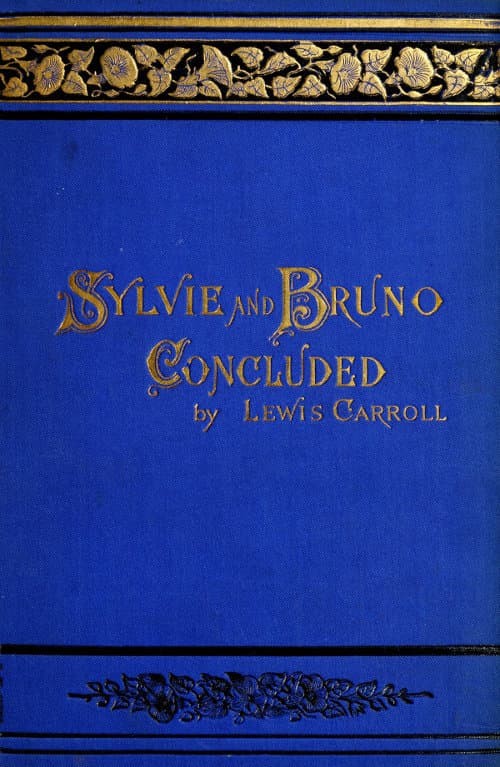
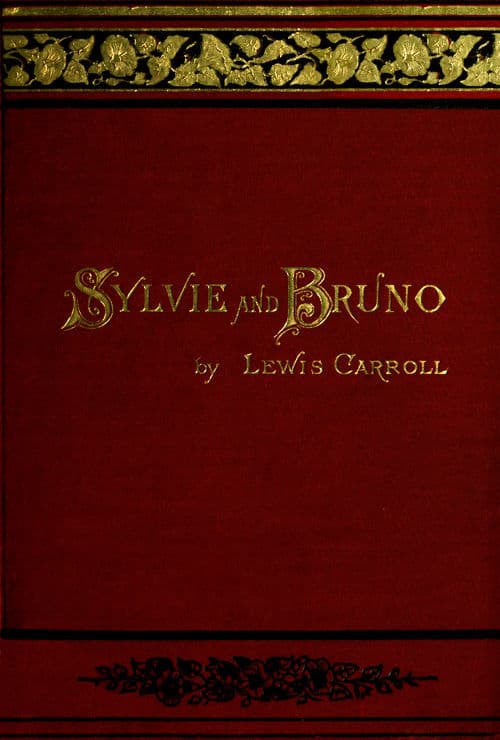
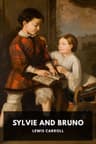
Sylvie and Bruno
Sylvie and Bruno
Lewis Carroll's final novel is also his strangest: a book that refuses to choose between the fairy tale logic of his beloved Alice books and something darker, more adult. The narrative splits between the real world of Victorian England, where political chaos erupts over absurd demands and bureaucrats bumble through confusion, and the enchanted realm of Fairyland, where two children named Sylvie and Bruno wander through adventures that blur the line between dream and waking. This duality is no mere gimmick. It is Carroll's last, quietly radical experiment: what happens when nonsense meets social satire, when childhood innocence collides with the follies of adult society. The characters discuss religion, morality, and philosophy with a seriousness absent from Alice, yet the wit remains. The result feels like a bridge between Carroll's playful early work and something more melancholic, more reflective of his later years. It is a book for those who have always wondered what lies beyond the looking glass, in the spaces where the nonsense ends and real feeling begins.
Editions
X-Ray
“Be sure the safest rule is that we should not dare to live in any scene in which we dare not die.””
— Lewis Carroll
“Is Life itself a dream, I wonder?””
— Lewis Carroll
“Come, my child," I said, trying to lead her away. "Wish good-bye to the poor hare, and come and look for blackberries.""Good-bye, poor hare!" Sylvie obediently repeated, looking over her shoulder at it as we turned away. And then, all in a moment, her self-command gave way. Pulling her hand out of mine, she ran back to where the dead hare was lying, and flung herself down at its side in such an agony of grief as I could hardly have believed possible in so young a child."Oh, my darling, my darling!" she moaned, over and over again. "And God meant your life to be so beautiful!””
— Lewis Carroll
“Perhaps the hardest thing in all literature”
— Lewis Carroll
“The Mad Gardener's SongHe thought he saw an Elephant, That practised on a fife:He looked again, and found it was A letter from his wife.'At length I realise,' he said, 'The bitterness of Life!'He thought he saw a Buffalo Upon the chimney-piece:He looked again, and found it was His Sister's Husband's Niece.'Unless you leave this house,' he said, 'I'll send for the Police!'He thought he saw a Rattlesnake That questioned him in Greek:He looked again, and found it was The Middle of Next Week.'The one thing I regret,' he said, 'Is that it cannot speak!'He thought he saw a Banker's Clerk Descending from the bus:He looked again, and found it was A Hippopotamus.'If this should stay to dine,' he said, 'There won't be much for us!'He thought he saw a Kangaroo That worked a coffee-mill:He looked again, and found it was A Vegetable-Pill.'Were I to swallow this,' he said, 'I should be very ill!'He thought he saw a Coach-and-Four That stood beside his bed:He looked again, and found it was A Bear without a Head.'Poor thing,' he said, 'poor silly thing! It's waiting to be fed!'He thought he saw an Albatross That fluttered round the lamp:He looked again, and found it was A Penny-Postage Stamp.'You'd best be getting home,' he said: 'The nights are very damp!'He thought he saw a Garden-Door That opened with a key:He looked again, and found it was A Double Rule of Three:'And all its mystery,' he said, 'Is clear as day to me!'He thought he saw a Argument That proved he was the Pope:He looked again, and found it was A Bar of Mottled Soap.'A fact so dread,' he faintly said, 'Extinguishes all hope!””
— Lewis Carroll
“He thought he saw a RattlesnakeThat questioned him in Greek:He looked again, and found it wasThe Middle of Next Week.'The one thing I regret,' he said,'Is that it cannot speak!””
— Lewis Carroll
“So may it be for him, and me, and all of us!" I mused. "All that is evil, and dead, and hopeless, fading with the Night that is past! All that is good, and living, and hopeful, rising with the dawn of Day!””
— Lewis Carroll
“I entered my room, and undrew the window-curtains, just in time to see the sun burst in glory from his ocean-prison, and clothe the world in the light of a new day.””
— Lewis Carroll
“He wasn't running," said Bruno, "and he wasn't crawling. He went struggling along like a portmanteau. And he held his chin ever so high in the air”
— Lewis Carroll
Link to this book
Add a free, dofollow link to Lex on your blog, forum, syllabus, or reading list.

<a href="https://lex-books.com/book/sylvie-and-bruno-d7b0ce0e-11e3-4113-a45c-9c1be7d2020b"><img src="https://lex-books.com/badges/read-on-lex.svg" alt="Read Sylvie and Bruno by Lewis Carroll free on Lex" width="160" height="40"></a>[](https://lex-books.com/book/sylvie-and-bruno-d7b0ce0e-11e3-4113-a45c-9c1be7d2020b)[url=https://lex-books.com/book/sylvie-and-bruno-d7b0ce0e-11e3-4113-a45c-9c1be7d2020b][img]https://lex-books.com/badges/read-on-lex.svg[/img][/url]Read Sylvie and Bruno by Lewis Carroll free on Lex: https://lex-books.com/book/sylvie-and-bruno-d7b0ce0e-11e3-4113-a45c-9c1be7d2020bCite this book
Reading this edition for a paper or guide? Copy a citation.
Carroll, Lewis. Sylvie and Bruno. Lex, lex-books.com/book/sylvie-and-bruno-d7b0ce0e-11e3-4113-a45c-9c1be7d2020b.Carroll, L. (n.d.). Sylvie and Bruno. Lex. https://lex-books.com/book/sylvie-and-bruno-d7b0ce0e-11e3-4113-a45c-9c1be7d2020bCarroll, Lewis. Sylvie and Bruno. Lex. https://lex-books.com/book/sylvie-and-bruno-d7b0ce0e-11e3-4113-a45c-9c1be7d2020b.