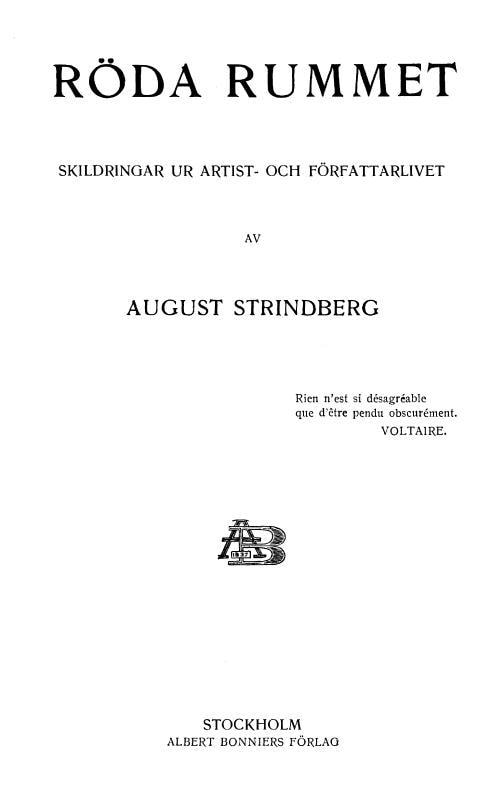
Röda Rummet: Skildringar Ur Artist- Och Författarlivet
1879
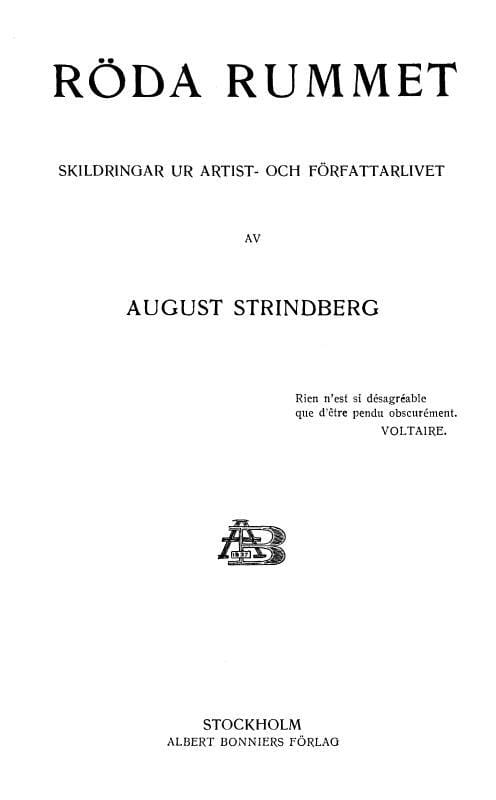
Röda Rummet: Skildringar Ur Artist- Och Författarlivet
1879
A young man leaves his cellar and his bureaucratic career to become a writer. This is the promise that opens Strindberg's ferocious first novel, and it is the first of many ruptures in a book that maps the collision between artistic ambition and social reality in 1870s Stockholm. Arvid Falk enters a world of artists, journalists, critics, and dreamers, each struggling to survive in a society remaking itself through commerce and industry. The Red Room of the title is the tavern where Bohemia congregates, a space of debate and display, but also of petty hierarchies and betrayals. Strindberg writes with the energy of someone who knows that literature is a battlefield, that every review is a weapon, every friendship a transaction. The satire is Dickensian in its gallery of vivid characters, but colder, more relentless in its exposure of how art and commerce contaminate each other. This is the novel that made Swedish literature modern, and its sharpness has not dulled with time.
Editions
X-Ray
“as soon as a work of art is of practical use, betrays a purpose or a tendency its beauty vanishes.””
— August Strindberg
“Jag återvänder till mitt yttrande att vi sakna nationalitet. Kan någon säga mig något svenskt i Sverige annat än våra tallar, granar och järngruvor, vilka snart icke behövas mer i marknaden! Vad äro våra folkvisor? Franska, engelska och tyska romanser, i dålig översättning! [...] Säg mig något svenskt skaldestycke, konstverk, musikstycke, som är specifikt svenskt, varigenom det skiljer sig från alla icke-svenska! Visa mig en svensk byggnad! Det finns icke, och finns det så är det antingen dåligt eller är det bildat efter utländskt mönster.””
— August Strindberg
“Jag vet mycket litet i kvinnofrågan, ty den rör mig icke, men jag tror, efter vad jag sett, att vår generation kommer avskaffa det asiatiska, som ännu finnes i äktenskapet. Båda parterna avsluta ett fritt fördrag, ingen uppger sin självständighet, den ena söker icke uppfostra den andra, man lär sig respektera varandras svagheter och man har ett kamratskap för livet, som icke tröttar genom den ena partens pockande på ömhet. Fru Nicolaus Falk, du vet, den där välgörande djäveln, den anser jag vara ingenting annat än en femme entretenue, och så betraktar hon ju sig själv också; de flesta fruar gifta sig för att få det bra och slippa arbeta, att bli "sin egen"; att där ingås så få äktenskap, det är kvinnans fel, och mannens!””
— August Strindberg
“Sedan du sålunda fått ditt erkännande av utlänningen, så har du fått ditt namn här hemma naturligtvis och jag slipper gå längre och skämmas för dig.””
— August Strindberg
“Att vara konservativ på spekulation är den största synd en människa kan begå. Det är ett attentat mot världsplanen för tre skilling, ty den konservative söker hindra utvecklingen; han sätter ryggen mot den rullande jorden och säger: stå still! Det finnes blott en ursäkt: dumhet; dåliga affärer är ingen ursäkt, men väl ett motiv!””
— August Strindberg
“- Ni kanske inte läsa de böcker ni recensera? - Vem tror du har tid att läsa böcker? Är det inte nog att man skriver om dem! Man läser tidningarna och det är tillräckligt! För övrigt ha vi för princip att rappa alla! - Ja, men det är ju en dum princip. - Nix! Därigenom får man alla författares ovänner och avundsmän med sig - och då har man ju majoritet. De neutrala läsa hellre ovett om andra än de läsa beröm! Det ligger något uppbyggligt och trösterikt för den obemärkte att se hur törnig berömmelsens väg är! Inte sant?””
— August Strindberg
“Han tände en cigarr och ställde sig att betrakta porträttet. Den som observerat hans ansikte nu, skulle icke kunna se hans tankar, ty han hade redan lärt sig så mycket om livets konst att han icke en gång anförtrodde ensamheten sina meningar, ja, han fruktade till och med att meddela sig med sig själv.””
— August Strindberg
“Återstod problemet att skaffa en ny redaktör. Enligt bolagets nya program skulle han äga följande kvalifikationer: han skulle först åtnjuta odelat förtroende som medborgare, tillhöra ämbetsmannakåren, äga en titel, usurperad eller förvärvad, som vid behov kunde påbättras; han skulle dessutom äga ett respektabelt utseende, så att han kunde visas vid fester och andra offentliga nöjen; han skulle vara osjälvständig, liten smula dum, emedan bolaget visste att den sanna dumheten alltid åtföljes av konservatism i tänkesätt och därjämte av en viss grad bakslughet, som känner förmäns önskningar i luften och som aldrig glömmer, att allmänt väl är enskilt, rätteligen förstått nämligen; han skulle tillika vara halvgammal, emedan man lättare skulle kunna styra honom, och gift, emedan bolaget, som bestod av affärsmän, sett att gifta drängar uppför sig bättre än ogifta.””
— August Strindberg
“Falk kunde som vanligt, och vilket var hans olycka, icke förrän efteråt finna passande svar på tal […]””
— August Strindberg
Link to this book
Add a free, dofollow link to Lex on your blog, forum, syllabus, or reading list.

<a href="https://lex-books.com/book/r-da-rummet-skildringar-ur-artist-och-f-rfattarlivet-ab9220b4-6127-4ece-b1cc-1ff0dc3eb767"><img src="https://lex-books.com/badges/read-on-lex.svg" alt="Read Röda Rummet: Skildringar Ur Artist- Och Författarlivet by August Strindberg free on Lex" width="160" height="40"></a>[](https://lex-books.com/book/r-da-rummet-skildringar-ur-artist-och-f-rfattarlivet-ab9220b4-6127-4ece-b1cc-1ff0dc3eb767)[url=https://lex-books.com/book/r-da-rummet-skildringar-ur-artist-och-f-rfattarlivet-ab9220b4-6127-4ece-b1cc-1ff0dc3eb767][img]https://lex-books.com/badges/read-on-lex.svg[/img][/url]Read Röda Rummet: Skildringar Ur Artist- Och Författarlivet by August Strindberg free on Lex: https://lex-books.com/book/r-da-rummet-skildringar-ur-artist-och-f-rfattarlivet-ab9220b4-6127-4ece-b1cc-1ff0dc3eb767Cite this book
Reading this edition for a paper or guide? Copy a citation.
Strindberg, August. Röda Rummet: Skildringar Ur Artist- Och Författarlivet. Lex, lex-books.com/book/r-da-rummet-skildringar-ur-artist-och-f-rfattarlivet-ab9220b4-6127-4ece-b1cc-1ff0dc3eb767.Strindberg, A. (1879). Röda Rummet: Skildringar Ur Artist- Och Författarlivet. Lex. https://lex-books.com/book/r-da-rummet-skildringar-ur-artist-och-f-rfattarlivet-ab9220b4-6127-4ece-b1cc-1ff0dc3eb767Strindberg, August. Röda Rummet: Skildringar Ur Artist- Och Författarlivet. Lex. https://lex-books.com/book/r-da-rummet-skildringar-ur-artist-och-f-rfattarlivet-ab9220b4-6127-4ece-b1cc-1ff0dc3eb767.