Poems
1952
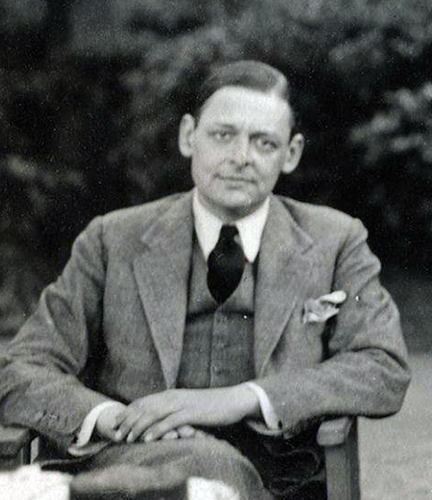
The poems that broke English poetry open and remade it in the image of modern despair. Here is the voice of a civilization at once fragmented and desperately searching, from the trembling self-consciousness of J. Alfred Prufrock, who cannot eat peaches or speak to women, to the shattered visions of The Waste Land, where the dead are buried and the rain comes dry. Eliot captures something true about the twentieth century: the way language itself seemed to be collapsing under the weight of meaninglessness, and how a poet might find strange beauty in the ruins. These are poems of urban decay and spiritual thirst, of voices speaking simultaneously from different rooms of a decaying house. They move from intimate failure to mythic resurrection, from Preludes' winter evenings 'smelling of pork' to Journey of the Magi's bitter king, born to die. The Waste Land remains the most influential poem in English of the past hundred years, not because it offers answers, but because it maps the exact shape of modern confusion with an accuracy that still startles. For readers who want poetry that feels dangerous and necessary.
Editions
X-Ray
“You gave me hyacinths first a year ago; They called me the hyacinth girl.'”
— T. S. Eliot
“And indeed there will be time for the yellow smoke that slides along the street rubbing its back upon the window-panes; there will be time , there will be time to prepare a face to meet the faces that you meet; there will be time to murder and create, and time for all the works and days of hands that lift and drop a question on your plate; time for you and time for me, and time yet for a hundred indecisions, and for a hundred visions and revisions, before the taking of toast and tea.””
— T. S. Eliot
“I am moved by fancies that are curledAround these images, and cling:The notion of some infinitely gentleInfinitely suffering thing.Wipe your hand across your mouth, and laugh;The worlds revolve like ancient womenGathering fuel in vacant lots.””
— T. S. Eliot
“O perpetual revolution of configured stars, o perpetual recurrence of determined seasons, o world of spring and autumn, birth and dying! The endless cycle of idea and action, endless invention, endless experiment, brings knowledge of motion, but not of stillness; knowledge of speech, but not of silence; knowledge of words, and ignorance of the Word. All our knowledge brings us nearer to our ignorance, all our ignorance brings us nearer to death, but nearness to death no nearer to God. Where is the Life we have lost in living? Where is the wisdom we have lost in knowledge? Where is the knowledge we have lost in information? The cycles of Heaven in twenty centuries bring us farther from God and nearer to the Dust.””
— T. S. Eliot
“For I have known them all already, known them all -Have known the evenings, mornings, afternoons,I have measured out my life with coffee spoons;I know the voices dying with a dying fallBeneath the music from a farther room. So how should I presume? And I have known the eyes already, known them all -The eyes that fix you in a formulated phrase,And when I am formulated, sprawling on a pin,When I am pinned and wriggling on the wall,Then how should I beginTo spit out all the butt-ends of my days and ways? And how should I presume?””
— T. S. Eliot
“Fading, fading: strength beyond hope and despair climbing the third stair. Lord, I am not worthy Lord, I am not worthy but speak the word only.””
— T. S. Eliot
“Datta, dayadhvam, damyata(Give, sympathize, control)””
— T. S. Eliot
“Think neither fear nor courage saves us.Unnatural vices are fathered by our heroism. Virtues are forced upon us by our impudent crimes. These tears are shaken from the wrath-bearing tree.””
— T. S. Eliot
“After such knowledge, what forgiveness? Think now History has many cunning passages, contrived corridors And issues, deceives with whispering ambitions, Guides us by vanities. Think now She gives when our attention is distracted And what she gives, gives with such supple confusions That the giving famishes the craving. Gives too late What’s not believed in, or if still believed, In memory only, reconsidered passion. Gives too soon Into weak hands, what’s thought can be dispensed with Till the refusal propagates a fear. Think Neither fear nor courage saves us. Unnatural vices Are fathered by our heroism. Virtues Are forced upon us by our impudent crimes. These tears are shaken from the wrath-bearing tree.””
— T. S. Eliot
Link to this book
Add a free, dofollow link to Lex on your blog, forum, syllabus, or reading list.

<a href="https://lex-books.com/book/poems-436aa79d-6e0d-49ad-90e3-3ddb5de0636a"><img src="https://lex-books.com/badges/read-on-lex.svg" alt="Read Poems by T. S. Eliot free on Lex" width="160" height="40"></a>[](https://lex-books.com/book/poems-436aa79d-6e0d-49ad-90e3-3ddb5de0636a)[url=https://lex-books.com/book/poems-436aa79d-6e0d-49ad-90e3-3ddb5de0636a][img]https://lex-books.com/badges/read-on-lex.svg[/img][/url]Read Poems by T. S. Eliot free on Lex: https://lex-books.com/book/poems-436aa79d-6e0d-49ad-90e3-3ddb5de0636aCite this book
Reading this edition for a paper or guide? Copy a citation.
Eliot, T. S.. Poems. Lex, lex-books.com/book/poems-436aa79d-6e0d-49ad-90e3-3ddb5de0636a.Eliot, T. S. (1952). Poems. Lex. https://lex-books.com/book/poems-436aa79d-6e0d-49ad-90e3-3ddb5de0636aEliot, T. S.. Poems. Lex. https://lex-books.com/book/poems-436aa79d-6e0d-49ad-90e3-3ddb5de0636a.