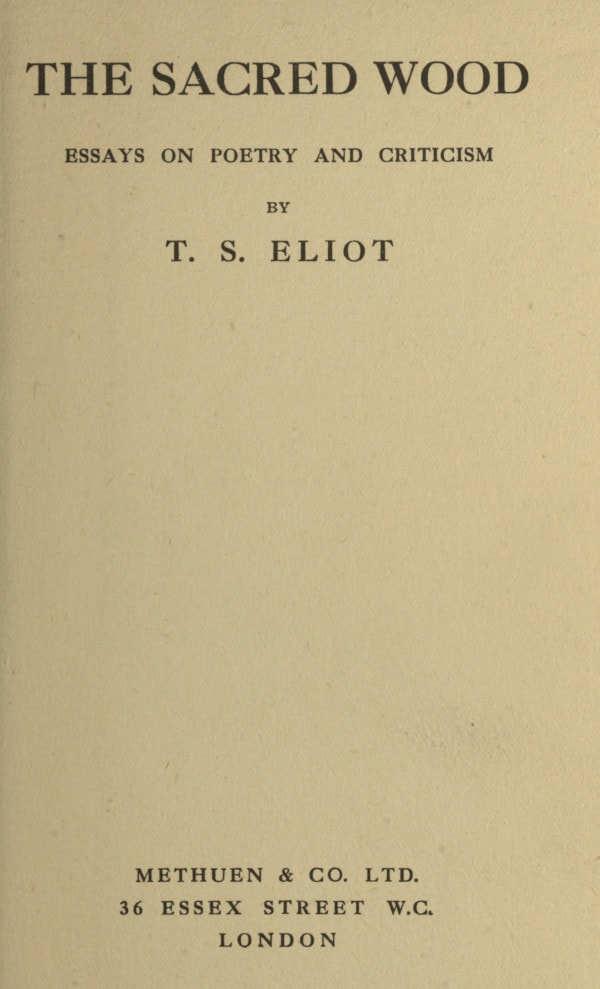
The Sacred Wood: Essays on Poetry and Criticism
1920
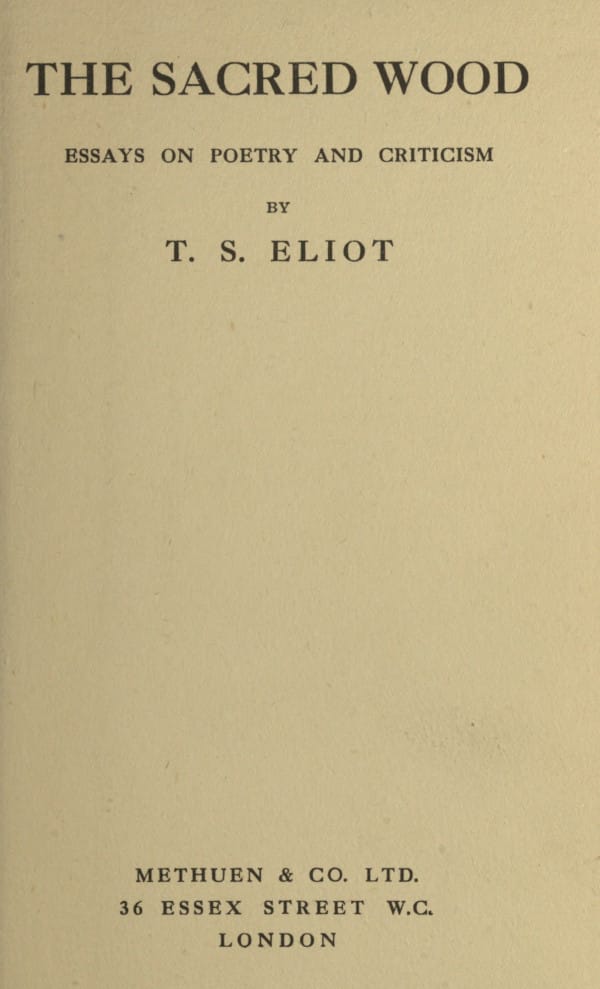
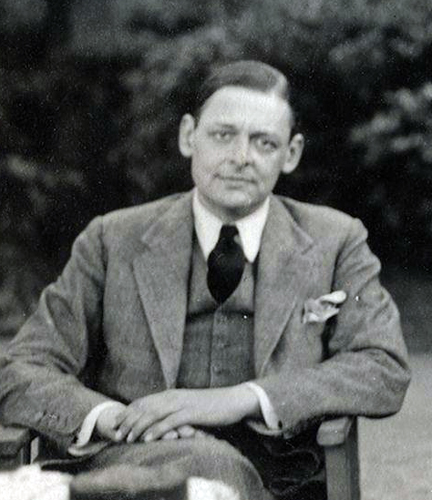
The book that essentially invented modern literary criticism. Published in 1920, when Eliot was still years away from publishing The Waste Land, these essays argue for a revolutionary vision of poetry that would reshape English literature. The centerpiece, "Tradition and the Individual Talent," proposes that a poet's work cannot be understood in isolation but only in relation to the entire historical tradition of European literature, that the past is actively altered by the arrival of the new. Eliot attacks the Romantic emphasis on personal sentiment and champions impersonality, precision, and the critic's duty to engage with tradition as a living whole. His controversial take on Hamlet as an "artistic failure" and his pioneering defense of Dante are included here. These are not detached academic exercises but passionate advocacy from a young poet constructing the intellectual foundation for his own revolutionary work. The urgency Eliot later acknowledged still crackles on every page. Essential reading for anyone who wants to understand how Modernism happened.
Editions
X-Ray
“Immature poets imitate; mature poets steal.””
— T. S. Eliot
“Immature poets imitate; mature poets steal; bad poets deface what they take, and good poets make it into something better, or at least something different.””
— T. S. Eliot
“No poet, no artist of any art, has his complete meaning alone. His significance, his appreciation is the appreciation of his relation to the dead poets and artists. You cannot value him alone; you must set him, for contrast and comparison, among the dead.””
— T. S. Eliot
“The vast accumulations of knowledge”
— T. S. Eliot
“If you compare several representative passages of the greatest poetry you see how great is the variety of types of combination, and also how completely any semi-ethical criterion of “sublimity” misses the mark. For it is not the “greatness,” the intensity, of the emotions, the components, but the intensity of the artistic process, the pressure, so to speak, under which the fusion takes place, that counts.””
— T. S. Eliot
“The aim of the poet is to state a vision, and no vision of life can be complete which does not include the articulate formulation of life which human minds make.””
— T. S. Eliot
“If the artistic emotion presented by any episode of the Comedy is dependent upon the whole, we may proceed to inquire what the whole scheme is. The usefulness of allegory and astronomy is obvious. A mechanical framework, in a poem of so vast an ambit, was a necessity. As the centre of gravity of emotions is more remote from a single human action, or a system of purely human actions, than in drama or epic, so the framework has to be more artificial and apparently more mechanical. It is not essential that the allegory or the almost unintelligible astronomy should be understood”
— T. S. Eliot
“The world of Swinburne does not depend upon some other world which it simulates; it has the necessary completeness and self-sufficiency for justification and permanence.””
— T. S. Eliot
“In that case we must say that rhetoric is any adornment or inflation of speech which is not done for a particular effect but for a general impressiveness.””
— T. S. Eliot
Link to this book
Add a free, dofollow link to Lex on your blog, forum, syllabus, or reading list.

<a href="https://lex-books.com/book/the-sacred-wood-essays-on-poetry-and-criticism-93bbc088-1141-4653-ad2d-2475aa550b6b"><img src="https://lex-books.com/badges/read-on-lex.svg" alt="Read The Sacred Wood: Essays on Poetry and Criticism by T. S. Eliot free on Lex" width="160" height="40"></a>[](https://lex-books.com/book/the-sacred-wood-essays-on-poetry-and-criticism-93bbc088-1141-4653-ad2d-2475aa550b6b)[url=https://lex-books.com/book/the-sacred-wood-essays-on-poetry-and-criticism-93bbc088-1141-4653-ad2d-2475aa550b6b][img]https://lex-books.com/badges/read-on-lex.svg[/img][/url]Read The Sacred Wood: Essays on Poetry and Criticism by T. S. Eliot free on Lex: https://lex-books.com/book/the-sacred-wood-essays-on-poetry-and-criticism-93bbc088-1141-4653-ad2d-2475aa550b6bCite this book
Reading this edition for a paper or guide? Copy a citation.
Eliot, T. S.. The Sacred Wood: Essays on Poetry and Criticism. Lex, lex-books.com/book/the-sacred-wood-essays-on-poetry-and-criticism-93bbc088-1141-4653-ad2d-2475aa550b6b.Eliot, T. S. (1920). The Sacred Wood: Essays on Poetry and Criticism. Lex. https://lex-books.com/book/the-sacred-wood-essays-on-poetry-and-criticism-93bbc088-1141-4653-ad2d-2475aa550b6bEliot, T. S.. The Sacred Wood: Essays on Poetry and Criticism. Lex. https://lex-books.com/book/the-sacred-wood-essays-on-poetry-and-criticism-93bbc088-1141-4653-ad2d-2475aa550b6b.