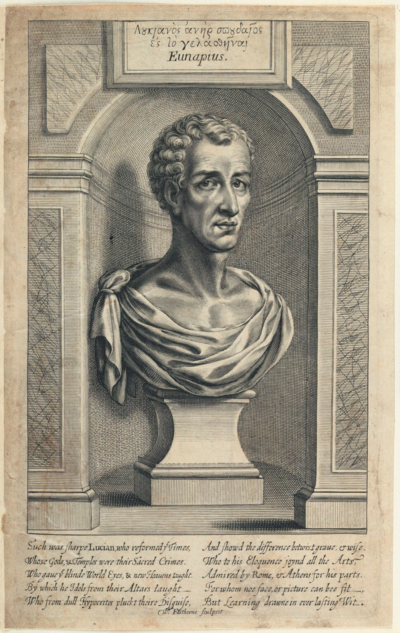
Lucian's True History
1894
Lucian's True History
1894
Translated by Francis Hickes
Lucian's "True History" is the original tall tale, and the book that invented science fiction two millennia before Jules Verne. The narrator sets sail, gets swept up in a storm, and embarks on a journey that defies every law of nature: a river of wine, women made of vines, a whale big enough to swallow an entire ship whole. Inside the beast, he discovers a buried city of ancient heroes. Then things get truly strange. He travels to the sun, where armies clash over colonies; to the moon, ruled by a king named Endymion; to the Elysian Fields, where he debates philosophy with Homer, Pythagoras, and Socrates. But Lucian's true game is expose. The narrator opens by admitting everything he writes is a lie, then asks: so what? The great poets and historians lie too. This is satire that bends genres into weapons, mocking travel narratives, mythology, and the human hunger for wonder. It's proto-Douglas Adams, proto-Gulliver's Travels, proto-everything. The jokes are often dated, packed with puns and political digs that required a second-century education. But the imagination still dazzles. This is ancient literature that feels genuinely unhinged.
Editions
X-Ray
“The good historian, then, must be thus described: he must be fearless, uncorrupted, free, the friend of truth and of liberty; one who, to use the words of the comic poet, calls a fig a fig, and a skiff a skiff, neither giving nor withholding from any, from favour or from enmity, not influenced by pity, by shame, or by remorse; a just judge, so far benevolent to all as never to give more than is due to any in his work; a stranger to all, of no country, bound only by his own laws, acknowledging no sovereign, never considering what this or that man may say of him, but relating faithfully everything as it happened.””
— of Samosata Lucian
“The only business of the historian is to relate things exactly as they are: this he can never do as long as he is afraid””
— of Samosata Lucian
“Give me a scholar, therefore, who is able to think and to write, to look with an eye of discernment into things, and to do business himself, if called upon, who hath both civil and military knowledge; one, moreover, who has been in camps, and has seen armies in the field and out of it; knows the use of arms, and machines, and warlike engines of every kind; can tell what the front, and what the horn is, how the ranks are to be disposed, how the horse is to be directed, and from whence to advance or to retreat; one, in short, who does not stay at home and trust to the reports of others: but, above all, let him be of a noble and liberal mind; let him neither fear nor hope for anything; otherwise he will only resemble those unjust judges who determine from partiality or prejudice, and give sentence for hire: but, whatever the man is, as such let him be described.””
— of Samosata Lucian
“In size the men were as large as the Colossus of Rhodes from the waist up, and the horses were as large as a great merchantman. Their number, however, I leave unrecorded for fear that someone may think it incredible, it was so great.””
— of Samosata Lucian
Link to this book
Add a free, dofollow link to Lex on your blog, forum, syllabus, or reading list.

<a href="https://lex-books.com/book/lucian-s-true-history-d62f834c-9ff8-49ea-8104-39014cba3de3"><img src="https://lex-books.com/badges/read-on-lex.svg" alt="Read Lucian's True History by of Samosata Lucian free on Lex" width="160" height="40"></a>[](https://lex-books.com/book/lucian-s-true-history-d62f834c-9ff8-49ea-8104-39014cba3de3)[url=https://lex-books.com/book/lucian-s-true-history-d62f834c-9ff8-49ea-8104-39014cba3de3][img]https://lex-books.com/badges/read-on-lex.svg[/img][/url]Read Lucian's True History by of Samosata Lucian free on Lex: https://lex-books.com/book/lucian-s-true-history-d62f834c-9ff8-49ea-8104-39014cba3de3Cite this book
Reading this edition for a paper or guide? Copy a citation.
Lucian, of Samosata. Lucian's True History. Lex, lex-books.com/book/lucian-s-true-history-d62f834c-9ff8-49ea-8104-39014cba3de3.Lucian, O. S. (1894). Lucian's True History. Lex. https://lex-books.com/book/lucian-s-true-history-d62f834c-9ff8-49ea-8104-39014cba3de3Lucian, of Samosata. Lucian's True History. Lex. https://lex-books.com/book/lucian-s-true-history-d62f834c-9ff8-49ea-8104-39014cba3de3.