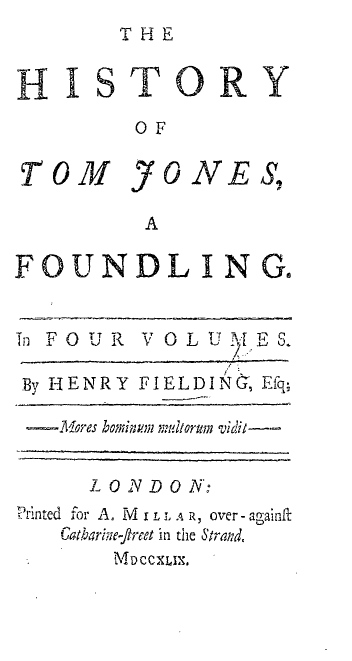
History of Tom Jones, a Foundling
1924
History of Tom Jones, a Foundling
1924
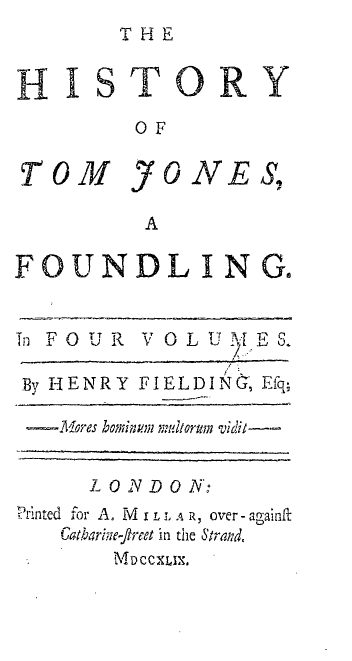
Henry Fielding's 1749 masterpiece helped invent the English novel. Tom Jones, abandoned as an infant on Squire Allworthy's bed, is raised by the benevolent landowner despite the stain of illegitimacy. When Tom is wrongly accused and expelled from Allworthy's estate, he embarks on a picaresque journey across England, encountering rogues, soldiers, philosophers, and the incomparable Sophia Western, a wealthy heiress fleeing her own cage. The novel burns with comic energy while asking serious questions about virtue, vice, and what society actually rewards. Fielding constructs his sprawling narrative with mathematical precision, Samuel Taylor Coleridge placed its plot among the three most perfect ever written, alongside Sophocles and Jonson. At 340,000 words across eighteen books, it's vast but propulsive, funny but morally serious, judging characters not by their birth but by their choices. The book that made England fall in love with the novel form.
Editions


X-Ray
“No one hath seen beauty in its highest lustre who hath never seen it in distress.””
— Henry Fielding
“For I hope my Friends will pardon me, when I declare, I know none of them without a Fault; and I should be sorry if I could imagine, I had any Friend who could not see mine. Forgiveness, of this Kind, we give and demand in Turn.””
— Henry Fielding
“It is much easier to make good men wise, than to make bad men good.””
— Henry Fielding
“Reader, I think proper, before we proceed any further together, to acquaint thee that I intend to digress, through this whole history, as often as I see occasion, of which I am myself a better judge than any pitiful critic whatever; and here I must desire all those critics to mind their own business, and not to intermeddle with affairs or works which no ways concern them; for till they produce the authority by which they are constituted judges, I shall not plead to their jurisdiction.””
— Henry Fielding
“A good countenance is a letter of recommendation.””
— Henry Fielding
“Men who are ill-natured and quarrelsome when drunk are very worthy persons when sober. For drink in reality doth not reverse nature or create passions in men which did not exist in them before. It takes away the guard of reason and consequently forces us to produce those symptoms which many when sober have art enough to conceal.””
— Henry Fielding
“There are a set of religious, or rather moral writers, who teach that virtue is the certain road to happiness, and vice to misery, in this world. A very wholesome and comfortable doctrine, and to which we have but one objection, namely, that it is not true.””
— Henry Fielding
“And here, I believe, the wit is generally misunderstood. In reality, it lies in desiring another to kiss your a-- for having just before threatened to kick his; for I have observed very accurately, that no one ever desires you to kick that which belongs to himself, nor offers to kiss this part in another.””
— Henry Fielding
“To see a Woman you love in Distress; to be unable to relieve her, and at the same Time to reflect that you have brought her into this Situation, is, perhaps, a Curse of which no Imagination can represent the Horrors to those who have not felt it.””
— Henry Fielding
About History of Tom Jones, a Foundling
Chapter Summaries
- Book I, Chapter i.
- The author introduces his work as a 'public ordinary' rather than a private treat, promising a 'bill of fare' of human nature. He compares his role to a cook, emphasizing that the excellence lies in the 'cookery' (author's skill) rather than the common subject matter.
- Book I, Chapter ii.
- Mr. Allworthy, a benevolent and wealthy squire, is introduced, along with his sister, Miss Bridget Allworthy, a woman past thirty, known for her good qualities rather than beauty, and her discreet but guarded prudence.
- Book I, Chapter iii.
- Mr. Allworthy returns home to find an infant in his bed. His housekeeper, Mrs. Deborah Wilkins, is shocked by the sight and expresses harsh judgments about bastards and their mothers, while Allworthy feels compassion.
Key Themes
- Nature vs. Art (or Hypocrisy)
- This theme explores the contrast between innate goodness and learned behavior or outward appearances. Characters like Tom Jones, despite his 'natural' follies, possess a good heart, while characters like Blifil and Thwackum, who profess virtue and religion, are often driven by self-interest and malice. The author frequently comments on how 'art' (social conventions, education, dissimulation) can obscure or pervert 'nature'.
- Providence and Fortune
- The novel frequently attributes events to 'Fortune' or 'Providence,' highlighting the role of chance and divine intervention in human affairs. While characters often make choices, their lives are also shaped by unexpected accidents, coincidences, and the unpredictable turns of fate, suggesting a larger, often benevolent, design at play.
- Justice and Mercy
- Mr. Allworthy embodies the ideal of tempering justice with mercy, particularly in his treatment of Jenny Jones and Tom. The novel contrasts this with the rigid, often cruel, application of law and moral judgment by characters like Thwackum, Mrs. Wilkins, and even the legal system itself, questioning whether strict adherence to rules always leads to true justice.
Characters
- Tom Jones(protagonist)
- A foundling raised by Mr. Allworthy, known for his good nature, generosity, and impetuous spirit, often getting into trouble but possessing a fundamentally good heart.
- Mr. Allworthy(supporting)
- A benevolent and wealthy squire who adopts Tom Jones, known for his goodness, generosity, and sometimes naive judgment of character.
- Miss Bridget Allworthy (Mrs. Blifil)(supporting)
- Mr. Allworthy's sister, a woman of rigid virtue and strong opinions, who marries Captain Blifil and is the mother of Master Blifil.
- Captain Blifil(supporting)
- An avaricious and calculating man who marries Miss Bridget Allworthy, primarily for her fortune, and schemes against Tom Jones.
- Master Blifil(antagonist)
- The son of Captain Blifil and Miss Bridget, a hypocritical and malicious young man who outwardly displays virtue while secretly plotting against Tom Jones.
- Mrs. Deborah Wilkins(supporting)
- Mr. Allworthy's prim and judgmental housekeeper, who is quick to condemn others, especially those of lower social standing.
Link to this book
Add a free, dofollow link to Lex on your blog, forum, syllabus, or reading list.

<a href="https://lex-books.com/book/history-of-tom-jones-a-foundling-2ee3f06f-7a3c-44ad-8dd6-71d6aad35de9"><img src="https://lex-books.com/badges/read-on-lex.svg" alt="Read History of Tom Jones, a Foundling by Henry Fielding free on Lex" width="160" height="40"></a>[](https://lex-books.com/book/history-of-tom-jones-a-foundling-2ee3f06f-7a3c-44ad-8dd6-71d6aad35de9)[url=https://lex-books.com/book/history-of-tom-jones-a-foundling-2ee3f06f-7a3c-44ad-8dd6-71d6aad35de9][img]https://lex-books.com/badges/read-on-lex.svg[/img][/url]Read History of Tom Jones, a Foundling by Henry Fielding free on Lex: https://lex-books.com/book/history-of-tom-jones-a-foundling-2ee3f06f-7a3c-44ad-8dd6-71d6aad35de9Cite this book
Reading this edition for a paper or guide? Copy a citation.
Fielding, Henry. History of Tom Jones, a Foundling. Lex, lex-books.com/book/history-of-tom-jones-a-foundling-2ee3f06f-7a3c-44ad-8dd6-71d6aad35de9.Fielding, H. (1924). History of Tom Jones, a Foundling. Lex. https://lex-books.com/book/history-of-tom-jones-a-foundling-2ee3f06f-7a3c-44ad-8dd6-71d6aad35de9Fielding, Henry. History of Tom Jones, a Foundling. Lex. https://lex-books.com/book/history-of-tom-jones-a-foundling-2ee3f06f-7a3c-44ad-8dd6-71d6aad35de9.