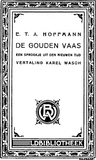
De Gouden Vaas
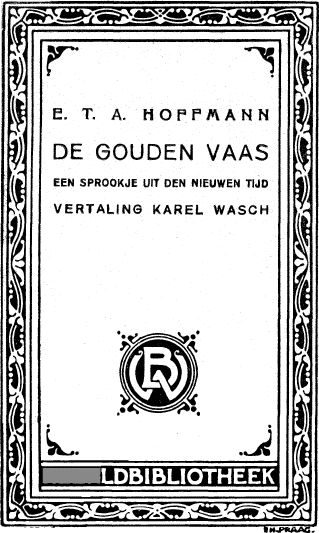
De Gouden Vaas
Translated by Karel Johan Hendrik Wasch
De Gouden Vaas, written by E. T. A. Hoffmann in the early 19th century, is a fantastical novel that blends romance and the supernatural. The story follows Anselmus, a hapless student in Dresden, as he navigates a series of comedic misadventures and encounters mystical elements that reflect his innermost desires. This work explores themes of love, transformation, and the quest for beauty, challenging Anselmus's perceptions of reality along the way.
Editions
X-Ray
“Let me ask you outright, gentle reader, if there have not been hours, indeed whole days and weeks of your life, during which all your usual activities were painfully repugnant, and everything you believed in and valued seemed foolish and worthless?””
— E. T. A. Hoffmann
“I may be permitted, kind reader, to doubt whether you have ever been enclosed in a glass bottle, unless some vivid dream has teased you with such magical mishaps.””
— E. T. A. Hoffmann
“It is only in the morning that one should marry, read unfavourable reviews, make one's will, beat one's servants, and so forth.””
— E. T. A. Hoffmann
“In such a dreamy mood one may find one may well wound one's feet against sharp stones, forget to doff one's hat to distinguished persons, bid one's friends good morning in the middle of the night, and dash one's head against the first front door one comes to, because one had forgot to open it; in short, the spirit wears one's body like an ill-fitting garment that is everywhere too wide, too long, too uncomfortable.””
— E. T. A. Hoffmann
“It may be, after all," said the Student Anselmus to himself, "that the superfine stomachic liqueur, which I took somewhat freely in Monsieur Conradi's, might really be the cause of all these shocking phantasms, which tortured me so at Archivarius Lindhorst's door.””
— E. T. A. Hoffmann
“Leuwenhoek received Peregrinus with a repulsively unctuous display of friendship and with the servile compliments which convey an enforced and reluctant acknowledgement of superiority.””
— E. T. A. Hoffmann
“If you wonder at something because it has not yet happened to you, or because you think you cannot perceive the connection of cause and effect, that simply shows that your powers of perception are limited by the deficiencies of your vision. Whether your vision is naturally deficient, or sicklied o'er with the pale cast of thought, I cannot say.””
— E. T. A. Hoffmann
“It is an old-established custom for the hero of a story, when overcome by violent emotion, to run out into the forest, or at least to some solitary glade. This custom is a good one, because it prevails in real life. Mr Peregrinus Tyss therefore had no altenative but to run in a straight line from his house on the Horsemarket until he had left the town behind him and reached a nearby glade.””
— E. T. A. Hoffmann
“Thinking, according to Knarrpanti, was in itself a dangerous undertaking, and all the more so when performed by dangerous individuals.””
— E. T. A. Hoffmann
Link to this book
Add a free, dofollow link to Lex on your blog, forum, syllabus, or reading list.

<a href="https://lex-books.com/book/de-gouden-vaas-cba95dbd-53e6-4309-8519-6b5b01a52fe6"><img src="https://lex-books.com/badges/read-on-lex.svg" alt="Read De Gouden Vaas by E. T. A. Hoffmann free on Lex" width="160" height="40"></a>[](https://lex-books.com/book/de-gouden-vaas-cba95dbd-53e6-4309-8519-6b5b01a52fe6)[url=https://lex-books.com/book/de-gouden-vaas-cba95dbd-53e6-4309-8519-6b5b01a52fe6][img]https://lex-books.com/badges/read-on-lex.svg[/img][/url]Read De Gouden Vaas by E. T. A. Hoffmann free on Lex: https://lex-books.com/book/de-gouden-vaas-cba95dbd-53e6-4309-8519-6b5b01a52fe6Cite this book
Reading this edition for a paper or guide? Copy a citation.
Hoffmann, E. T. A.. De Gouden Vaas. Lex, lex-books.com/book/de-gouden-vaas-cba95dbd-53e6-4309-8519-6b5b01a52fe6.Hoffmann, E. T. A. (n.d.). De Gouden Vaas. Lex. https://lex-books.com/book/de-gouden-vaas-cba95dbd-53e6-4309-8519-6b5b01a52fe6Hoffmann, E. T. A.. De Gouden Vaas. Lex. https://lex-books.com/book/de-gouden-vaas-cba95dbd-53e6-4309-8519-6b5b01a52fe6.