Compensation: Being an Essay as Written by Ralph Waldo Emerson
1841
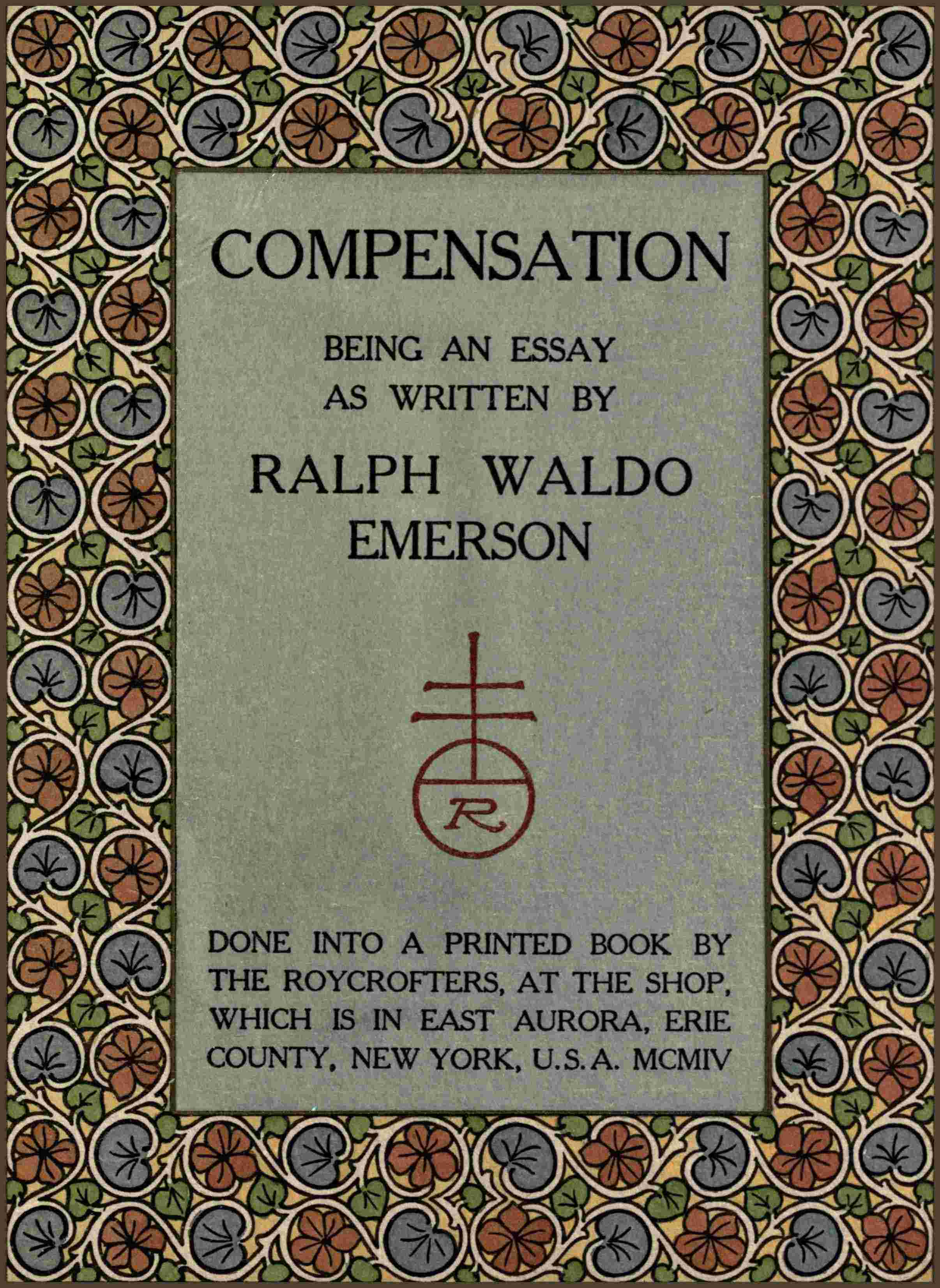
Compensation: Being an Essay as Written by Ralph Waldo Emerson
1841
In this bracing 1841 essay, Emerson advances a proposition as simple as it is unflinching: the universe maintains perfect balance. Every action exacts its price; every gain carries its burden. This is not karma or poetic justice, but something deeper, a cosmic law woven into the fabric of existence itself. Drawing examples from nature, economics, politics, and the innermost workings of the soul, Emerson demonstrates that for every force there is a counter-force, for every virtue its shadow. The essay crackles with paradox: the thief is punished not by law alone but by his own theft; the generous soul is enriched precisely in the act of giving away. Written during Emerson's Transcendentalist prime, "Compensation" distills his philosophy into its most challenging form: a refusal to offer comfort, only truth. It asks readers to accept that they cannot escape the balance, that what they do matters, not because God will punish the wicked, but because the universe itself is so constituted. More than a century and a half later, the essay still provokes. It is for readers who want philosophy to cost them something, who suspect that easy answers are false answers, and who are ready to reckon with the full weight of their own agency.
Editions
X-Ray
“The one thing in the world, of value, is the active soul””
— Ralph Waldo Emerson
“Books are the best of things, well used; abused, among the worst...They are for nothing but to inspire.””
— Ralph Waldo Emerson
“Of course, there is a portion of reading quite indispensable to a wise man. History and exact science he must learn by laborious reading. Colleges, in like manner, have their indispensable office, - to teach elements. But they can only highly serve us, when they aim not to drill, but to create; when they gather from far every ray of various genius to their hospitable halls, and, by the concentrated fires, set the hearts of their youth on flame. Thought and knowledge are natures in which apparatus and pretension avail nothing. Gowns, and pecuniary foundations, though of towns of gold, can never countervail the least sentence or syllable of wit. Forget this, and our American colleges will recede in their public importance, whilst they grow richer every year.””
— Ralph Waldo Emerson
“It is one light which beams out of a thousand stars. It is one soul which animates all men.””
— Ralph Waldo Emerson
“Books are the best type of influence of the past...Each age, it is found, must write its own books; or rather, each generation for the next succeeding. The books of an older period will not fit this.””
— Ralph Waldo Emerson
“Books are the best of things, well used; abused, among the worst. What is the right use? What is the one end which all means go to effect? They are for nothing but to inspire. I had better never see a book than to be warped by its attraction clean out of my own orbit, and made a satellite instead of a system.””
— Ralph Waldo Emerson
“If there is any period one would desire to be born in, ⎯ is it not the age of Revolution; whenthe old and the new stand side by side, and admit of being compared; when the energies of all men are searched by fear and by hope; when the historic glories of the old, can be compensated by the rich possibilities of the new era? This time, like all times, is a very good one, if we but know what to do with it.””
— Ralph Waldo Emerson
“The ancient precept, “Know thyself,” and the modern precept, “Study nature,” become at last one maxim.””
— Ralph Waldo Emerson
“and, of course, the self-accursation, the faint heart, the frequent uncertainty and loss of time, which are the nettles and tangling vines in the way of the self-relying and self-directed; and the state of virtual hostility in which he seems to stand to society. For all this loss and scorn, what offset? He is to find consolation in exercising the highest functions of human nature. He is one who raises himself from private considerations and breathes and lives on public and illustrious thoughts. He is the world's eye.””
— Ralph Waldo Emerson
Link to this book
Add a free, dofollow link to Lex on your blog, forum, syllabus, or reading list.

<a href="https://lex-books.com/book/compensation-being-an-essay-as-written-by-ralph-waldo-emerson-06747df6-b7b3-4a62-91f4-c735e2cf91c1"><img src="https://lex-books.com/badges/read-on-lex.svg" alt="Read Compensation: Being an Essay as Written by Ralph Waldo Emerson by Ralph Waldo Emerson free on Lex" width="160" height="40"></a>[](https://lex-books.com/book/compensation-being-an-essay-as-written-by-ralph-waldo-emerson-06747df6-b7b3-4a62-91f4-c735e2cf91c1)[url=https://lex-books.com/book/compensation-being-an-essay-as-written-by-ralph-waldo-emerson-06747df6-b7b3-4a62-91f4-c735e2cf91c1][img]https://lex-books.com/badges/read-on-lex.svg[/img][/url]Read Compensation: Being an Essay as Written by Ralph Waldo Emerson by Ralph Waldo Emerson free on Lex: https://lex-books.com/book/compensation-being-an-essay-as-written-by-ralph-waldo-emerson-06747df6-b7b3-4a62-91f4-c735e2cf91c1Cite this book
Reading this edition for a paper or guide? Copy a citation.
Emerson, Ralph Waldo. Compensation: Being an Essay as Written by Ralph Waldo Emerson. Lex, lex-books.com/book/compensation-being-an-essay-as-written-by-ralph-waldo-emerson-06747df6-b7b3-4a62-91f4-c735e2cf91c1.Emerson, R. W. (1841). Compensation: Being an Essay as Written by Ralph Waldo Emerson. Lex. https://lex-books.com/book/compensation-being-an-essay-as-written-by-ralph-waldo-emerson-06747df6-b7b3-4a62-91f4-c735e2cf91c1Emerson, Ralph Waldo. Compensation: Being an Essay as Written by Ralph Waldo Emerson. Lex. https://lex-books.com/book/compensation-being-an-essay-as-written-by-ralph-waldo-emerson-06747df6-b7b3-4a62-91f4-c735e2cf91c1.