Cautionary Tales for Children
1907
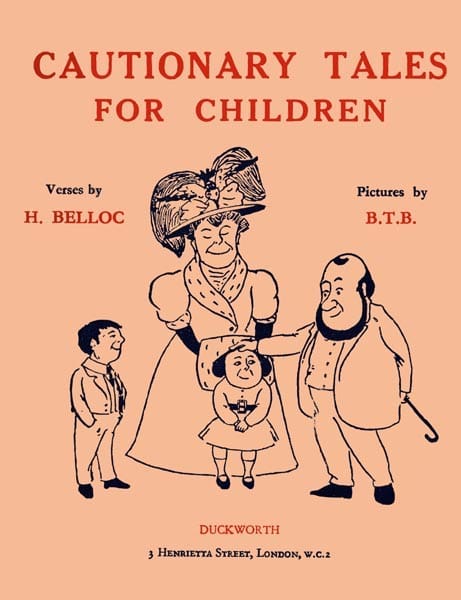
Cautionary Tales for Children
1907
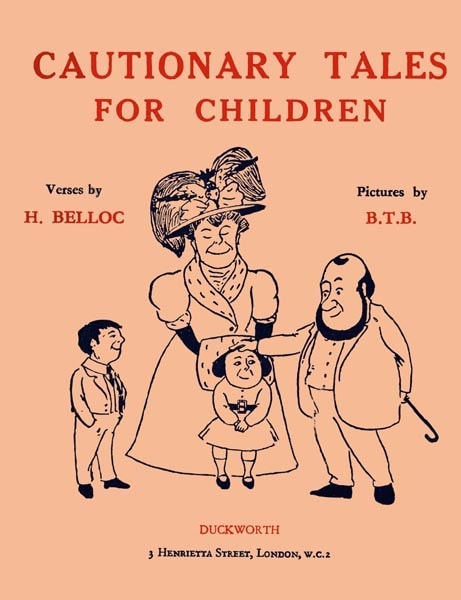
Hilaire Belloc wrote what may be the most vicious children's book ever published. In eleven rhyming couplets, he dispatches misbehaving children with cheerful precision: Jim runs from his nurse and is eaten by a lion, Matilda lies until no one believes her when the house actually burns, Henry King chokes on string, and Godolphin Horne's pride reduces him to shining shoes. The genius lies in Belloc's tone - that of a concerned moralist gravely warning against naughtiness while clearly relishing every grotesque detail. It's a parody that exposes the hypocrisy of Victorian cautionary tales, revealing how moral instruction often masked something darker: a gleeful fascination with children's destruction. Yet the book transcends satire. These verses work as pure dark comedy, their mock-seriousness and absurd rhymes creating genuine delight. The deadpan listing of horrific fates reads like a precursor to Roald Dahl at his most wicked. For over a century, readers have returned to these tales not for their (deeply questionable) moral wisdom, but for the savage pleasure of watching Belloc's satirical针 poke through the pretension of adult authority.
Editions
X-Ray
“Upon being asked by a Reader whether the verses contained in this book were true. And is it True? It is not True. And if it were it wouldn’t do, For people such as me and you Who pretty nearly all day long Are doing something rather wrong. Because if things were really so, You would have perished long ago, And I would not have lived to write The noble lines that meet your sight, Nor B. T. B. survived to draw The nicest things you ever saw. H. B.””
— Hilaire Belloc
Link to this book
Add a free, dofollow link to Lex on your blog, forum, syllabus, or reading list.

<a href="https://lex-books.com/book/cautionary-tales-for-children-89d24a83-ef60-41f2-9865-9bab8d8a0ad0"><img src="https://lex-books.com/badges/read-on-lex.svg" alt="Read Cautionary Tales for Children by Hilaire Belloc free on Lex" width="160" height="40"></a>[](https://lex-books.com/book/cautionary-tales-for-children-89d24a83-ef60-41f2-9865-9bab8d8a0ad0)[url=https://lex-books.com/book/cautionary-tales-for-children-89d24a83-ef60-41f2-9865-9bab8d8a0ad0][img]https://lex-books.com/badges/read-on-lex.svg[/img][/url]Read Cautionary Tales for Children by Hilaire Belloc free on Lex: https://lex-books.com/book/cautionary-tales-for-children-89d24a83-ef60-41f2-9865-9bab8d8a0ad0Cite this book
Reading this edition for a paper or guide? Copy a citation.
Belloc, Hilaire. Cautionary Tales for Children. Lex, lex-books.com/book/cautionary-tales-for-children-89d24a83-ef60-41f2-9865-9bab8d8a0ad0.Belloc, H. (1907). Cautionary Tales for Children. Lex. https://lex-books.com/book/cautionary-tales-for-children-89d24a83-ef60-41f2-9865-9bab8d8a0ad0Belloc, Hilaire. Cautionary Tales for Children. Lex. https://lex-books.com/book/cautionary-tales-for-children-89d24a83-ef60-41f2-9865-9bab8d8a0ad0.