Esto Perpetua: Algerian Studies and Impressions
1906
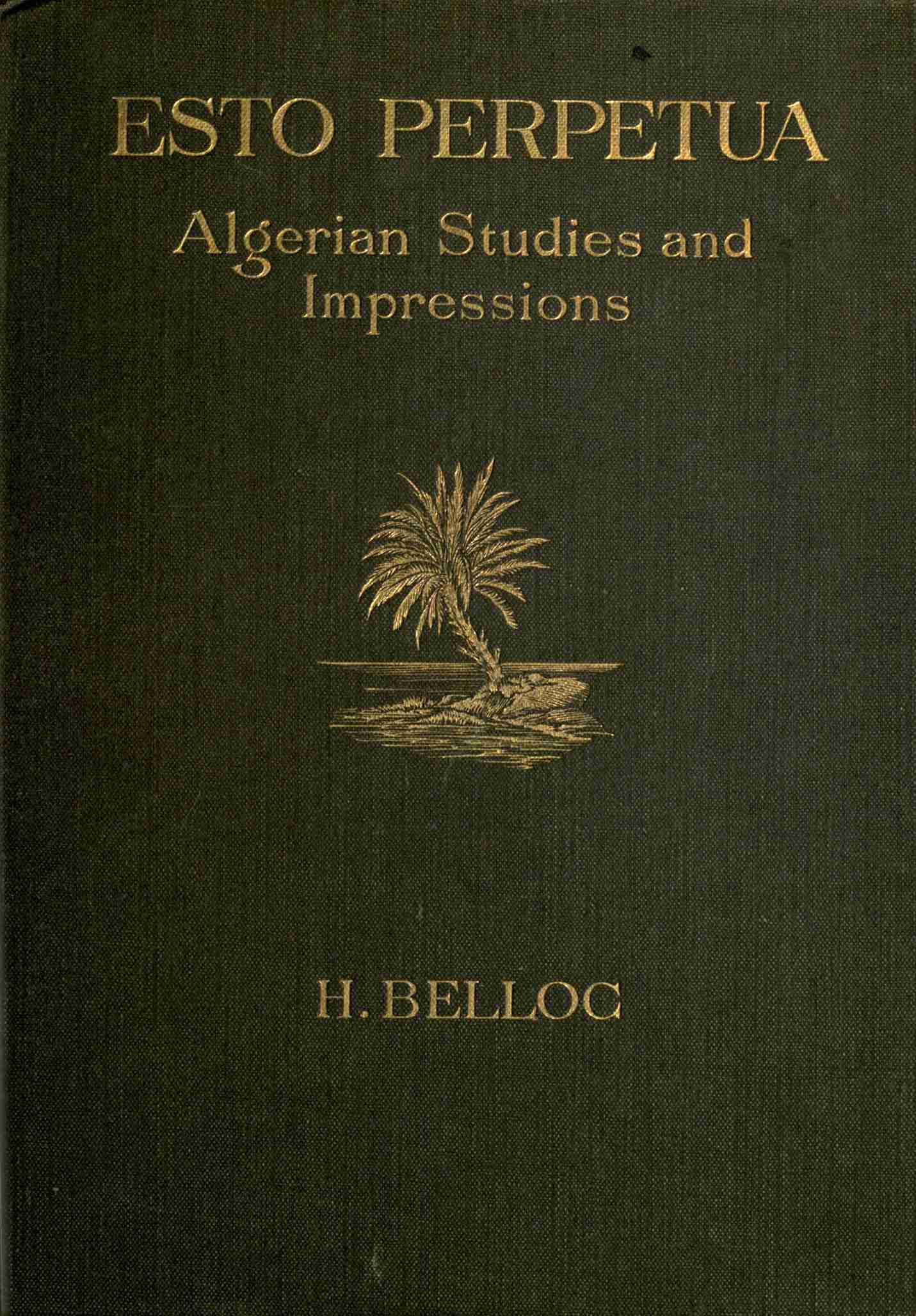
At dawn, a craftsman in a Mediterranean village works at his bench, shaping two ornamental forms side by side: a Christian cross and an Islamic crescent. This single image, witnessed by Hilaire Belloc in 1906, becomes the key to a country and a question that would haunt his journey through Algeria. What follows is not merely a traveler's account but a sustained meditation on how two civilizations have occupied the same ground for centuries, each shaping the other in ways neither intended. Belloc arrives in what the Romans called "the Island of the West" seeking to understand a land where Roman ruins stand beside Arab mosques, where French colonists have recently planted their flag, and where the ancient rhythms of North African life continue regardless of who governs. His prose, characteristically precise and witty, moves between historical analysis and immediate observation, between philosophical reflection and vivid scene-painting. He is interested in the geological bones of the country, its position as gateway between Europe and Africa, and the peculiar tolerance that has allowed Muslims and Christians to coexist in uneasy proximity. This is a book for readers who enjoy travel writing at its most intellectually ambitious, who want to see the early twentieth century through the eyes of a sharp, opinionated, and genuinely curious mind.
Editions

Link to this book
Add a free, dofollow link to Lex on your blog, forum, syllabus, or reading list.

<a href="https://lex-books.com/book/esto-perpetua-algerian-studies-and-impressions-043a5dda-616b-47b6-9768-9f61a919c01a"><img src="https://lex-books.com/badges/read-on-lex.svg" alt="Read Esto Perpetua: Algerian Studies and Impressions by Hilaire Belloc free on Lex" width="160" height="40"></a>[](https://lex-books.com/book/esto-perpetua-algerian-studies-and-impressions-043a5dda-616b-47b6-9768-9f61a919c01a)[url=https://lex-books.com/book/esto-perpetua-algerian-studies-and-impressions-043a5dda-616b-47b6-9768-9f61a919c01a][img]https://lex-books.com/badges/read-on-lex.svg[/img][/url]Read Esto Perpetua: Algerian Studies and Impressions by Hilaire Belloc free on Lex: https://lex-books.com/book/esto-perpetua-algerian-studies-and-impressions-043a5dda-616b-47b6-9768-9f61a919c01aCite this book
Reading this edition for a paper or guide? Copy a citation.
Belloc, Hilaire. Esto Perpetua: Algerian Studies and Impressions. Lex, lex-books.com/book/esto-perpetua-algerian-studies-and-impressions-043a5dda-616b-47b6-9768-9f61a919c01a.Belloc, H. (1906). Esto Perpetua: Algerian Studies and Impressions. Lex. https://lex-books.com/book/esto-perpetua-algerian-studies-and-impressions-043a5dda-616b-47b6-9768-9f61a919c01aBelloc, Hilaire. Esto Perpetua: Algerian Studies and Impressions. Lex. https://lex-books.com/book/esto-perpetua-algerian-studies-and-impressions-043a5dda-616b-47b6-9768-9f61a919c01a.