Barnabé Rudge, Tome I
1841
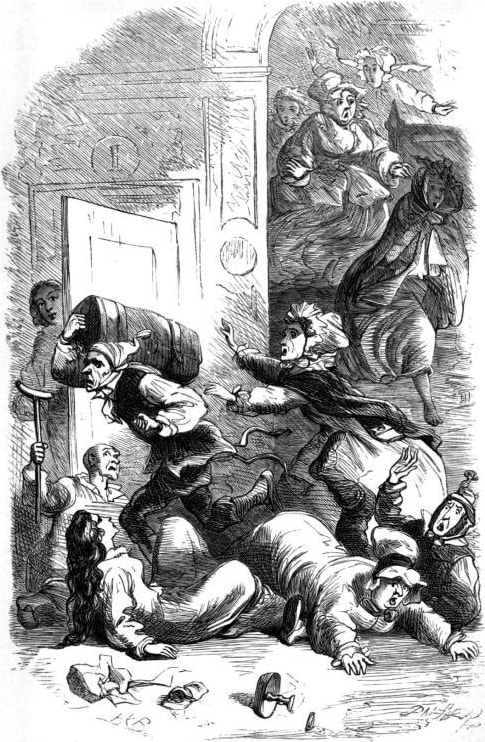
Barnabé Rudge, Tome I, published in 1841 by Charles Dickens, is a historical novel set in 1775 London during the Gordon Riots. The narrative follows Barnabé Rudge, a troubled young man, and his interactions with various characters linked to the Maypole tavern, including the tavern owner John Willet and his son Joe. The story intertwines personal dramas with the political unrest of the time, exploring themes of rebellion and social conflict against a backdrop of mystery surrounding the Haredale family.
Editions
X-Ray
“Time has been lost and opportunity thrown away, but I am yet a young man, and may retrieve it.””
— Charles Dickens
“…a lady of what is commonly called an uncertain temper--a phrase which being interpreted signifies a temper tolerably certain to make everybody more or less uncomfortable.””
— Charles Dickens
“I hope I know my own unworthiness, and that I hate and despise myself and all my fellow-creatures as every practicable Christian should.””
— Charles Dickens
“[...] certain it is that minds, like bodies, will often fall into a pimpled ill-conditioned state from mere excess of comfort, and like them, are often successfully cured by remedies in themselves very nauseous and unpalatable.””
— Charles Dickens
“I have broken where I should have bent; and have mused and brooded, when my spirit should have mixed with all God's great creation. The men who learn endurance, are they who call the whole world, brother. I have turned from the world, and I pay the penalty.””
— Charles Dickens
“[...] There are tales among us that you have sold yourself to the devil, and I know not what.''We all have, have we not?' returned the stranger, looking up. 'If we were fewer in number, perhaps he would give better wages.””
— Charles Dickens
“That what we falsely call a religious cry is easily raised by men who have no religion, and who in their daily practice set at nought the commonest principles of right and wrong; that it is begotten of intolerance and persecution; that it is senseless, besotted, inveterate and unmerciful; all History teaches us.””
— Charles Dickens
“Let no man turn aside, even so slightly, from the broad path of honor, on the plausible pretence that he is justified by the goodness of his end. All good ends can be worked out by good means. Those that cannot, are bad; and may be counted so at once, and left alone.””
— Charles Dickens
“A mob is usually a creature of very mysterious existence, particularly in a large city. Where it comes from or whither it goes, few men can tell. Assembling and dispersing with equal suddenness, it is as difficult to follow to its various sources as the sea itself; nor does the parallel stop here, for the ocean is not more fickle and uncertain, more terrible when roused, more unreasonable, or more cruel.””
— Charles Dickens
Link to this book
Add a free, dofollow link to Lex on your blog, forum, syllabus, or reading list.

<a href="https://lex-books.com/book/barnab-rudge-tome-i-ea4cdb06-7f72-4c5c-8c01-df7bb078800c"><img src="https://lex-books.com/badges/read-on-lex.svg" alt="Read Barnabé Rudge, Tome I by Charles Dickens free on Lex" width="160" height="40"></a>[](https://lex-books.com/book/barnab-rudge-tome-i-ea4cdb06-7f72-4c5c-8c01-df7bb078800c)[url=https://lex-books.com/book/barnab-rudge-tome-i-ea4cdb06-7f72-4c5c-8c01-df7bb078800c][img]https://lex-books.com/badges/read-on-lex.svg[/img][/url]Read Barnabé Rudge, Tome I by Charles Dickens free on Lex: https://lex-books.com/book/barnab-rudge-tome-i-ea4cdb06-7f72-4c5c-8c01-df7bb078800cCite this book
Reading this edition for a paper or guide? Copy a citation.
Dickens, Charles. Barnabé Rudge, Tome I. Lex, lex-books.com/book/barnab-rudge-tome-i-ea4cdb06-7f72-4c5c-8c01-df7bb078800c.Dickens, C. (1841). Barnabé Rudge, Tome I. Lex. https://lex-books.com/book/barnab-rudge-tome-i-ea4cdb06-7f72-4c5c-8c01-df7bb078800cDickens, Charles. Barnabé Rudge, Tome I. Lex. https://lex-books.com/book/barnab-rudge-tome-i-ea4cdb06-7f72-4c5c-8c01-df7bb078800c.