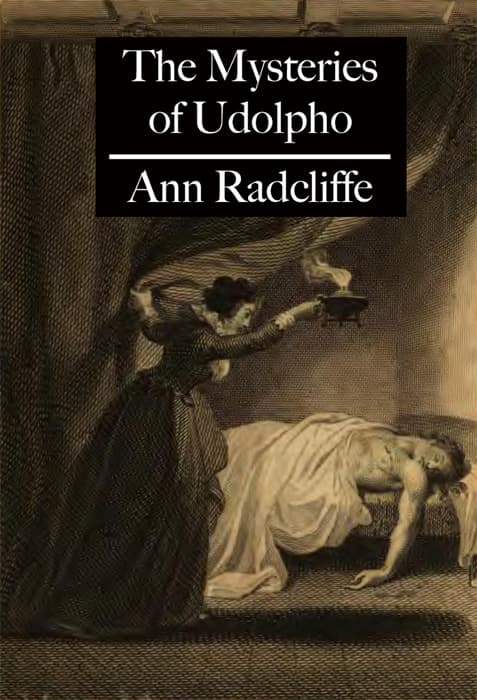
A Sicilian Romance
1790
Radcliffe's second novel (1790) established the blueprint for everything that would make Gothic fiction irresistible: crumbling castles, imprisoned heroines, and secrets that fester in darkness like wounds. The story follows Emilia and Julia, two beautiful sisters trapped in the decaying Sicilian castle of Mazzini after their mother's death. Their father, the morose Marquis, has remarried to the cunning Maria de Vellorno, a woman whose voluptuous menace signals only trouble. As the sisters explore the castle's forbidden corridors and encounter ghostly lights and strange sounds, they uncover the shameful secrets of their aristocratic lineage. The novel crackles with psychological terror, where the greatest horrors are not ghosts but the machinery of patriarchal oppression and the violence hidden behind noble facades. Radcliffe pioneered the explained supernatural, leaving readers suspended between terror and reason. This is Gothic fiction in its volatile youth: rawer, darker, more sexually charged than her later masterpieces. For readers who want to understand where the haunted castle trope came from, this is the origin story.
Editions

X-Ray
“How short a period often reverses the character of our sentiments, rendering that which yesterday we despised, today desirable.””
— Ann Ward Radcliffe
“As I walked over the loose fragments of stone, which lay scattered and surveyed the sublimity and grandeur of the ruins, I recurred, by a natural association of ideas, to the times when these walls stood proudly in their original splendor, when the halls were the scenes of hospitality and festive magnificence, and when they resounded with the voices of those whom death had long since swept from earth. "Thus," said I, "shall the present generation - he who now sink in misery - and he who now swim in pleasure, alike pass away and be forgotten.””
— Ann Ward Radcliffe
“Tremblingly alive to a sense of delight, and unchilled by disappointment, the young heart welcomes every feeling, not simply painful, with a romantic expectation that it will expand into bliss.””
— Ann Ward Radcliffe
“Wisdom or accident, at length, recall us from our error, and offers to us some object capable of producing a pleasing, yet lasting effect, which effect, therefore, we call happiness. Happiness has this essential difference from what is commonly called pleasure, that virtue forms its basis, and virtue being the offspring of reason, may be expected to produce uniformity of effect.””
— Ann Ward Radcliffe
“It seemed as if his desire of her affection increased with his knowledge of the loss of it; and the very circumstance which should have roused his aversion, by a strange perversity of disposition, appeared to heighten his passion, and to make him think it impossible he could exist without her.””
— Ann Ward Radcliffe
“The loved idea of Angelo still rose upon my fancy, and its powers of captivation, heightened by absence, and, perhaps even by despair, pursued me with incessant grief. I concealed in silence the anguish that preyed upon my heart, and resigned myself a willing victim””
— Ann Ward Radcliffe
“what yesterday affected us strongly, is to-day but imperfectly felt, and to-morrow perhaps shall be disregarded.””
— Ann Ward Radcliffe
“The weakness of humanity is never willingly perceived by young minds.””
— Ann Ward Radcliffe
“We learn, also, that those who do only THAT WHICH IS RIGHT, endure nothing in misfortune but a trial of their virtue, and from trials well endured derive the surest claim to the protection of heaven.””
— Ann Ward Radcliffe
Link to this book
Add a free, dofollow link to Lex on your blog, forum, syllabus, or reading list.

<a href="https://lex-books.com/book/a-sicilian-romance-4f894066-444a-48e1-b29f-595d7fc8084f"><img src="https://lex-books.com/badges/read-on-lex.svg" alt="Read A Sicilian Romance by Ann Ward Radcliffe free on Lex" width="160" height="40"></a>[](https://lex-books.com/book/a-sicilian-romance-4f894066-444a-48e1-b29f-595d7fc8084f)[url=https://lex-books.com/book/a-sicilian-romance-4f894066-444a-48e1-b29f-595d7fc8084f][img]https://lex-books.com/badges/read-on-lex.svg[/img][/url]Read A Sicilian Romance by Ann Ward Radcliffe free on Lex: https://lex-books.com/book/a-sicilian-romance-4f894066-444a-48e1-b29f-595d7fc8084fCite this book
Reading this edition for a paper or guide? Copy a citation.
Radcliffe, Ann Ward. A Sicilian Romance. Lex, lex-books.com/book/a-sicilian-romance-4f894066-444a-48e1-b29f-595d7fc8084f.Radcliffe, A. W. (1790). A Sicilian Romance. Lex. https://lex-books.com/book/a-sicilian-romance-4f894066-444a-48e1-b29f-595d7fc8084fRadcliffe, Ann Ward. A Sicilian Romance. Lex. https://lex-books.com/book/a-sicilian-romance-4f894066-444a-48e1-b29f-595d7fc8084f.