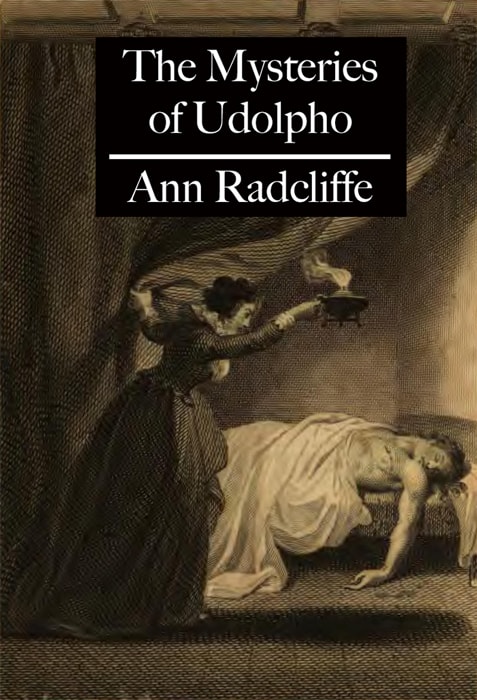
The Mysteries of Udolpho
1794
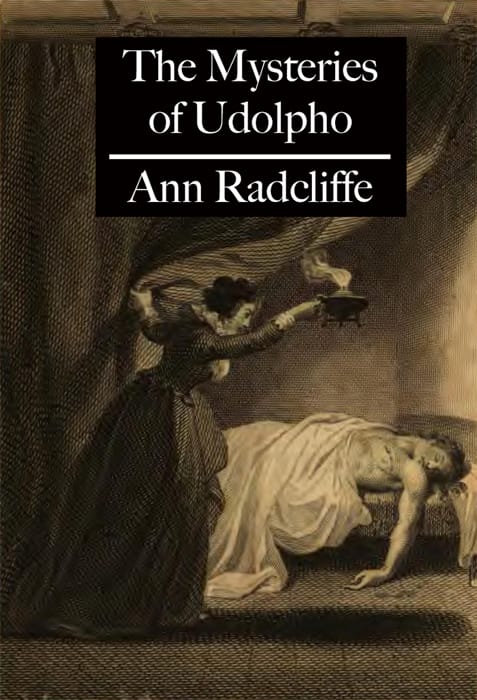
The Mysteries of Udolpho
1794
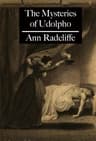
When young Emily St. Aubert loses both her parents and is imprisoned in the crumbling castle of her sinister guardian Montoni, she faces more than physical captivity. Within the walls of Udolpho, where every corridor hums with whispered dread and every shadow might conceal either danger or madness, Emily must conjure reserves of courage she never knew she possessed. Ann Radcliffe invented the modern Gothic here: not merely the haunted castle and the imperiled heroine, but the very mechanism by which terror operates on the mind, transforming ordinary darkness into an abyss of imagined horrors. The novel pulses with Emily's poetic sensibility, her desperate love for the absent Valancourt, and the mounting suspense of Montoni's schemes and the castle's seeming supernatural terrors. This is atmosphere as psychological landscape, where fear becomes a mirror reflecting what we most dread within ourselves. It influenced everything from Jane Austen's knowing satire in Northanger Abbey to the entire Gothic tradition that followed, and it remains electrifying: a novel that understands how the imagination, left alone in the dark, becomes its own most fearsome adversary.
Editions

X-Ray
“A well-informed mind is the best security against the contagion of folly and vice. The vacant mind is ever on the watch for relief, and ready to plunge into error, to escape from the languor of idleness. Store it with ideas, teach it the pleasure of thinking; and the temptations of the world without, will be counteracted by the gratifications derived from the world within.””
— Ann Ward Radcliffe
“I ought not to doubt the steadiness of your affection, yet such is the inconsistency of real love, that it is always awake to suspicion, however unreasonable; always requiring new assurances from the object of its interest, and thus it is, that I always feel revived, as by a new conviction, when your words tell me I am dear to you; and, wanting these, I relapse into doubt, and too often into despondency.””
— Ann Ward Radcliffe
“Such is the inconsistency of real love, that it is always awake to suspicion, however unreasonable; always requiring new assurances from the object of its interest.””
— Ann Ward Radcliffe
“He loved the soothing hour, when the last tints of light die away; when the stars, one by one, tremble through æther, and are reflected on the dark mirror of the waters; that hour, which, of all others, inspires the mind with pensive tenderness, and often elevates it to sublime contemplation.””
— Ann Ward Radcliffe
“Do you believe your heart to be, indeed, so hardened, that you can look without emotion on the suffering, to which you would condemn me?””
— Ann Ward Radcliffe
“How strange it is, that a fool or a knave, with riches, should be treated with more respect by the world, than a good man, or a wise man in poverty!””
— Ann Ward Radcliffe
“Towards evening, they wound down precipices, black with forest of cypress, pine and cedar, into a glen so savage and secluded, that, if Solicitude ever had local habitation, this might have been "her place of dearest residence””
— Ann Ward Radcliffe
“...he brought music of his own, and awakened every fairy echo with the tender accents of his oboe...””
— Ann Ward Radcliffe
“Why all this terror?' said he, in a tremulous voice. 'Hear me, Emily: I come not to alarm you; no, by Heaven! I love you too well- too well for my own peace.””
— Ann Ward Radcliffe
Link to this book
Add a free, dofollow link to Lex on your blog, forum, syllabus, or reading list.

<a href="https://lex-books.com/book/the-mysteries-of-udolpho-ba3012fb-2a9c-4771-8858-54e539f2a551"><img src="https://lex-books.com/badges/read-on-lex.svg" alt="Read The Mysteries of Udolpho by Ann Ward Radcliffe free on Lex" width="160" height="40"></a>[](https://lex-books.com/book/the-mysteries-of-udolpho-ba3012fb-2a9c-4771-8858-54e539f2a551)[url=https://lex-books.com/book/the-mysteries-of-udolpho-ba3012fb-2a9c-4771-8858-54e539f2a551][img]https://lex-books.com/badges/read-on-lex.svg[/img][/url]Read The Mysteries of Udolpho by Ann Ward Radcliffe free on Lex: https://lex-books.com/book/the-mysteries-of-udolpho-ba3012fb-2a9c-4771-8858-54e539f2a551Cite this book
Reading this edition for a paper or guide? Copy a citation.
Radcliffe, Ann Ward. The Mysteries of Udolpho. Lex, lex-books.com/book/the-mysteries-of-udolpho-ba3012fb-2a9c-4771-8858-54e539f2a551.Radcliffe, A. W. (1794). The Mysteries of Udolpho. Lex. https://lex-books.com/book/the-mysteries-of-udolpho-ba3012fb-2a9c-4771-8858-54e539f2a551Radcliffe, Ann Ward. The Mysteries of Udolpho. Lex. https://lex-books.com/book/the-mysteries-of-udolpho-ba3012fb-2a9c-4771-8858-54e539f2a551.