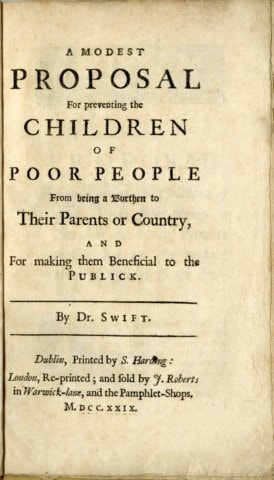
A Modest Proposal: For Preventing the Children of Poor People in Ireland, from Being a Burden on Their Parents or Country, and for Making Them Beneficial to the Publick
1729
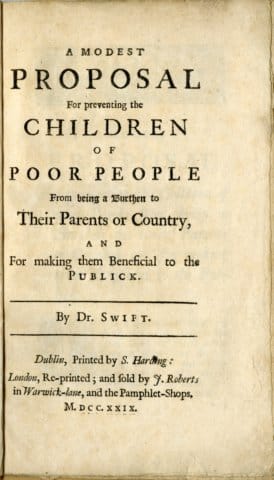
A Modest Proposal: For Preventing the Children of Poor People in Ireland, from Being a Burden on Their Parents or Country, and for Making Them Beneficial to the Publick
1729
A Modest Proposal is perhaps the most audacious piece of satire in the English language: a deadpan treatise that suggests the poor of Ireland might ease their economic distress by selling their children as food for the wealthy. Written in 1729 during Swift's tenure as Dean of St Patrick's Cathedral, Dublin, the essay masquerades as a rational economic proposal, complete with careful calculations about the yield of infant meat and the benefits to landlords, merchants, and the nation at large. That Swift could write such a thing with a straight face is the point. The horror of the suggestion is not a flaw but a weapon, aimed at exposing the monstrousness of conditions that had reduced the Irish poor to commodities in their own country. Swift skewers British colonial policy, indifferent Irish landlords, and a society that treats human beings as burdens to be managed rather than people to be helped. Nearly three centuries later, the essay's power remains undiminished. Swift understood that sometimes the only way to make the world see its own cruelty is to hold up a mirror so grotesque it cannot be ignored.
Editions
X-Ray
The detached, rational, and seemingly benevolent persona who presents the 'modest proposal' as a logical solution to Ireland's poverty.
The suffering population of Ireland, depicted as a burden on society and the subject of the Proposer's grotesque 'solution'.
The wealthy landowners who exploit their tenants, implicitly blamed for the dire conditions that necessitate such extreme proposals.
A 'knowing American' cited by the Proposer as an expert on the edibility and nutritional value of young children.
About A Modest Proposal: For Preventing the Children of Poor People in Ireland, from Being a Burden on Their Parents or Country, and for Making Them Beneficial to the Publick
Chapter Summaries
- 1
- The essay opens by describing the widespread poverty and beggary in Ireland, particularly among mothers and children, highlighting their desperate plight. The narrator then introduces his 'modest proposal' to solve this problem by suggesting that the children of the poor be fattened and sold as food to the wealthy, thereby providing economic benefit and reducing the population burden. He meticulously details the economic advantages, culinary uses, and societal benefits of this plan, while dismissing other, more humane solutions as impractical or ineffective, concluding with a chilling assertion of his own disinterest.
Key Themes
- Satire and Irony
- Swift employs biting satire and sustained irony to critique the social and political conditions of Ireland. The Proposer's calm, logical tone in presenting such a horrific solution serves to highlight the absurdity and inhumanity of the actual policies and attitudes towards the Irish poor.
- Poverty and Social Injustice
- The essay vividly portrays the extreme poverty, beggary, and suffering prevalent in 18th-century Ireland. It underscores the systemic social injustice that left a large portion of the population without means of sustenance or dignity, forcing them into desperate circumstances.
- Dehumanization and Objectification
- A core theme is the dehumanization of the Irish poor, particularly children, who are reduced to economic commodities. The proposal treats infants as livestock to be bred, fattened, and sold, reflecting how the impoverished were already viewed as less than human by the ruling class.
Characters
- The Proposer (Narrator)(protagonist)
- The detached, rational, and seemingly benevolent persona who presents the 'modest proposal' as a logical solution to Ireland's poverty.
- The Poor Irish (Mothers, Children, Beggars, Cottagers, Labourers, Farmers)(supporting)
- The suffering population of Ireland, depicted as a burden on society and the subject of the Proposer's grotesque 'solution'.
- Landlords(antagonist)
- The wealthy landowners who exploit their tenants, implicitly blamed for the dire conditions that necessitate such extreme proposals.
- American Acquaintance(minor)
- A 'knowing American' cited by the Proposer as an expert on the edibility and nutritional value of young children.
- Worthy Person/Friend(minor)
- A 'true lover of his country' who offers a 'refinement' to the proposal, suggesting older children could be eaten, further highlighting the moral degradation.
- Psalmanaazor(minor)
- A historical figure, a supposed native of Formosa, whose fabricated accounts of cannibalism are used by the Proposer's friend to justify eating older children.
Link to this book
Add a free, dofollow link to Lex on your blog, forum, syllabus, or reading list.

<a href="https://lex-books.com/book/a-modest-proposal-for-preventing-the-children-of-poor-people-in-ireland-from-bei-4f63aafd-c690-4658-869f-693a42f54802"><img src="https://lex-books.com/badges/read-on-lex.svg" alt="Read A Modest Proposal: For Preventing the Children of Poor People in Ireland, from Being a Burden on Their Parents or Country, and for Making Them Beneficial to the Publick by Jonathan Swift free on Lex" width="160" height="40"></a>[](https://lex-books.com/book/a-modest-proposal-for-preventing-the-children-of-poor-people-in-ireland-from-bei-4f63aafd-c690-4658-869f-693a42f54802)[url=https://lex-books.com/book/a-modest-proposal-for-preventing-the-children-of-poor-people-in-ireland-from-bei-4f63aafd-c690-4658-869f-693a42f54802][img]https://lex-books.com/badges/read-on-lex.svg[/img][/url]Read A Modest Proposal: For Preventing the Children of Poor People in Ireland, from Being a Burden on Their Parents or Country, and for Making Them Beneficial to the Publick by Jonathan Swift free on Lex: https://lex-books.com/book/a-modest-proposal-for-preventing-the-children-of-poor-people-in-ireland-from-bei-4f63aafd-c690-4658-869f-693a42f54802Cite this book
Reading this edition for a paper or guide? Copy a citation.
Swift, Jonathan. A Modest Proposal: For Preventing the Children of Poor People in Ireland, from Being a Burden on Their Parents or Country, and for Making Them Beneficial to the Publick. Lex, lex-books.com/book/a-modest-proposal-for-preventing-the-children-of-poor-people-in-ireland-from-bei-4f63aafd-c690-4658-869f-693a42f54802.Swift, J. (1729). A Modest Proposal: For Preventing the Children of Poor People in Ireland, from Being a Burden on Their Parents or Country, and for Making Them Beneficial to the Publick. Lex. https://lex-books.com/book/a-modest-proposal-for-preventing-the-children-of-poor-people-in-ireland-from-bei-4f63aafd-c690-4658-869f-693a42f54802Swift, Jonathan. A Modest Proposal: For Preventing the Children of Poor People in Ireland, from Being a Burden on Their Parents or Country, and for Making Them Beneficial to the Publick. Lex. https://lex-books.com/book/a-modest-proposal-for-preventing-the-children-of-poor-people-in-ireland-from-bei-4f63aafd-c690-4658-869f-693a42f54802.