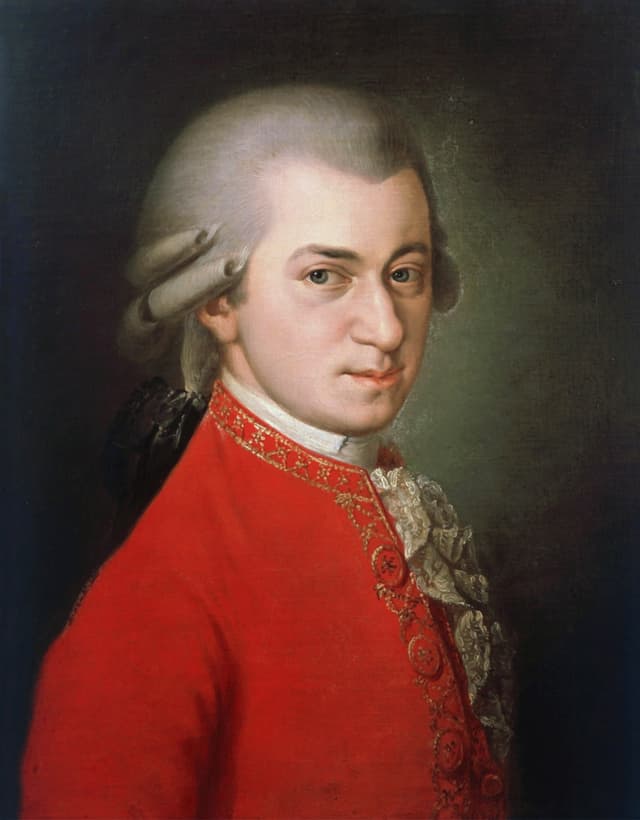
Wolfgang Amadeus Mozart
Wolfgang Amadeus Mozart was a prolific composer of the Classical period, whose remarkable talent emerged at an astonishingly young age. Born in Salzburg, he displayed extraordinary musical abilities by the age of five, mastering the keyboard and violin while composing and performing for European royalty. His father, Leopold Mozart, recognized his son's prodigious gifts and took him on extensive tours across Europe, exposing him to a wide array of musical influences. Despite his early successes, including a position at the Salzburg court, Mozart grew restless and sought greater opportunities, leading him to travel through Paris, Mannheim, and Munich in search of a more fulfilling career. Settling in Vienna in 1781, Mozart achieved fame and recognition, although financial stability remained elusive. His Vienna years were marked by the creation of some of his most celebrated works, including the operas "The Marriage of Figaro," "Don Giovanni," and "The Magic Flute," as well as the iconic "Eine kleine Nachtmusik" and his final three symphonies, culminating in the masterful Jupiter Symphony. His Requiem, left unfinished at his untimely death at age 35, has become shrouded in myth and intrigue. Today, Mozart is revered as one of the greatest composers in Western music history, celebrated for his melodic beauty, formal elegance, and rich harmonic textures that have profoundly influenced the development of classical music.
Famous Quotes
View all 3 quotes“The music is not in the notes, but in the silence between.”
“Neither a lofty degree of intelligence nor imagination nor both together go to the making of genius. Love, love, love, that is the soul of genius.”
“I pay no attention whatever to anybody's praise or blame. I simply follow my own feelings.”
Books from the author





Link to this page
Add a free, dofollow link to Lex on your blog, forum, syllabus, or reading list.

<a href="https://lex-books.com/author/wolfgang-amadeus-mozart"><img src="https://lex-books.com/badges/read-on-lex.svg" alt="Wolfgang Amadeus Mozart on Lex" width="160" height="40"></a>[](https://lex-books.com/author/wolfgang-amadeus-mozart)[url=https://lex-books.com/author/wolfgang-amadeus-mozart][img]https://lex-books.com/badges/read-on-lex.svg[/img][/url]Wolfgang Amadeus Mozart on Lex: https://lex-books.com/author/wolfgang-amadeus-mozart