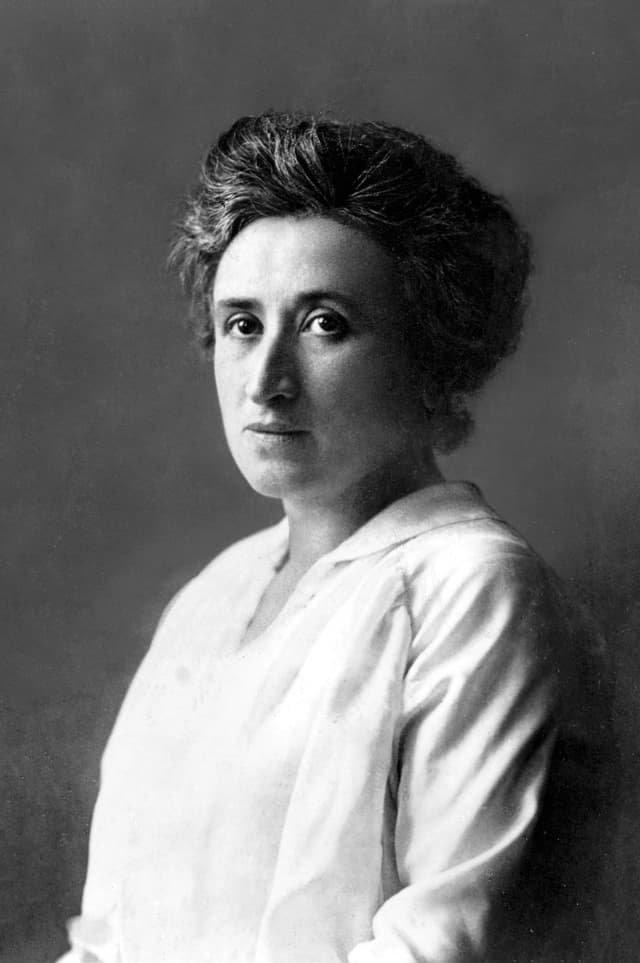
Rosa Luxemburg
Rosa Luxemburg was a Polish-born Marxist theorist and revolutionary who became a prominent figure in the German socialist movement. Raised in a secular Jewish family in Russian-ruled Poland, she became politically active in her youth, co-founding the Social Democracy of the Kingdom of Poland and Lithuania, which prioritized international class struggle over Polish nationalism. After relocating to Germany in 1898, she emerged as a leading voice within the Social Democratic Party (SPD), advocating for revolutionary socialism against reformist ideologies. Her 1900 pamphlet, 'Social Reform or Revolution?', argued for the necessity of revolution, while her theory of the mass strike highlighted the spontaneous power of the working class as a tool for change. Luxemburg's fierce anti-militarism and critique of imperialism, articulated in her major work 'The Accumulation of Capital' (1913), put her at odds with the SPD leadership, especially during World War I. Imprisoned for her opposition to the war, she penned the influential 'Junius Pamphlet', which condemned the conflict as a betrayal of the working class and introduced the phrase 'socialism or barbarism'. While she initially celebrated the Russian Revolution of 1917, her posthumously published critiques of Bolshevik authoritarianism underscored her commitment to democratic socialism and mass participation in revolutionary movements. Luxemburg's legacy endures as a powerful voice for socialist democracy and a critical thinker within the international socialist movement.
Famous Quotes
View all 3 quotes“Those who do not move, do not notice their chains.”
“Freiheit ist immer die Freiheit des Andersdenkenden Freedom is always, and exclusively, freedom for the one who thinks differently.”
“Being human means throwing your whole life on the scales of destiny when need be, all the while rejoicing in every sunny day and every beautiful cloud.”
Books from the author







Link to this page
Add a free, dofollow link to Lex on your blog, forum, syllabus, or reading list.

<a href="https://lex-books.com/author/rosa-luxemburg"><img src="https://lex-books.com/badges/read-on-lex.svg" alt="Rosa Luxemburg on Lex" width="160" height="40"></a>[](https://lex-books.com/author/rosa-luxemburg)[url=https://lex-books.com/author/rosa-luxemburg][img]https://lex-books.com/badges/read-on-lex.svg[/img][/url]Rosa Luxemburg on Lex: https://lex-books.com/author/rosa-luxemburg