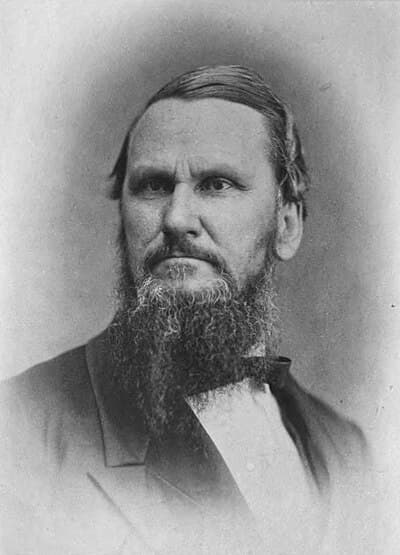
Robert Lewis Dabney
Robert Lewis Dabney was a prominent Southern Presbyterian pastor, theologian, and Confederate army chaplain from Virginia. He played a significant role in the religious and cultural landscape of the South during the 19th century. As chief of staff and biographer to the renowned Confederate general Stonewall Jackson, Dabney produced a biography that has endured through the years, offering insights into Jackson's life and character. His theological contributions, alongside those of his contemporary James Henley Thornwell, positioned him as one of the leading scholars of Southern Presbyterianism, where he championed Calvinist doctrines and Old School Presbyterian values. Despite his lasting influence, Dabney's legacy is complex and contentious. His writings continue to be valued by some conservative Presbyterians, particularly within the Presbyterian Church in America and the Orthodox Presbyterian Church. However, his views on race, particularly his support for white supremacy and antebellum slavery, have led to significant criticism and repudiation from various factions within the church. This duality in his legacy reflects the broader tensions within American religious thought and the ongoing debates surrounding the intersection of faith and social issues in the context of Southern history.
Famous Quotes
View all 3 quotes“It may be inferred again that the present movement for women’s rights will certainly prevail from the history of its only opponent, Northern conservatism. This [Northern conservatism] is a party which never conserves anything. Its history has been that it demurs to each aggression of the progressive party, and aims to save its credit by a respectable amount of growling, but always acquiesces at last in the innovation. What was the resisted novelty of yesterday is today one of the accepted principles of conservatism; it is now conservative only in affecting to resist the next innovation, which will tomorrow be forced upon its timidity and will be succeeded by some third revolution; to be denounced and then adopted in its turn. American conservatism is merely the shadow that follows Radicalism as it moves forward towards perdition. It remains behind it, but never retards it, and always advances near its leader. This pretended salt hath utterly lost its savor: wherewith shall it be salted? Its impotency is not hard, indeed, to explain. It is worthless because it is the conservatism of expediency only, and not of sturdy principle. It intends to risk nothing serious for the sake of the truth, and has no idea of being guilty of the folly of martyrdom. It always when about to enter a protest very blandly informs the wild beast whose path it essays to stop, that its “bark is worse than its bite,” and that it only means to save its manners by enacting its decent role of resistance: The only practical purpose which it now subserves in American politics is to give enough exercise to Radicalism to keep it “in wind,” and to prevent its becoming pursy and lazy, from having nothing to whip.”
“The moral judgments and acts of the soul all involve an exercise of reason, so that it is impossible to separate the ethical and intellectual functions.”
“A truth is not necessary, because we negatively are not able to conceive the actual existence of the opposite thereof;but a truth is necessary when we positively are able to apprehend that the negation thereof includes an inevitable contradiction. It is not that that we can see how the opposite comes to be true, but it is that the opposite can not possibly be true.”
Books from the author






Link to this page
Add a free, dofollow link to Lex on your blog, forum, syllabus, or reading list.

<a href="https://lex-books.com/author/robert-lewis-dabney"><img src="https://lex-books.com/badges/read-on-lex.svg" alt="Robert Lewis Dabney on Lex" width="160" height="40"></a>[](https://lex-books.com/author/robert-lewis-dabney)[url=https://lex-books.com/author/robert-lewis-dabney][img]https://lex-books.com/badges/read-on-lex.svg[/img][/url]Robert Lewis Dabney on Lex: https://lex-books.com/author/robert-lewis-dabney