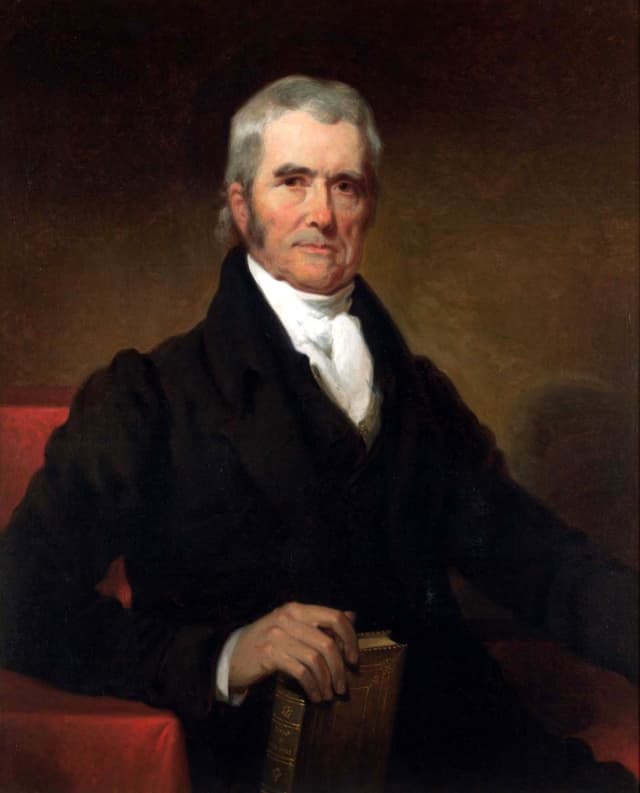
John Marshall
John Marshall was an influential American statesman and jurist, serving as the fourth Chief Justice of the United States from 1801 until his death in 1835. Born in Germantown, Virginia, in 1755, he played a pivotal role in the early years of the American republic. A veteran of the Continental Army during the Revolutionary War, Marshall's political career began in the Virginia House of Delegates, where he advocated for the ratification of the U.S. Constitution. His diplomatic efforts during the XYZ Affair, where he sought to resolve tensions with France, further established his prominence in American politics. He briefly served as Secretary of State under President John Adams before his historic appointment to the Supreme Court. As Chief Justice, Marshall transformed the Supreme Court into a powerful and independent branch of government. He is best known for his landmark decision in Marbury v. Madison, which established the principle of judicial review, allowing courts to invalidate laws that conflict with the Constitution. This ruling not only solidified the judiciary's role in the American political system but also set a precedent for future cases. Marshall's tenure on the court, marked by his ability to forge consensus among justices and articulate a clear legal philosophy, has left a lasting legacy on American law and governance, making him one of the most significant figures in the history of the U.S. judiciary.
Famous Quotes
View all 20 quotes“A detective in love with a breathtakingly beautiful stripper, who also is a major criminal: “Among her coterie of supplicants was Joe Fucci, a senior detective on the Laughlin force. Joe regarded himself as handsome, and he was. If he went without shaving for three days, a John Deere was required to cut through the growth. No electric razor created by man stood a chance in that tangle of growth.””
“The Constitution is colorblind, and neither knows nor tolerates classes among citizens.””
“The power to tax is the power to destroy.””
Books from the author


Link to this page
Add a free, dofollow link to Lex on your blog, forum, syllabus, or reading list.

<a href="https://lex-books.com/author/john-marshall"><img src="https://lex-books.com/badges/read-on-lex.svg" alt="John Marshall on Lex" width="160" height="40"></a>[](https://lex-books.com/author/john-marshall)[url=https://lex-books.com/author/john-marshall][img]https://lex-books.com/badges/read-on-lex.svg[/img][/url]John Marshall on Lex: https://lex-books.com/author/john-marshall