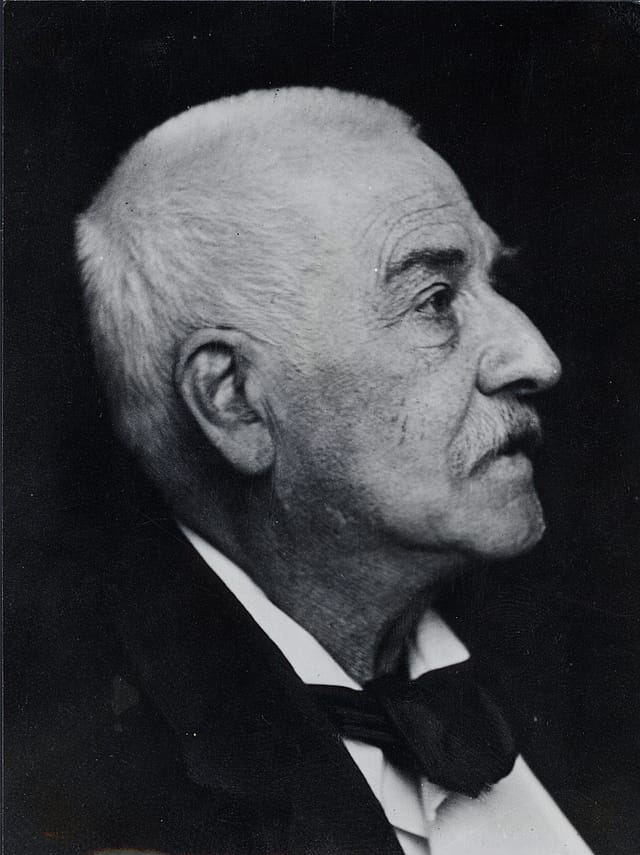
Jacob Burckhardt
Carl Jacob Christoph Burckhardt was a Swiss historian whose groundbreaking work laid the foundation for the field of cultural history. He is best known for his seminal book, The Civilization of the Renaissance in Italy, published in 1860, which offered a comprehensive examination of the Renaissance period. Burckhardt's innovative approach emphasized the interconnectedness of art, social institutions, and daily life, marking a significant shift in historiographical methods. His insights into the cultural dynamics of the Renaissance not only illuminated the artistic achievements of the era but also explored the broader societal contexts that shaped them. Burckhardt's influence extended beyond his own writings; he is often regarded as a key figure in the development of cultural history as a discipline. His ability to synthesize various aspects of Renaissance life into a cohesive narrative set a precedent for future historians. Sigfried Giedion aptly described him as the "great discoverer of the age of the Renaissance," highlighting his role in transforming how historians approach the study of cultural phenomena. Burckhardt's legacy endures in the way art and culture are analyzed in relation to their historical contexts, making him a pivotal figure in the historiography of art and culture.
Famous Quotes
View all 3 quotes“Nothing in the world is better suited to laziness than orthodoxy. If you gag your mouth, stop up your ears and put a blinder over your eyes, you can sleep peacefully.”
“It is the historian’s function, not to make us clever for the next time, but to make us wise forever.”
“The seventeenth century is everywhere a time in which the state's power over everything individual increases, whether that power be in absolutist hands or may be considered the result of a contract, etc. People begin to dispute the sacred right of the individual ruler or authority without being aware that at the same time they are playing into the hands of a colossal state power.”
Books from the author





Link to this page
Add a free, dofollow link to Lex on your blog, forum, syllabus, or reading list.

<a href="https://lex-books.com/author/jacob-burckhardt"><img src="https://lex-books.com/badges/read-on-lex.svg" alt="Jacob Burckhardt on Lex" width="160" height="40"></a>[](https://lex-books.com/author/jacob-burckhardt)[url=https://lex-books.com/author/jacob-burckhardt][img]https://lex-books.com/badges/read-on-lex.svg[/img][/url]Jacob Burckhardt on Lex: https://lex-books.com/author/jacob-burckhardt