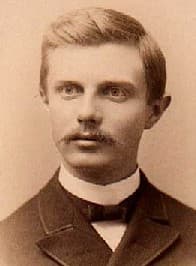
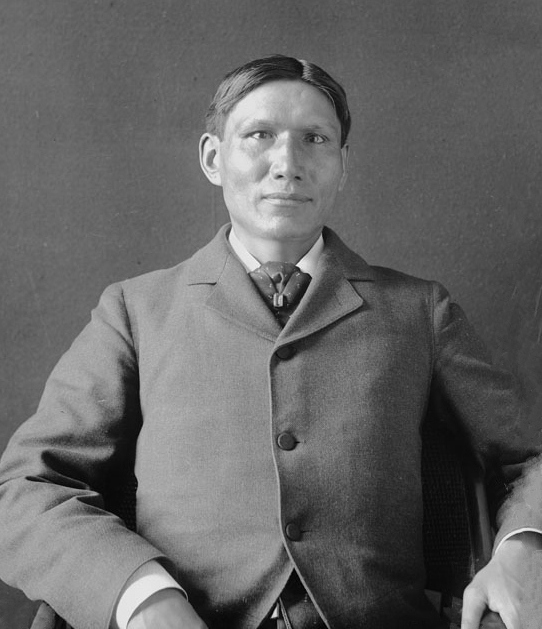
Frederick Jackson Turner
Frederick Jackson Turner was a prominent American historian whose work significantly shaped the field of American history in the early 20th century. He spent much of his career at the University of Wisconsin-Madison before moving to Harvard University in 1910. Turner is best known for his influential frontier thesis, articulated in his seminal essay "The Significance of the Frontier in American History." In this work, he posited that the American frontier played a crucial role in shaping the nation's democracy and character, arguing that the experience of westward expansion fostered individualism and democratic ideals from the colonial period until 1890. His theories also encompassed geographical sectionalism, further contributing to the understanding of regional influences on American development. Turner's ideas sparked considerable debate among historians and have left a lasting legacy in historical scholarship. His emphasis on the frontier's impact on American identity has influenced generations of historians, and his promotion of interdisciplinary and quantitative methods has encouraged a more rigorous approach to historical research. Despite ongoing discussions about the validity and implications of his thesis, Turner's work remains a foundational element in the study of American history, highlighting the complex interplay between geography, culture, and national identity.
Famous Quotes
View all 3 quotes“That coarseness and strength combined with acuteness and inquisitiveness; that practical, inventive turn of mind, quick to find expedients; that masterful grasp of material things, lacking in the artistic but powerful to effect great ends; that restless, nervous energy; that dominant individualism, working for good and evil, and withal that buoyancy and exuberance which comes with freedom - these are the traits of the frontier.”
“Those who insist that history is simply the effort to tell the thing exactly as it was, to state the facts, are confronted with the difficulty that the fact which they would represent is not planted on the solid ground of fixed conditions; it is in the midst and is itself a part of the changing currents, the complex and interacting influences of the time, deriving its significance as a fact from its relations to the deeper-seated movements of the age, movements so gradual that often only the passing years can reveal the truth about the fact and its right to a place on the historian’s page.”
“In short, at the frontier the environment is at first too strong for the man.”
Books from the author




Link to this page
Add a free, dofollow link to Lex on your blog, forum, syllabus, or reading list.

<a href="https://lex-books.com/author/frederick-jackson-turner"><img src="https://lex-books.com/badges/read-on-lex.svg" alt="Frederick Jackson Turner on Lex" width="160" height="40"></a>[](https://lex-books.com/author/frederick-jackson-turner)[url=https://lex-books.com/author/frederick-jackson-turner][img]https://lex-books.com/badges/read-on-lex.svg[/img][/url]Frederick Jackson Turner on Lex: https://lex-books.com/author/frederick-jackson-turner