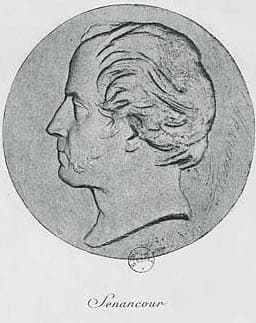
Etienne Pivert de Senancour
Étienne Pivert de Senancour was a French essayist and philosopher, best known for his influential epistolary novel, Obermann. Born in Paris, he was deeply engaged with the philosophical currents of his time, particularly Romanticism, which shaped his exploration of individual consciousness and emotional depth. Obermann, published in 1804, stands out for its introspective narrative and profound examination of the human condition, reflecting the struggles of its protagonist against societal norms and personal despair. This work is often regarded as a precursor to later existentialist literature, showcasing Senancour's ability to articulate the complexities of human emotion and isolation. Senancour's literary contributions extended beyond Obermann, as he also wrote essays that delved into themes of nature, society, and the individual's place within it. His philosophical inquiries and literary style influenced subsequent generations of writers and thinkers, positioning him as a significant figure in the evolution of French literature. Although not as widely recognized today, his work laid important groundwork for the exploration of psychological and existential themes in literature, marking him as a notable precursor to the Romantic and existential movements that followed.
Famous Quotes
View all 1 quotes“Even here, it is only the evening that I love. The dawn gladdens me for a moment; I fancy I could fell the charm of it if the day that is to follow were not bound to be so long! I certainly have a free domain to wander in, but it is not wild and impressive enough. its features are tame, its rocks small and uninteresting, the vegetation as a rule lacks the luxuriance and profusion I like to see; one never catches here the murmur of a torrent far down in the depths; it is a land of plains. Nothing burdens me here; nothing satisfies me. I fancy, if anything, my boredom increases; simply because I have not enough to suffer. I am happier then, you think? Not a bit of it; to suffer and to be unhappy are not at all the same thing, no more than enjoyment is identical with happiness. I am delightfully circumstanced, and yet I live a melancholy life. I could not be better off than I am here: free, undistracted, well in health, unyoked from business, unconcerned about a future from which I expect nothing, and leaving behind without regret a past I have not enjoyed. But here is within me a persistent unrest, a yearning I cannot define, imperative and absorbing, which takes me out of the sphere of perishable creatures... No, it is not the yearning to love; you are mistaken there, as I once was mistaken myself. The interval is wide enough between the emptiness of my heart and the love it has so eagerly desired, but the distance between what I am and what I want to be is infinite. I do not want to enjoy possession; I want hope, I should like to know. I need limitless illusions, receding before me to keep me always under their spell. What use to me is anything that can end? The hour which will arrive in sixty years' time is already close at hand. I have no liking for anything that takes its rise, draws near, arrives and is no more. I want a good, a dream, in fact a hope that is ever in advance, ever beyond me, greater than my expectation itself, greater than the things which pass away. I would like to be pure intelligence, I would like the eternal order of the world... And yet, thirty years ago, that order was, and I had no existence. worthless and accidental creature of a day, I used not to exist, and soon I shall exist no more. I discover with surprise that my thought is greater than my being, and when I consider that my life is absurd in my own eyes, I lose my way in hopeless darkness. Truly, happier is he who fells trees and burns charcoal, and flies to holy water when the thunder peals. He lives like the brute. Nay; for he sings at his work. I shall never know his peace, and yet I shall pass like him. His life will glide along with time, but mine is led astray and hurried on by excitement and unrest, and by the phantoms of an unknown greatness.”
Books from the author


Link to this page
Add a free, dofollow link to Lex on your blog, forum, syllabus, or reading list.

<a href="https://lex-books.com/author/etienne-pivert-de-senancour"><img src="https://lex-books.com/badges/read-on-lex.svg" alt="Etienne Pivert de Senancour on Lex" width="160" height="40"></a>[](https://lex-books.com/author/etienne-pivert-de-senancour)[url=https://lex-books.com/author/etienne-pivert-de-senancour][img]https://lex-books.com/badges/read-on-lex.svg[/img][/url]Etienne Pivert de Senancour on Lex: https://lex-books.com/author/etienne-pivert-de-senancour