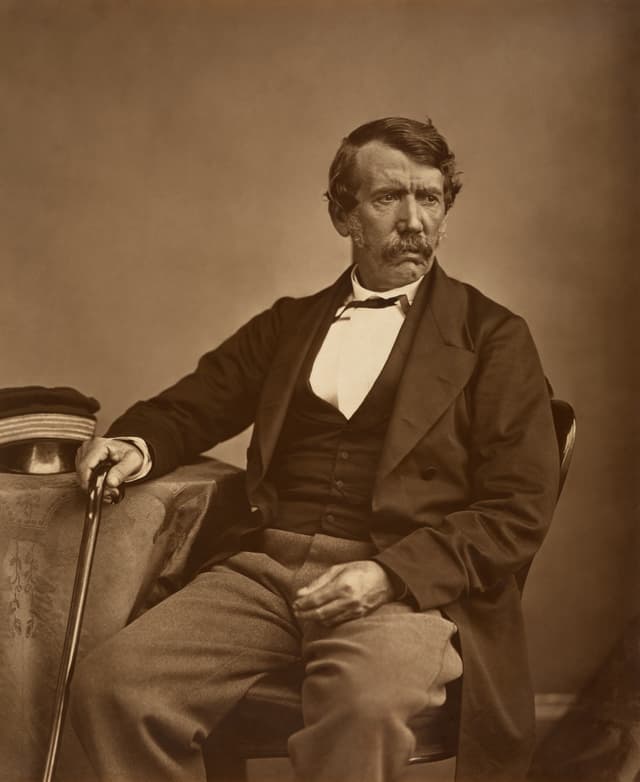
David Livingstone
David Livingstone was a Scottish doctor and Congregationalist missionary who gained fame as an explorer in Africa during the 19th century. Married to Mary Moffat, he was deeply influenced by her family's missionary legacy. Livingstone's work was marked by a fervent commitment to ending the East African slave trade, which he believed could be achieved through his explorations, particularly in search of the sources of the Nile. His belief that uncovering these sources would grant him the influence necessary to combat slavery underscored his dual role as both a scientific investigator and an anti-slavery crusader. Livingstone's expeditions into the heart of Africa represented a significant chapter in the era of European geographical discovery and colonial expansion. His travels and eventual disappearance in Africa captivated the public imagination, leading to his posthumous glorification as a national hero in Britain. His legacy includes the establishment of several major Christian missionary initiatives in central Africa, which continued during the period of the European 'Scramble for Africa.' Livingstone's life and work not only highlighted the complexities of imperialism but also set the stage for future humanitarian efforts on the continent, cementing his status as a pivotal figure in both exploration and missionary work.
Famous Quotes
View all 3 quotes“God, send me anywhere, only go with me. Lay any burden on me, only sustain me. And sever any tie in my heart except the tie that binds my heart to Yours.”
“If you have men who will only come if they know there is a good road, I don't want them. I want men who will come if there is no road at all.”
“I will go anywhere, provided it be forward.”
Books from the author



Link to this page
Add a free, dofollow link to Lex on your blog, forum, syllabus, or reading list.

<a href="https://lex-books.com/author/david-livingstone"><img src="https://lex-books.com/badges/read-on-lex.svg" alt="David Livingstone on Lex" width="160" height="40"></a>[](https://lex-books.com/author/david-livingstone)[url=https://lex-books.com/author/david-livingstone][img]https://lex-books.com/badges/read-on-lex.svg[/img][/url]David Livingstone on Lex: https://lex-books.com/author/david-livingstone