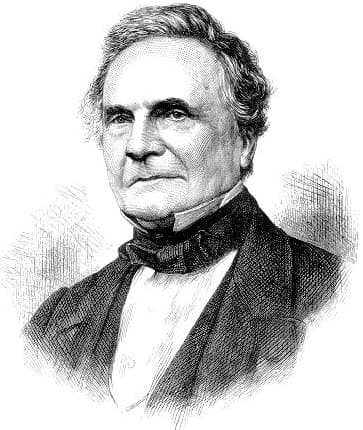
Charles Babbage
Charles Babbage was an English polymath whose groundbreaking ideas laid the foundation for modern computing. Renowned as the 'father of the computer,' he conceptualized the first mechanical computer, the Difference Engine, which aimed to automate mathematical calculations. His most ambitious project, the Analytical Engine, introduced the principles of programmability and is considered a precursor to contemporary computers. Babbage's innovative designs included the first computer printers, showcasing his forward-thinking approach to technology. Beyond his contributions to computing, Babbage was a prolific thinker with diverse interests, as reflected in his 1832 work, 'Economy of Manufactures and Machinery.' He played a significant role in London's intellectual community, famously introducing the 'scientific soirée' to foster discussions among scientists and mathematicians. Although many of his inventions were never completed during his lifetime, Babbage's visionary concepts and designs have had a lasting impact on the field of computing, with a functioning Difference Engine constructed in 1991 from his original plans, demonstrating the feasibility of his ideas and solidifying his legacy in the history of technology.
Famous Quotes
View all 3 quotes“On two occasions, I have been asked [by members of Parliament], 'Pray, Mr. Babbage, if you put into the machine wrong figures, will the right answers come out?' I am not able to rightly apprehend the kind of confusion of ideas that could provoke such a question.”
“Whenever a man can get hold of numbers, they are invaluable: if correct, they assist in informing his own mind, but they are still more useful in deluding the minds of others. Numbers are the masters of the weak, but the slaves of the strong.”
“I find no flaw in your reasoning about the Analytical Engine; I admire it; but you are aware that it rests entirely on the hypothesis that I care for the 'whole human race.”
Books from the author







Link to this page
Add a free, dofollow link to Lex on your blog, forum, syllabus, or reading list.

<a href="https://lex-books.com/author/charles-babbage"><img src="https://lex-books.com/badges/read-on-lex.svg" alt="Charles Babbage on Lex" width="160" height="40"></a>[](https://lex-books.com/author/charles-babbage)[url=https://lex-books.com/author/charles-babbage][img]https://lex-books.com/badges/read-on-lex.svg[/img][/url]Charles Babbage on Lex: https://lex-books.com/author/charles-babbage