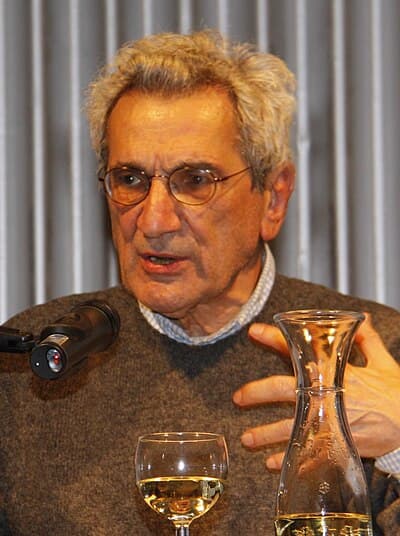
Antonio Negri
Antonio Negri was an influential Italian political philosopher, renowned for his contributions to autonomism and his collaborative work with Michael Hardt on the seminal text 'Empire.' Born in Padua, he became a professor of political philosophy at the University of Padua, where he focused on state and constitutional theory. In the late 1960s, Negri was a key figure in the Potere Operaio (Worker Power) movement and later the Autonomia Operaia, advocating for workers' rights and social change. His writings, including 'Multitude: War and Democracy in the Age of Empire,' explored the intersections of democracy, globalization, and collective action, positioning him as a critical voice in contemporary political thought. Negri's career was marked by controversy, particularly following his indictment in the late 1970s for alleged connections to the Red Brigades, a left-wing militant group involved in political violence in Italy. Although he denied these charges, he fled to France to avoid prosecution and continued his academic work, teaching alongside prominent philosophers like Jacques Derrida and Michel Foucault. After serving a reduced prison sentence upon his return to Italy, Negri continued to write and engage in political discourse, leaving a lasting impact on leftist thought and activism. His legacy endures through his exploration of the dynamics of power, resistance, and the role of the multitude in shaping political landscapes.
Famous Quotes
View all 3 quotes“Throughout the world what remains of the vast public spaces are now only the stuff of legends: Robin Hood’s forest, the Great Plains of the Amerindians, the steppes of the nomadic tribes, and so forth… Rousseau said that the first person who wanted a piece of nature as his or her own exclusive possession and transformed it into the transcendent form of private property was the one who invented evil. Good, on the contrary, is what is common.”
“Why do you accept being treated like an inmate?”
“This book is like a supreme car which can drive the world to a new horizon. N.DAS Humans declared themselves masters of their own lives,producers of cities and history,and inventor of heaven.Antonio Negri[EMPIRE]”
Books from the author



Link to this page
Add a free, dofollow link to Lex on your blog, forum, syllabus, or reading list.

<a href="https://lex-books.com/author/antonio-negri"><img src="https://lex-books.com/badges/read-on-lex.svg" alt="Antonio Negri on Lex" width="160" height="40"></a>[](https://lex-books.com/author/antonio-negri)[url=https://lex-books.com/author/antonio-negri][img]https://lex-books.com/badges/read-on-lex.svg[/img][/url]Antonio Negri on Lex: https://lex-books.com/author/antonio-negri