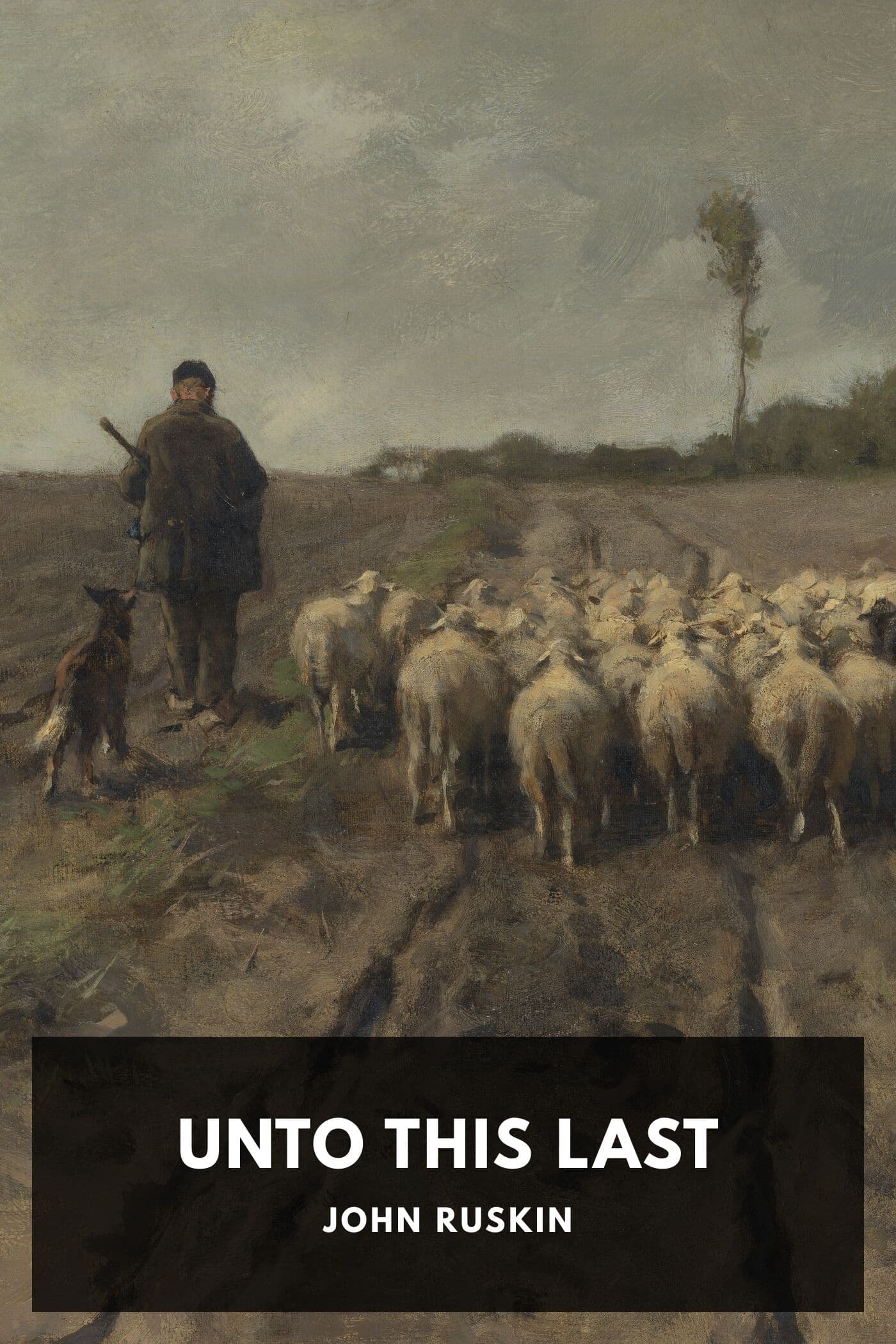
Unto This Last, and Other Essays on Political Economy
1860
In 1860, a Victorian art critic dared to tell industrial Britain that its economy was morally bankrupt. The result was four incendiary essays that would reshape how we think about wealth, labor, and the good society. John Ruskin argued that economics stripped of ethics is not science but cruelty, that a nation's true prosperity cannot be measured in factories alone. He proposed something radical: that the production of essential goods must harmonize with the cultivation of beauty, and that the dignity of labor matters as much as its output. These ideas were dismissed by orthodox economists then, but they found fertile ground in the ideas of Gandhi, who called Unto This Last his compass, and in the Arts and Crafts movement that reshaped design. A century and a half later, with inequality once again fracturing societies, Ruskin's insistence that economy cannot be separated from art, from community, from moral purpose feels less like Victorian nostalgia than urgent warning.
Editions
X-Ray
“There is no wealth but life. Life, including all its powers of love, of joy, and of admiration. That country is the richest which nourishes the greatest numbers of noble and happy human beings; that man is richest, who, having perfected the functions of his own life to the utmost, has also the widest helpful influence, both personal, and by means of his possessions, over the lives of others.””
— John Ruskin
“Lately in a wreck of a Californian ship, one of the passengers fastened a belt about him with two hundred pounds of gold in it, with which he was found afterwards at the bottom. Now, as he was sinking- had he the gold? or the gold him?””
— John Ruskin
“For, truly, the man who does not know when to die, does not know how to live.””
— John Ruskin
“The persons who become rich are, generally speaking, industrious, resolute, proud, covetous, prompt, methodical, sensible, unimaginative, insensitive, and ignorant. The persons who remain poor are the entirely foolish, the entirely wise, the idle, the reckless, the humble, the thoughtful, the dull, the imaginative, the sensitive, the well-informed, the improvident, the irregularly and impulsively wicked, the clumsy knave, the open thief, and the entirely merciful just and godly person.””
— John Ruskin
“As the art of life is learned, it will be found at last that all lovely things are also necessary: - the wild flower by the wayside, as well as the tended corn; and the wild birds and creatures of the forest, as well as the tended cattle; because man doth not live by bread only, but also by the desert manna; by every wondrous word and unknowable work of God””
— John Ruskin
“In all buying, consider, first, what condition of existence you cause in the producers of what you buy; secondly, whether the sum you have paid is just to the producer, and in due proportion, lodged in his hands; thirdly, to how much clear use, for food, knowledge, or joy, this that you have bought can be put; and fourthly, to whom and in what way it can be most speedily and serviceably distributed: in all dealings whatsoever insisting on entire openness and stern fulfillment; and in all doings, on perfection and loveliness of accomplishment; especially on fineness and purity of all marketable commodity: watching at the same time for all ways of gaining, or teaching, powers of simple pleasure, and of showing”
— John Ruskin
“What one person has, another cannot have; and that every atom of substance, of whatever kind, used or consumed, is so much human life spent, which, if it issue in the saving present life, or gaining more, is well spent, but if not, is either so much life prevented or so much slain.””
— John Ruskin
“It being the privilege of the fishes, as it is of rats and wolves, to live by the laws of demand and supply; but the distinction of humanity, to live by those of right.””
— John Ruskin
“So far, therefore, as the science of exchange relates to the advantage of one of the exchanging persons only, it is founded on the ignorance or incapacity of the opposite person. . . . It is therefore a science founded on nescience. . . . This science, alone of sciences, must, by all available means, promulgate and prolong its opposite nescience. . . . It is therefore peculiarly and alone science of darkness.””
— John Ruskin
Link to this book
Add a free, dofollow link to Lex on your blog, forum, syllabus, or reading list.

<a href="https://lex-books.com/book/unto-this-last-and-other-essays-on-political-economy-631e20a1-9b73-4d36-a36f-d44780502f6d"><img src="https://lex-books.com/badges/read-on-lex.svg" alt="Read Unto This Last, and Other Essays on Political Economy by John Ruskin free on Lex" width="160" height="40"></a>[](https://lex-books.com/book/unto-this-last-and-other-essays-on-political-economy-631e20a1-9b73-4d36-a36f-d44780502f6d)[url=https://lex-books.com/book/unto-this-last-and-other-essays-on-political-economy-631e20a1-9b73-4d36-a36f-d44780502f6d][img]https://lex-books.com/badges/read-on-lex.svg[/img][/url]Read Unto This Last, and Other Essays on Political Economy by John Ruskin free on Lex: https://lex-books.com/book/unto-this-last-and-other-essays-on-political-economy-631e20a1-9b73-4d36-a36f-d44780502f6dCite this book
Reading this edition for a paper or guide? Copy a citation.
Ruskin, John. Unto This Last, and Other Essays on Political Economy. Lex, lex-books.com/book/unto-this-last-and-other-essays-on-political-economy-631e20a1-9b73-4d36-a36f-d44780502f6d.Ruskin, J. (1860). Unto This Last, and Other Essays on Political Economy. Lex. https://lex-books.com/book/unto-this-last-and-other-essays-on-political-economy-631e20a1-9b73-4d36-a36f-d44780502f6dRuskin, John. Unto This Last, and Other Essays on Political Economy. Lex. https://lex-books.com/book/unto-this-last-and-other-essays-on-political-economy-631e20a1-9b73-4d36-a36f-d44780502f6d.