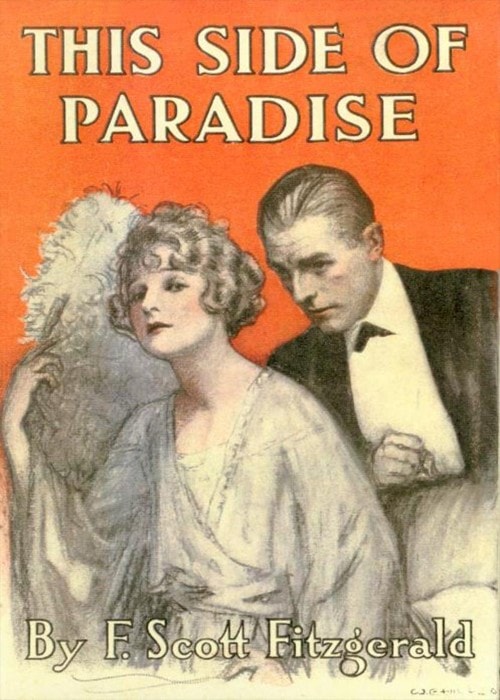
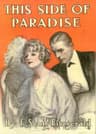
This Side of Paradise
1920
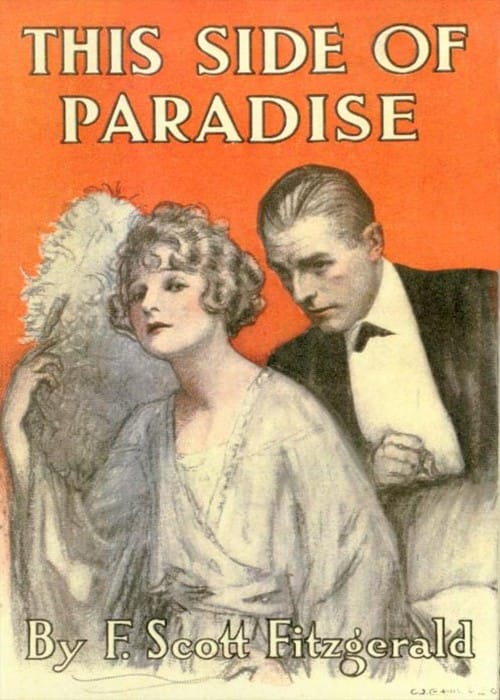
Fitzgerald wrote this novel at twenty-three, and you can feel that youthful hunger on every page. It's a book about wanting everything - love, fame, meaning - and discovering the world might not have enough to go around. Amory Blaine is handsome, privileged, desperately earnest, a young man who believes his own greatness is simply a matter of time. We follow him through Princeton's ivy-covered halls and the glittering parties of the Jazz Age, watching him pursue romance after romance, each one leaving him emptier than the last. The novel captures something specific and painful about early twentieth-century America: that feverish, post-war moment when everything seemed possible and nothing quite delivered. Fitzgerald's prose has the energy of someone who hasn't yet learned to be cynical, which makes the novel's undercurrent of disillusionment hit harder. This is the book that made Fitzgerald famous overnight, that defined an era, and that still speaks to anyone who has felt the burn of ambition or the ache of love that money cannot buy.
Editions

X-Ray
“I don't want to repeat my innocence. I want the pleasure of losing it again.””
— F. Scott Fitzgerald
“I'm not sentimental--I'm as romantic as you are. The idea, you know,is that the sentimental person thinks things will last--the romanticperson has a desperate confidence that they won't.””
— F. Scott Fitzgerald
“They slipped briskly into an intimacy from which they never recovered.””
— F. Scott Fitzgerald
“You'll find another.' God! Banish the thought. Why don't you tell me that 'if the girl had been worth having she'd have waited for you'? No, sir, the girl really worth having won't wait for anybody.””
— F. Scott Fitzgerald
“It was always the becoming he dreamed of, never the being.””
— F. Scott Fitzgerald
“I'm a slave to my emotions, to my likes, to my hatred of boredom, to most of my desires.””
— F. Scott Fitzgerald
“There is a moment”
— F. Scott Fitzgerald
“I'm a cynical idealist.””
— F. Scott Fitzgerald
“Don't let yourself feel worthless: often through life you will really be at your worst when you seem to think best of yourself; and don't worry about losing your "personality," as you persist in calling it: at fifteen you had the radiance of early morning, at twenty you will begin to have the melancholy brilliance of the moon, and when you are my age you will give out, as I do, the genial golden warmth of 4 p.m.””
— F. Scott Fitzgerald
Link to this book
Add a free, dofollow link to Lex on your blog, forum, syllabus, or reading list.

<a href="https://lex-books.com/book/this-side-of-paradise-4be1c4c2-c3d2-4cf6-9119-0efcf31838f5"><img src="https://lex-books.com/badges/read-on-lex.svg" alt="Read This Side of Paradise by F. Scott Fitzgerald free on Lex" width="160" height="40"></a>[](https://lex-books.com/book/this-side-of-paradise-4be1c4c2-c3d2-4cf6-9119-0efcf31838f5)[url=https://lex-books.com/book/this-side-of-paradise-4be1c4c2-c3d2-4cf6-9119-0efcf31838f5][img]https://lex-books.com/badges/read-on-lex.svg[/img][/url]Read This Side of Paradise by F. Scott Fitzgerald free on Lex: https://lex-books.com/book/this-side-of-paradise-4be1c4c2-c3d2-4cf6-9119-0efcf31838f5Cite this book
Reading this edition for a paper or guide? Copy a citation.
Fitzgerald, F. Scott. This Side of Paradise. Lex, lex-books.com/book/this-side-of-paradise-4be1c4c2-c3d2-4cf6-9119-0efcf31838f5.Fitzgerald, F. S. (1920). This Side of Paradise. Lex. https://lex-books.com/book/this-side-of-paradise-4be1c4c2-c3d2-4cf6-9119-0efcf31838f5Fitzgerald, F. Scott. This Side of Paradise. Lex. https://lex-books.com/book/this-side-of-paradise-4be1c4c2-c3d2-4cf6-9119-0efcf31838f5.