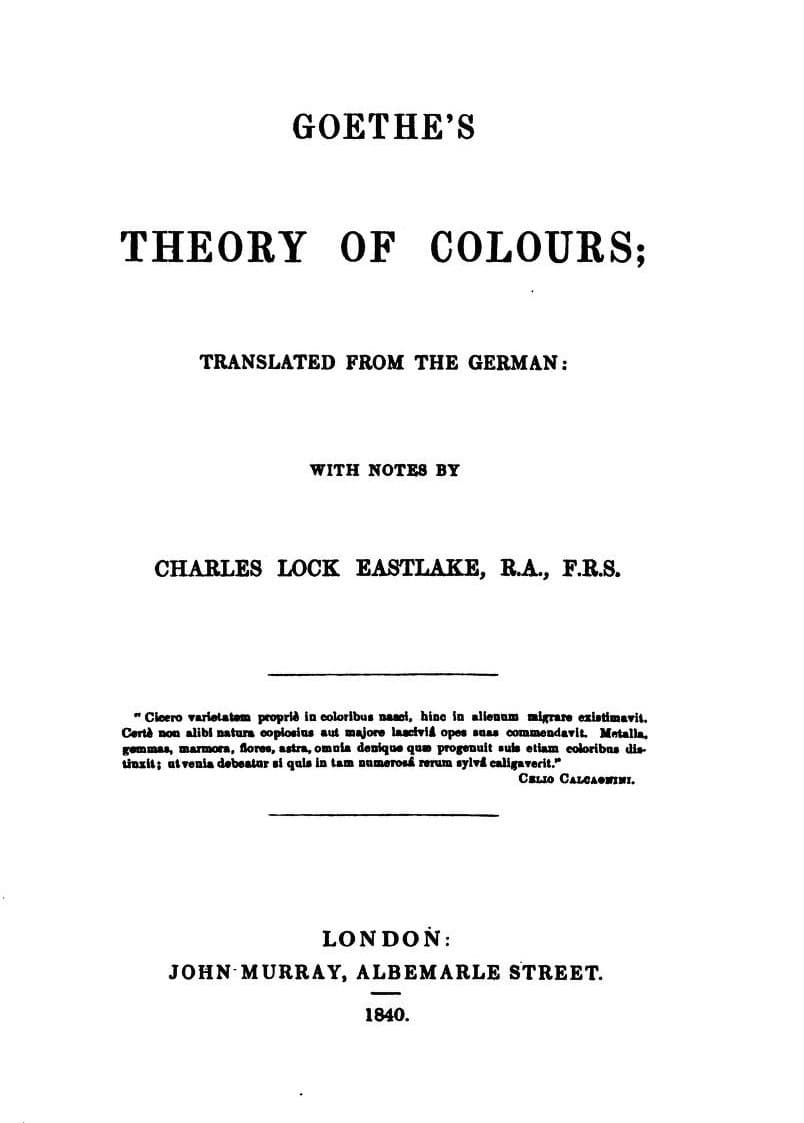
Theory of Colours
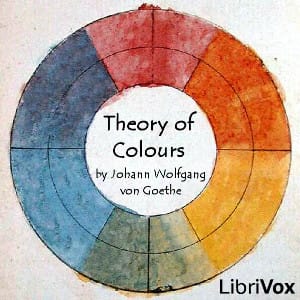
In 1810, the greatest poet of the German language mounted an audacious assault on the greatest physicist in English history. Goethe's Theory of Colours was written as a direct challenge to Newton, arguing that the great man's mathematical decomposition of light into wavelengths missed something essential: color as humans actually experience it. For Goethe, color was not a mere physical phenomenon to be measured but a living, subjective event that unfolds in the encounter between light and the human eye. He conducted hundreds of experiments, observing how colors transform at their edges where light meets dark, documenting the strange afterimages that bloom when the eye adjusts, cataloguing the emotional and physiological effects of different hues. He built a color wheel arranged not by wavelength but by psychological and aesthetic relationship, a tool still used by artists today. Physicists dismissed his work as unscientific, the rambling fantasy of a dilettante. They were wrong about his method but right that he was up to something different: a phenomenology of perception avant la lettre, a challenge to the idea that science captures reality rather than one highly selective version of it. This is a book for anyone curious about how we see, or who suspects there might be more to color than wavelengths.
Editions

Read by
Group Narration
18 readers
Lynne T, Nathan Rosquist, Dylan Campbell, Deborah Balm +14 more
Link to this book
Add a free, dofollow link to Lex on your blog, forum, syllabus, or reading list.

<a href="https://lex-books.com/book/theory-of-colours-27b9ab46-4010-4938-8dfd-d489b94aafb3"><img src="https://lex-books.com/badges/read-on-lex.svg" alt="Read Theory of Colours by Johann Wolfgang von Goethe free on Lex" width="160" height="40"></a>[](https://lex-books.com/book/theory-of-colours-27b9ab46-4010-4938-8dfd-d489b94aafb3)[url=https://lex-books.com/book/theory-of-colours-27b9ab46-4010-4938-8dfd-d489b94aafb3][img]https://lex-books.com/badges/read-on-lex.svg[/img][/url]Read Theory of Colours by Johann Wolfgang von Goethe free on Lex: https://lex-books.com/book/theory-of-colours-27b9ab46-4010-4938-8dfd-d489b94aafb3Cite this book
Reading this edition for a paper or guide? Copy a citation.
Goethe, Johann Wolfgang von. Theory of Colours. Lex, lex-books.com/book/theory-of-colours-27b9ab46-4010-4938-8dfd-d489b94aafb3.Goethe, J. W. V. (n.d.). Theory of Colours. Lex. https://lex-books.com/book/theory-of-colours-27b9ab46-4010-4938-8dfd-d489b94aafb3Goethe, Johann Wolfgang von. Theory of Colours. Lex. https://lex-books.com/book/theory-of-colours-27b9ab46-4010-4938-8dfd-d489b94aafb3.
![Faust [part 1]. Translated into English in the Original Metres](/_next/image?url=https%3A%2F%2Fd3b2n8gj62qnwr.cloudfront.net%2FCOVERS%2Fgutenberg_covers75k%2Febook-14591.png&w=3840&q=75)