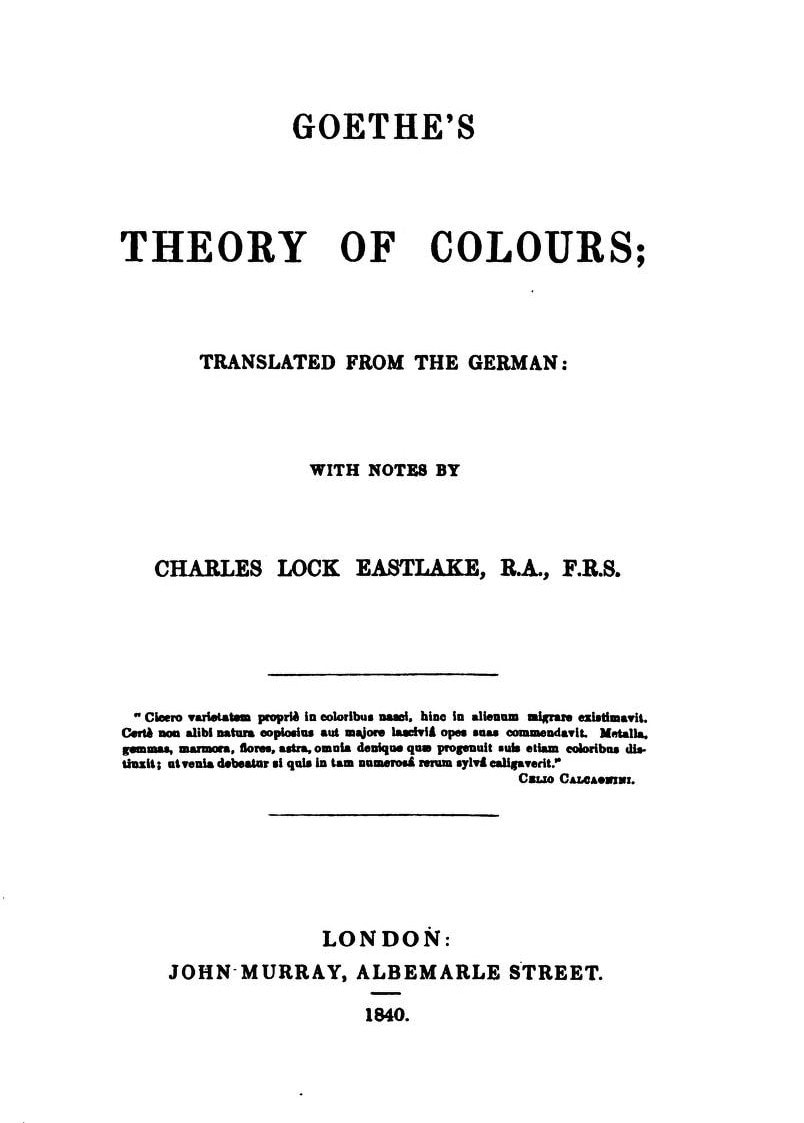
Goethe's Theory of Colours
1810
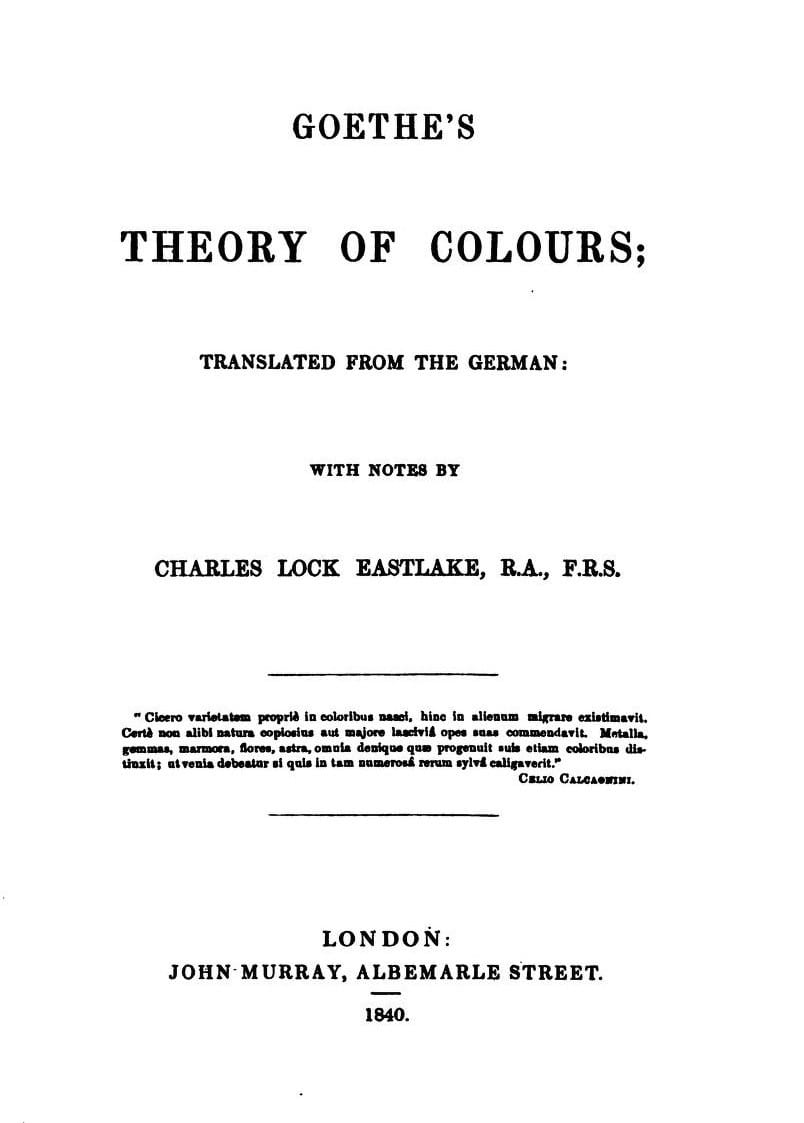
Goethe's Theory of Colours
1810
Translated by Charles Lock, Sir Eastlake
This is not a failed science book. It is something more interesting: a radical reimagining of what color means and how we know it. Written in 1810 as a direct challenge to Newton's optical theories, Goethe insisted that the wavelength approach mistook an incidental result for an elemental principle. What follows is a meticulous phenomenology of color as Goethe experienced it: the afterimages that bloom when you look away from a bright surface, the physiological effects of complementary hues, the emotional qualities that colors exert on the human eye. He organizes his inquiry into three realms: physiological colors (those produced by the eye itself), physical colors (those created by light and prisms), and chemical colors (those found in pigments and dyes). Yet this is fundamentally a work of philosophy rather than physics, an argument that objective measurement misses something essential about how color actually presents itself to a conscious observer. The scientific conclusions may be outdated, but the book endures for its extraordinary prose, its insights into early nineteenth-century thought, and its value as a practical guide to seeing color with fresh eyes unburdened by modern theory. Artists, designers, and anyone curious about alternative ways of knowing will find this both illuminating and strange.
Editions
X-Ray
“The highest goal that man can achieve is amazement.””
— Johann Wolfgang von Goethe
“Blue: as yellow is always accompanied with light, so it may be said that blue still brings a principle of darkness with it. This color has a peculiar and almost indescribable effect on the eye. As a hue it is powerful - but it is on the negative side, and in its highest purity is, as it were, a stimulating negation. Its appearance, then, is a kind of contradiction between excitement and repose.””
— Johann Wolfgang von Goethe
“Blue gives us an impression of cold, and thus, again, reminds us of shade. We have before spoken of its affinity with black.””
— Johann Wolfgang von Goethe
“Light and darkness, brightness and obscurity, or if a more general expression is preferred, light and its absence, are necessary to the production of color… Color itself is a degree of darkness.””
— Johann Wolfgang von Goethe
“Tot așa cum galbenul este intotdeauna asociat cu lumina, se poate spune și că albastrul aduce cu el și un principiu al întunericului. Această culoare are un efect special și aproape indescriptibil asupra ochiului. Pe scara culorilor este una puternică, însă de partea negativă, și la maximum de puritate este, cum s-ar zice, o negație stimulatoare. Aspectul său este deci un fel de contradicție între excitație și calm.””
— Johann Wolfgang von Goethe
“BlauEs ist die Farbe des Dunklen. Es ist als Farbe eine Energie und in der höchsten Reinheit ein reizendes Nichts. Es scheint zurückzuweichen (die fernen Berge sieht man blau) und zieht einen aber nach. Es ist angenehm anzusehen, es gibt ein Gefühl von Kälte und erinnert an einen Schatten. Blaue Zimmer wirken zwar weit, aber kalt und leer. Blaues Licht stimmt traurig. Wird blau von der Plusseite berührt ist dies angenehm.””
— Johann Wolfgang von Goethe
Link to this book
Add a free, dofollow link to Lex on your blog, forum, syllabus, or reading list.

<a href="https://lex-books.com/book/goethe-s-theory-of-colours-7926f60d-4038-4e4b-9c4f-3b017305931c"><img src="https://lex-books.com/badges/read-on-lex.svg" alt="Read Goethe's Theory of Colours by Johann Wolfgang von Goethe free on Lex" width="160" height="40"></a>[](https://lex-books.com/book/goethe-s-theory-of-colours-7926f60d-4038-4e4b-9c4f-3b017305931c)[url=https://lex-books.com/book/goethe-s-theory-of-colours-7926f60d-4038-4e4b-9c4f-3b017305931c][img]https://lex-books.com/badges/read-on-lex.svg[/img][/url]Read Goethe's Theory of Colours by Johann Wolfgang von Goethe free on Lex: https://lex-books.com/book/goethe-s-theory-of-colours-7926f60d-4038-4e4b-9c4f-3b017305931cCite this book
Reading this edition for a paper or guide? Copy a citation.
Goethe, Johann Wolfgang von. Goethe's Theory of Colours. Lex, lex-books.com/book/goethe-s-theory-of-colours-7926f60d-4038-4e4b-9c4f-3b017305931c.Goethe, J. W. V. (1810). Goethe's Theory of Colours. Lex. https://lex-books.com/book/goethe-s-theory-of-colours-7926f60d-4038-4e4b-9c4f-3b017305931cGoethe, Johann Wolfgang von. Goethe's Theory of Colours. Lex. https://lex-books.com/book/goethe-s-theory-of-colours-7926f60d-4038-4e4b-9c4f-3b017305931c.
![Faust [part 1]. Translated into English in the Original Metres](/_next/image?url=https%3A%2F%2Fd3b2n8gj62qnwr.cloudfront.net%2FCOVERS%2Fgutenberg_covers75k%2Febook-14591.png&w=3840&q=75)