The Terror: A Mystery
1917
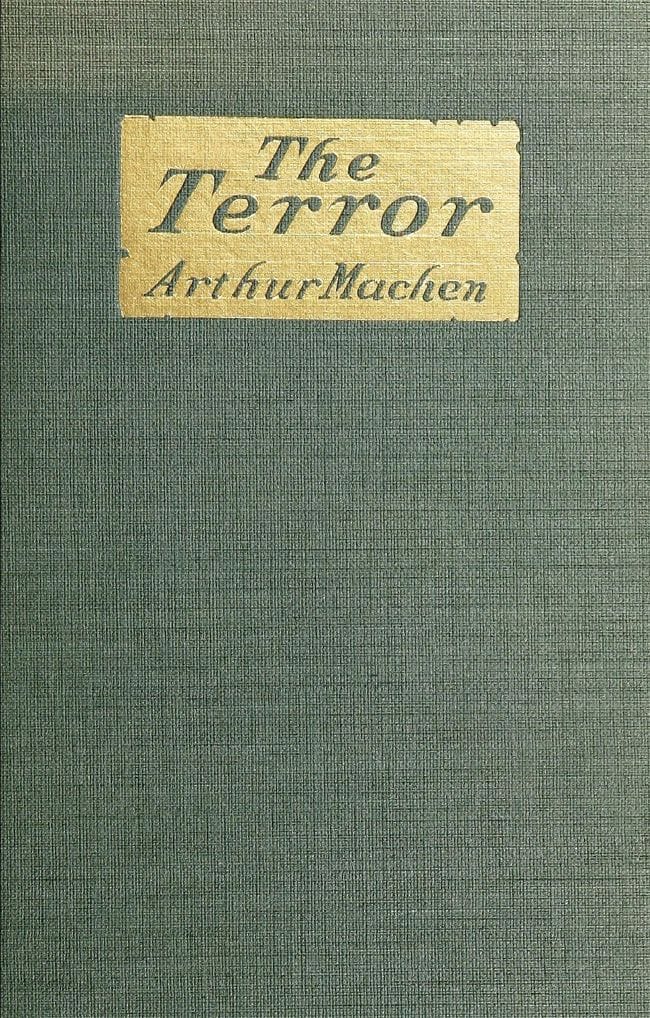
Written in 1917 as the Great War carnage unfolded, Arthur Machen's slim, shattering novel asks what happens when ancient dread awakens in a modern world convinced it has conquered superstition. The story unfolds in the rural Welsh district of Meirion, where a string of inexplicable disappearances and violent deaths begins to terrorize a close-knit community. As the protagonist investigates these events particularly those tied to a lost child he discovers that the horror cannot be explained by rational means. Something old and patient has emerged from the shadows, feeding on the fear cultivated by war and the erosion of certainty that industrial slaughter has inflicted on the human spirit. Machen, a master of supernatural dread, crafts an atmosphere of mounting paranoia where every rustle in the dark promises annihilation. The novel operates on two levels: a gripping mystery of rural terror and a profound meditation on how war strips away civilization's thin veneer, revealing something far older and more malignant underneath. It remains a chilling meditation on what humanity loses when it mistakes progress for safety.
Editions
X-Ray
“Poor sleepers should endeavor to compose themselves. Tampering with empty space, stirring up echoes in pitch-black pits of darkness is scarcely sedative.("Out Of The Deep")””
— Arthur Machen
“On the hearth, in front of a back-brand to give substance, blazed a fire of thorns, that crackled 'like the laughter of the fool.'Nineteen persons were gathered here. Of these, five women, wearing gowns of various bright hues, sat in chairs along the wall; girls shy and not shy filled the window-bench; four men, including Charley Jake the hedge-carpenter, Elijah New the parish-clerk, and John Pitcher, a neighboring dairyman, the shepherd's father-in-law, lolled in the settle; a young man and maid, who were blushing over tentative pourparlers on a life companionship, sat beneath the corner-cupboard; and an elderly engaged man of fifty or upward moved restlessly about from spots where his betrothed was not to the spot where she was. Enjoyment was pretty general, and so much the more prevailed in being unhampered by conventional restrictions. Absolute confidence in each other's good opinion begat perfect ease, while the finishing stroke of manner, amounting to a truly princely serenity, was lent to the majority by the absence of any expression or trait denoting that they wished to get on in the world, enlarge their minds, or do any eclipsing thing whatever - which nowadays so generally nips the bloom and bonhomie of all except the two extremes of the social scale.("The Three Strangers")””
— Arthur Machen
“There was still an hour or two of daylight - even though clouds admitted only a greyish light upon the world, and his Uncle Timothy's house was by nature friendly to gloom.("Out Of The Deep")””
— Arthur Machen
“When there hasn't been anything there, nothing can be said to have vanished from the place where it has not been.("Out Of The Deep")””
— Arthur Machen
“Pausing on the threshold, he looked in, conscious not so much of the few familiar sticks of furniture - the trucklebed, the worn strip of Brussels carpet, the chipped blue-banded ewer and basin, the framed illuminated texts on the walls - as of a perfect hive of abhorrent memories.That high cupboard in the corner, from which certain bodiless shapes had been wont to issue and stoop at him cowering out of his dreams; the crab-patterned paper that came alive as you stared; the window cold with menacing stars; the mouseholes, the rusty grate - trumpet of every wind that blows - these objects at once lustily shouted at him in their own original tongues.("Out Of The Deep")””
— Arthur Machen
“Thinking is like a fountain. Once it gets going at a certain pressure, well, it almost impossible to turn it off. And, my hat! what odd things come up with the water!("Out Of The Deep")””
— Arthur Machen
“Just why it should have happened, or why it should have happened just when it did, he could not, of course, possibly have said; nor perhaps could it even have occurred to him to ask. The thing was above all a secret, something to be preciously concealed from Mother and Father; and to that very fact it owed an enormous part of its deliciousness. It was like a peculiarly beautiful trinket to be carried unmentioned in one's trouser-pocket - a rare stamp, an old coin, a few tiny gold links found trodden out of shape on the path in the park, a pebble of carnelian, a sea shell distinguishable from all others by an unusual spot or stripe-and, as if it were anyone of these, he carried around with him everywhere a warm and persistent and increasingly beautiful sense of possession. Nor was it only a sense of possession - it was also a sense of protection. It was as if, in some delightful way, his secret gave him a fortress, a wall behind which he could retreat into heavenly seclusion.("Silent Snow, Secret Snow")””
— Arthur Machen
“When indeed you positively press your face, so to speak, against the crystalline window of your eyes, your mind is apt to become a perfect vacuum.("Out Of The Deep")””
— Arthur Machen
“It was gentler here, softer, its seethe the quietest of whispers, as if, in deference to a drawing room, it had quite deliberately put on its 'manners'; it kept itself out of sight, obliterated itself, but distinctly with an air of saying, 'Ah, but just wait! Wait till we are alone together! Then I will begin to tell you something new! Something white! something cold! something sleepy! something of cease, and peace, and the long bright curve of space! Tell them to go away. Banish them. Refuse to speak. Leave them, go upstairs to your room, turn out the light and get into bed - I will go with you, I will be waiting for you, I will tell you a better story than Little Kay of the Skates, or The Snow Ghost - I will surround your bed, I will close the windows, pile a deep drift against the door, so that none will ever again be able to enter. Speak to them!...' It seemed as if the little hissing voice came from a slow white spiral of falling flakes in the corner by the front window - but he could not be sure.("Silent Snow, Secret Snow")””
— Arthur Machen
Link to this book
Add a free, dofollow link to Lex on your blog, forum, syllabus, or reading list.

<a href="https://lex-books.com/book/the-terror-a-mystery-26ca00fa-0267-4ae6-b6ed-e0241db3f762"><img src="https://lex-books.com/badges/read-on-lex.svg" alt="Read The Terror: A Mystery by Arthur Machen free on Lex" width="160" height="40"></a>[](https://lex-books.com/book/the-terror-a-mystery-26ca00fa-0267-4ae6-b6ed-e0241db3f762)[url=https://lex-books.com/book/the-terror-a-mystery-26ca00fa-0267-4ae6-b6ed-e0241db3f762][img]https://lex-books.com/badges/read-on-lex.svg[/img][/url]Read The Terror: A Mystery by Arthur Machen free on Lex: https://lex-books.com/book/the-terror-a-mystery-26ca00fa-0267-4ae6-b6ed-e0241db3f762Cite this book
Reading this edition for a paper or guide? Copy a citation.
Machen, Arthur. The Terror: A Mystery. Lex, lex-books.com/book/the-terror-a-mystery-26ca00fa-0267-4ae6-b6ed-e0241db3f762.Machen, A. (1917). The Terror: A Mystery. Lex. https://lex-books.com/book/the-terror-a-mystery-26ca00fa-0267-4ae6-b6ed-e0241db3f762Machen, Arthur. The Terror: A Mystery. Lex. https://lex-books.com/book/the-terror-a-mystery-26ca00fa-0267-4ae6-b6ed-e0241db3f762.