The Modern Writer
1925
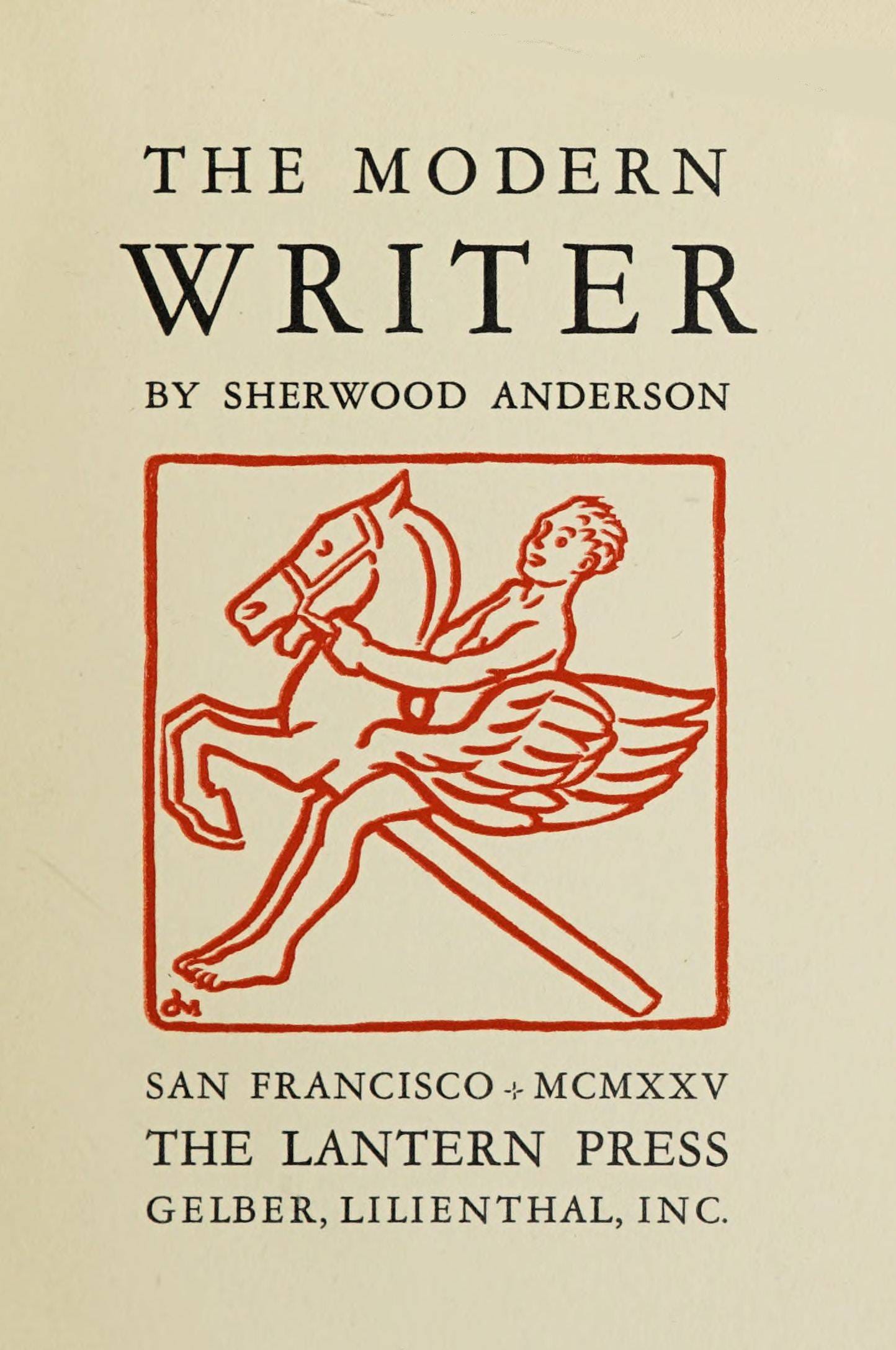
In this passionate 1925 manifesto, Sherwood Anderson articulates a vision for American literature that feels both urgently of its moment and startlingly prescient. Written amid the noise of industrialization and the rising tide of commercial culture, Anderson argues that the modern writer faces a singular challenge: how to remain faithful to the raw, irreducible stuff of human experience when every force in society pushes toward standardization and mass appeal. He posits that true art emerges not from chasing success or conforming to popular formulas, but from the writer's willingness to grapple honestly with the complexities of actual lives. Anderson sees the emerging modernist movement as a rebellion against the hollowing out of American culture, a search for deeper meaning conducted through careful, authentic craft. This is less a how-to guide than a declaration of principles: the writer's fulfillment must come from the work itself, not from external validation. For anyone who has ever wondered what it means to write something true in a world that rewards the easy and the expedient, Anderson's essay remains a galvanizing answer.
Editions
Link to this book
Add a free, dofollow link to Lex on your blog, forum, syllabus, or reading list.

<a href="https://lex-books.com/book/the-modern-writer-21ed3737-2397-4f1b-b7ef-310b56dd3f5e"><img src="https://lex-books.com/badges/read-on-lex.svg" alt="Read The Modern Writer by Sherwood Anderson free on Lex" width="160" height="40"></a>[](https://lex-books.com/book/the-modern-writer-21ed3737-2397-4f1b-b7ef-310b56dd3f5e)[url=https://lex-books.com/book/the-modern-writer-21ed3737-2397-4f1b-b7ef-310b56dd3f5e][img]https://lex-books.com/badges/read-on-lex.svg[/img][/url]Read The Modern Writer by Sherwood Anderson free on Lex: https://lex-books.com/book/the-modern-writer-21ed3737-2397-4f1b-b7ef-310b56dd3f5eCite this book
Reading this edition for a paper or guide? Copy a citation.
Anderson, Sherwood. The Modern Writer. Lex, lex-books.com/book/the-modern-writer-21ed3737-2397-4f1b-b7ef-310b56dd3f5e.Anderson, S. (1925). The Modern Writer. Lex. https://lex-books.com/book/the-modern-writer-21ed3737-2397-4f1b-b7ef-310b56dd3f5eAnderson, Sherwood. The Modern Writer. Lex. https://lex-books.com/book/the-modern-writer-21ed3737-2397-4f1b-b7ef-310b56dd3f5e.