The Heart of England
1906
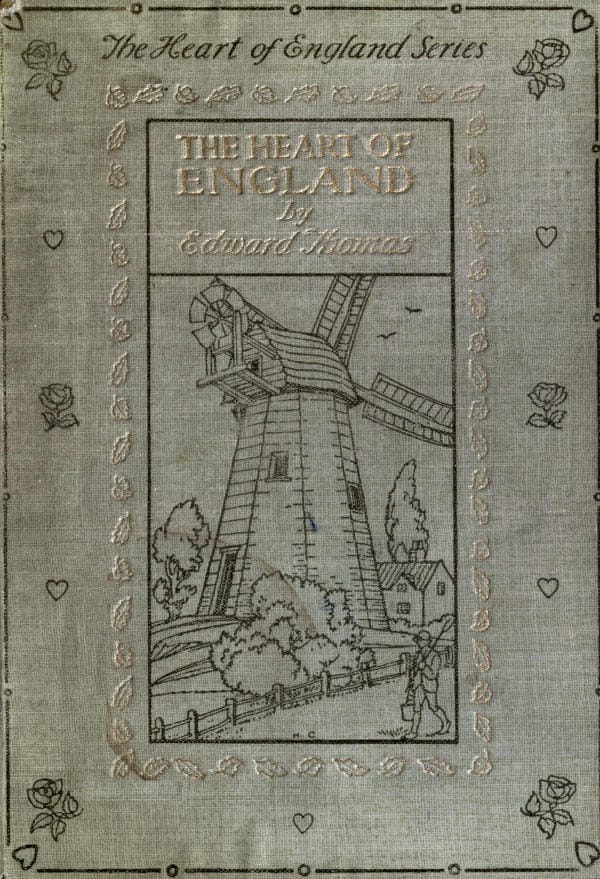
Edward Thomas wrote this book at the height of his powers, just years before the Great War claimed his life. This is not a guidebook to England but something far more intimate: a portrait of a landscape as seen through eyes that found in every hedgerow and railway station a reason for longing. Thomas moves through the English countryside like a man trying to memorize a room he knows he will have to leave. The opening follows a boy watching a watercress seller, that figure of apparent freedom who becomes a mirror for the boy's own restless yearning. Then Thomas boards a railway train and turns his poet's attention to the city, finding in the ordinariness of commuters and station platforms a quiet devastation. His eye misses nothing: the way light falls on a suburban street, the speech patterns of country people, the melancholy of old travelers. This is Thomas capturing a world on the edge of transformation, recording what would be lost in the war that was coming. His writing fuses natural history with human longing, making each walk through a field or wait on a platform an occasion for reflection on time, beauty, and the things we want but cannot name.
Editions
X-Ray
“I like to think how easily Nature will absorb London as she absorbed the mastodon, setting her spiders to spin the winding-sheet and her worms to fill in the grave, and her grass to cover it pitifully up, adding flowers - as an unknown hand added them to the grave of Nero.””
— Edward Thomas
“The moment we recognize an illusion as illusion, it ceases to be illusion and becomes an expression or aspect of reality and experience.””
— Edward Thomas
“Yet I think he was not wholly the loser by being unable to think. The eye untroubled by thought sees things like a mirror newly burnished; at night, for example, the musing can see nothing before him but a mist, but if he stops thinking quickly the roads, the walls, the trees become visible. (pp217)””
— Edward Thomas
“But it is hard to make anything like a truce between these two incompatible desires, the one for going on and on over the earth, the other that would settle for ever, in one place as in a grave and have nothing to do with change. Suppose a man to receive notice of death, it would be hard to decide whether to walk or sail until the end, seeing no man, or none but strangers; or to sit - alone - and by thinking or not thinking to make the change to come as little as is permitted. (pp 161)””
— Edward Thomas
“To envy a man is to misunderstand him or yourself (pp 111).””
— Edward Thomas
Link to this book
Add a free, dofollow link to Lex on your blog, forum, syllabus, or reading list.

<a href="https://lex-books.com/book/the-heart-of-england-2ab736b4-b70b-4dbe-805d-c3a4b8db265c"><img src="https://lex-books.com/badges/read-on-lex.svg" alt="Read The Heart of England by Edward Thomas free on Lex" width="160" height="40"></a>[](https://lex-books.com/book/the-heart-of-england-2ab736b4-b70b-4dbe-805d-c3a4b8db265c)[url=https://lex-books.com/book/the-heart-of-england-2ab736b4-b70b-4dbe-805d-c3a4b8db265c][img]https://lex-books.com/badges/read-on-lex.svg[/img][/url]Read The Heart of England by Edward Thomas free on Lex: https://lex-books.com/book/the-heart-of-england-2ab736b4-b70b-4dbe-805d-c3a4b8db265cCite this book
Reading this edition for a paper or guide? Copy a citation.
Thomas, Edward. The Heart of England. Lex, lex-books.com/book/the-heart-of-england-2ab736b4-b70b-4dbe-805d-c3a4b8db265c.Thomas, E. (1906). The Heart of England. Lex. https://lex-books.com/book/the-heart-of-england-2ab736b4-b70b-4dbe-805d-c3a4b8db265cThomas, Edward. The Heart of England. Lex. https://lex-books.com/book/the-heart-of-england-2ab736b4-b70b-4dbe-805d-c3a4b8db265c.