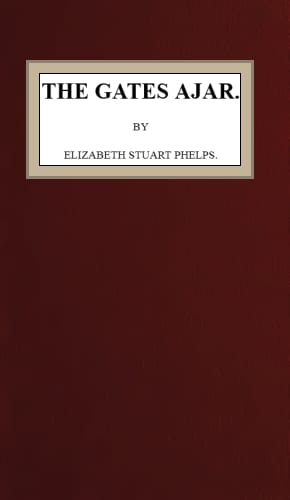
The Gates Ajar
1868
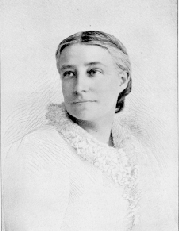
In the winter of 1868, America was still bleeding from a war that had left 600,000 dead. Elizabeth Stuart Phelps wrote this novel for every person who had lost someone and been told to be 'resigned' to a heaven that offered no comfort, no reunion, no warmth. Mary Cabot is barely a week into her grief when we meet her, still clutching the letter that told her brother Royal is never coming home. The neighbors bring platitudes. The minister speaks of mysterious ways. But Mary cannot accept a heaven where she will never see Royal again, where the silence between them stretches into eternity. Phelps rejects the cold, distant heaven of traditional theology and imagines something radical: an afterlife where families are reunited, where domestic life continues, where even the family dog waits at the door. It was a theological revolution disguised as a novel, and America devoured it. It spoke to a nation's grief and dared to say: you don't have to accept that heaven means goodbye.
Editions
X-Ray
“He forgot that anybody was there, and, sobbing, hid his face in his great hands.””
— Elizabeth Stuart Phelps
“A certain indefinable humanness softens his eyes and tones, and seems to be creeping into everything that he says.””
— Elizabeth Stuart Phelps
“He was once an abstract Grandeur which I struggled more in fear than love to please. He has become a living Presence, dear and real””
— Elizabeth Stuart Phelps
“...[F]or the sullenness left his face, and his eyes--which are pleasant, and not unmanly, when one fairly sees them-- sparkled softly, like a child's.””
— Elizabeth Stuart Phelps
“Aunt Winifred says that our hymns, taken all together, contain the worst and the best pictures of heaven that we have in any branch of literature.””
— Elizabeth Stuart Phelps
“Eternity will never become monotonous.””
— Elizabeth Stuart Phelps
“...[F]orgetfulness of the disagreeable things of this life implies forgetfulness of the pleasant ones. They are all tangled together.””
— Elizabeth Stuart Phelps
“The last pain borne, the last tear, the last sigh, the last lonely hour, the last unsatisfied dream, forever gone by; why should not the dead past bury its dead?””
— Elizabeth Stuart Phelps
“He believed, you know, that it takes a material body, a spiritual body, and a soul, to make a man. Death is simply the slipping off of the outer body, as a husk slips off from its kernel. The deathless frame stands ready then for the soul's untrammeled occupation.””
— Elizabeth Stuart Phelps
Link to this book
Add a free, dofollow link to Lex on your blog, forum, syllabus, or reading list.

<a href="https://lex-books.com/book/the-gates-ajar-40e3ee43-8e71-4063-8307-62785963b2eb"><img src="https://lex-books.com/badges/read-on-lex.svg" alt="Read The Gates Ajar by Elizabeth Stuart Phelps free on Lex" width="160" height="40"></a>[](https://lex-books.com/book/the-gates-ajar-40e3ee43-8e71-4063-8307-62785963b2eb)[url=https://lex-books.com/book/the-gates-ajar-40e3ee43-8e71-4063-8307-62785963b2eb][img]https://lex-books.com/badges/read-on-lex.svg[/img][/url]Read The Gates Ajar by Elizabeth Stuart Phelps free on Lex: https://lex-books.com/book/the-gates-ajar-40e3ee43-8e71-4063-8307-62785963b2ebCite this book
Reading this edition for a paper or guide? Copy a citation.
Phelps, Elizabeth Stuart. The Gates Ajar. Lex, lex-books.com/book/the-gates-ajar-40e3ee43-8e71-4063-8307-62785963b2eb.Phelps, E. S. (1868). The Gates Ajar. Lex. https://lex-books.com/book/the-gates-ajar-40e3ee43-8e71-4063-8307-62785963b2ebPhelps, Elizabeth Stuart. The Gates Ajar. Lex. https://lex-books.com/book/the-gates-ajar-40e3ee43-8e71-4063-8307-62785963b2eb.