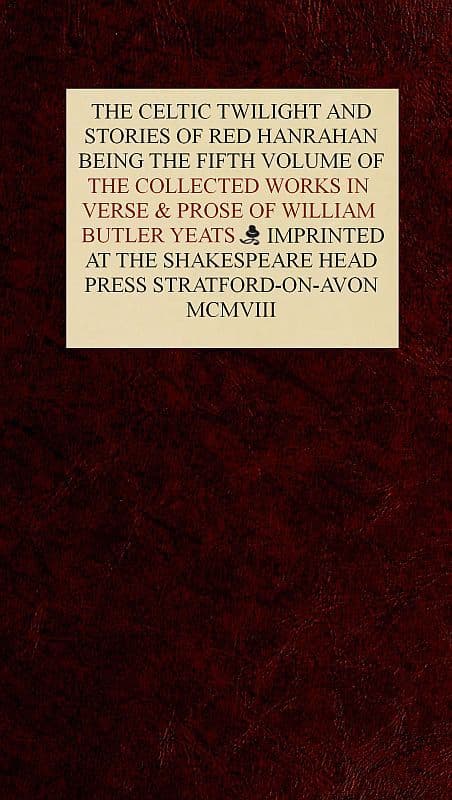
The Celtic Twilight
1893
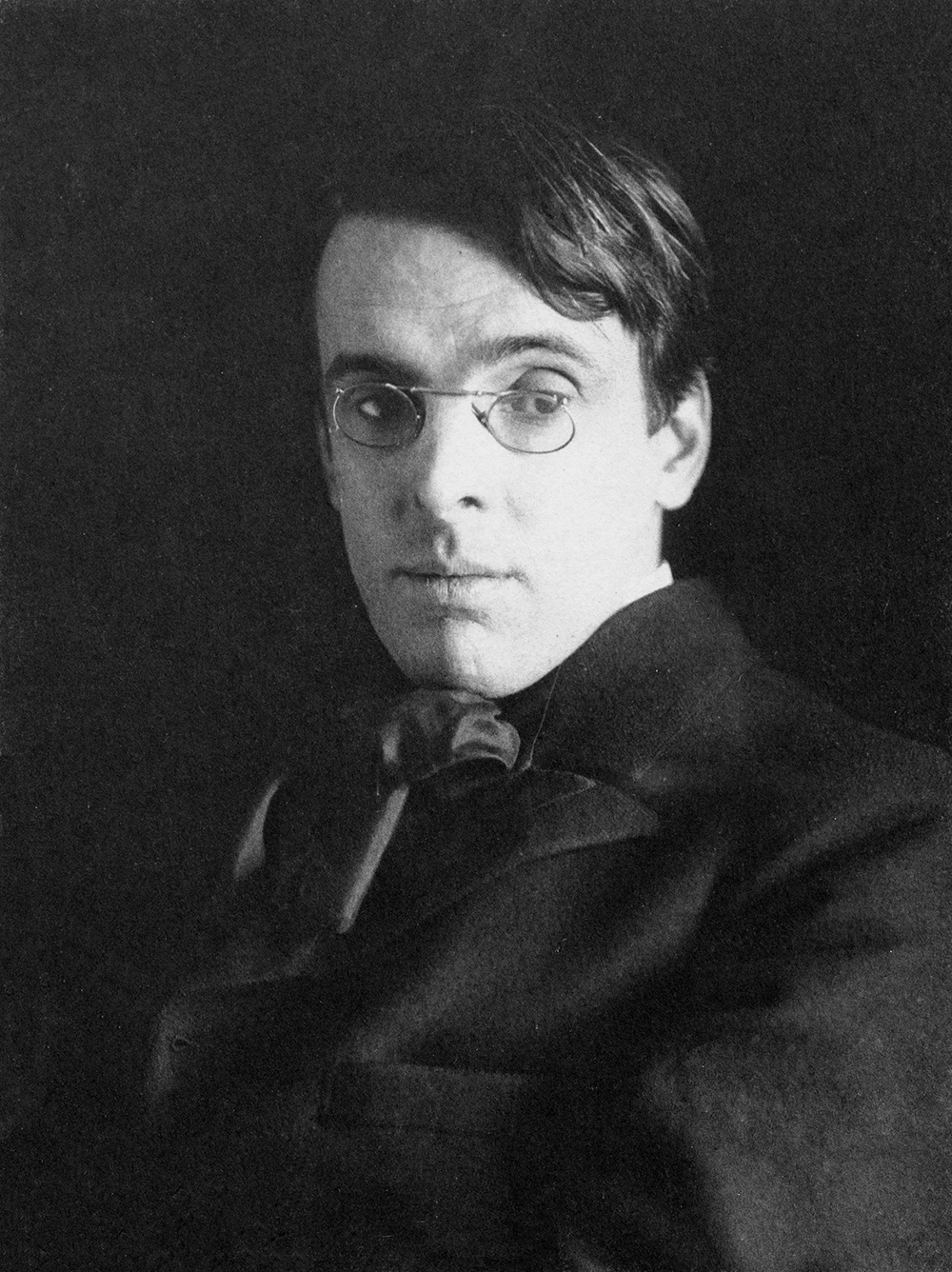
This is Yeats before the poetry - the young writer wandering the roads of Sligo, listening to old men and women tell of the time before. What he gathered was not mere folklore to archive but living belief: ghosts that walked, fairies that stole children, and a world where the border between the seen and unseen wore thin as gossamer. The book pulses with the voices of his neighbors - particularly Paddy Flynn, the charismatic storyteller whose tales of faerie encounters become, in Yeats' hands, something stranger than mere legend. Yeats does not merely transcribe; he participates. His own mystical experiences append themselves to these stories like footnotes from another world. The title refers to the pre-dawn hour when Druids performed their rituals, and the book occupies exactly that liminal space: between night and day, reason and faith, the Ireland that was vanishing and the imaginative Ireland Yeats was building in its place. It is the raw material of his greatest poetry, the workshop where a master learned his craft.
Editions
X-Ray
“We can make our minds so like still water that beings gather about us that they may see, it may be, their own images, and so live for a moment with a clearer, perhaps even with a fiercer life because of our quiet.””
— W. B. Yeats
“One loses, as one grows older, something of the lightness of one's dreams; one begins to take life up in both hands, and to care more for the fruit than the flower, and that is no great loss perhaps.””
— W. B. Yeats
“What is literature but the expression of moods by the vehicle of symbol and incident? And are there not moods which need heaven, hell, purgatory, and faeryland for their expression, no less than this dilapidated earth? Nay, are there not moods which shall find no expression unless there be men who dare to mix heaven, hell, purgatory, and faeryland together, or even to set the heads of beasts to the bodies of men, or to thrust the souls of men into the heart of rocks? Let us go forth, the tellers of tales, and seize whatever prey the heart long for, and have no fear. Everything exists, everything is true, and the earth is only a little dust under our feet." (A Teller of Tales)””
— W. B. Yeats
“In the great cities we see so little of the world, we drift into our minority. In the little towns and villages there are no minorities; people are not numerous enough. You must see the world there, perforce. Every man is himself a class; every hour carries its new challenge. When you pass the inn at the end of the village you leave your favourite whimsy behind you; for you will meet no one who can share it. We listen to eloquent speaking, read books and write them, settle all the affairs of the universe. The dumb village multitudes pass on unchanging; the feel of the spade in the hand is no different for all our talk: good seasons and bad follow each other as of old. The dumb multitudes are no more concerned with us than is the old horse peering through the rusty gate of the village pound. The ancient map-makers wrote across unexplored regions, 'Here are lions.' Across the villages of fishermen and turners of the earth, so different are these from us, we can write but one line that is certain, 'Here are ghosts.' ("Village Ghosts")””
— W. B. Yeats
“Time drops in decayLike a candle burnt out.And the mountains and woodsHave their day, have their day;But, kindly old routOf the fire-born moods,You pass not away.””
— W. B. Yeats
“I have desired, like every artist, to create a little world out of the beautiful, pleasant, and significant things of this marred and clumsy world, and to show in a vision something of the face of Ireland to any of my own people who would look where I bid them. I have thereforewritten down accurately and candidly much that I have heard and seen,and, except by way of commentary, nothing that I have merely imagined.””
— W. B. Yeats
“Let us go forth, the tellers of tales, and seize whatever prey the heart long for, and have no fear.””
— W. B. Yeats
“Everything exists, everything is true, and the earth is only a little dust under our feet.””
— W. B. Yeats
“There are some doubters even in the western villages. One woman told me last Christmas that she did not believe either in hell or in ghosts. Hell she thought was merely an invention got up by the priest to keep people good; and ghosts would not be permitted, she held, to go 'trapsin about the earth' at their own free will; 'but there are faeries,' she added, 'and little leprechauns, and water-horses, and fallen angels.' I have met also a man with a mohawk Indian tattooed upon his arm, who held exactly similar beliefs and unbeliefs. No matter what one doubts one never doubts the faeries, for, as the man with the mohawk Indian on his arm said to me, 'they stand to reason.' Even the official mind does not escape this faith. ("Reason and Unreason")””
— W. B. Yeats
Link to this book
Add a free, dofollow link to Lex on your blog, forum, syllabus, or reading list.

<a href="https://lex-books.com/book/the-celtic-twilight-9d0e3d3a-da24-475b-a060-dbecea4107d0"><img src="https://lex-books.com/badges/read-on-lex.svg" alt="Read The Celtic Twilight by W. B. Yeats free on Lex" width="160" height="40"></a>[](https://lex-books.com/book/the-celtic-twilight-9d0e3d3a-da24-475b-a060-dbecea4107d0)[url=https://lex-books.com/book/the-celtic-twilight-9d0e3d3a-da24-475b-a060-dbecea4107d0][img]https://lex-books.com/badges/read-on-lex.svg[/img][/url]Read The Celtic Twilight by W. B. Yeats free on Lex: https://lex-books.com/book/the-celtic-twilight-9d0e3d3a-da24-475b-a060-dbecea4107d0Cite this book
Reading this edition for a paper or guide? Copy a citation.
Yeats, W. B.. The Celtic Twilight. Lex, lex-books.com/book/the-celtic-twilight-9d0e3d3a-da24-475b-a060-dbecea4107d0.Yeats, W. B. (1893). The Celtic Twilight. Lex. https://lex-books.com/book/the-celtic-twilight-9d0e3d3a-da24-475b-a060-dbecea4107d0Yeats, W. B.. The Celtic Twilight. Lex. https://lex-books.com/book/the-celtic-twilight-9d0e3d3a-da24-475b-a060-dbecea4107d0.