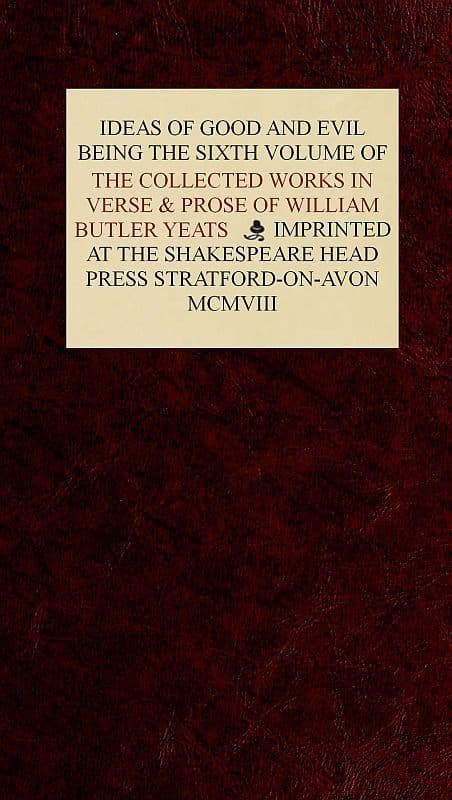
Ideas of Good and Evil
Here is the mind of the twentieth century's greatest poet, dissected in real time. Written in 1903, these essays capture Yeats at the threshold of his mastery, working out in public the philosophy that would produce "The Tower" and "The Waste Land." He interrogates what poetry is for in a world splitting between commercial mediocrity and spiritual hunger. He examines the Irish folk tradition not as nostalgia but as living myth, truths the rational mind cannot access. He argues for art that seizes the soul rather than merely pleases the ear, for symbolism that operates below consciousness, for a literature that serves a nation's longing for selfhood while refusing to bow to populism. The title itself is a provocation: in Yeats's Ireland, good and evil are not moral categories but aesthetic forces, and the poet's task is to navigate between them. This is essential reading for anyone who has ever wondered how a poet thinks, or why poetry matters at all.
Editions
X-Ray
“We cannot doubt that barbaric people receive such influences more visibly and obviously, and in all likelihood more easily and fully than we do, for our life in cities, which deafens or kills the passive meditative life, and our education that enlarges the separated, self-moving mind, have made our souls less sensitive.””
— W. B. Yeats
“All art is, indeed, a monotony in external things for the sake of an interior variety, a sacrifice of gross effects to subtle effects, an asceticism of the imagination.””
— W. B. Yeats
Link to this book
Add a free, dofollow link to Lex on your blog, forum, syllabus, or reading list.

<a href="https://lex-books.com/book/ideas-of-good-and-evil-2432072e-e805-4015-a5b4-c83d9028d477"><img src="https://lex-books.com/badges/read-on-lex.svg" alt="Read Ideas of Good and Evil by W. B. Yeats free on Lex" width="160" height="40"></a>[](https://lex-books.com/book/ideas-of-good-and-evil-2432072e-e805-4015-a5b4-c83d9028d477)[url=https://lex-books.com/book/ideas-of-good-and-evil-2432072e-e805-4015-a5b4-c83d9028d477][img]https://lex-books.com/badges/read-on-lex.svg[/img][/url]Read Ideas of Good and Evil by W. B. Yeats free on Lex: https://lex-books.com/book/ideas-of-good-and-evil-2432072e-e805-4015-a5b4-c83d9028d477Cite this book
Reading this edition for a paper or guide? Copy a citation.
Yeats, W. B.. Ideas of Good and Evil. Lex, lex-books.com/book/ideas-of-good-and-evil-2432072e-e805-4015-a5b4-c83d9028d477.Yeats, W. B. (n.d.). Ideas of Good and Evil. Lex. https://lex-books.com/book/ideas-of-good-and-evil-2432072e-e805-4015-a5b4-c83d9028d477Yeats, W. B.. Ideas of Good and Evil. Lex. https://lex-books.com/book/ideas-of-good-and-evil-2432072e-e805-4015-a5b4-c83d9028d477.