Perpetual Peace: A Philosophical Essay
1795
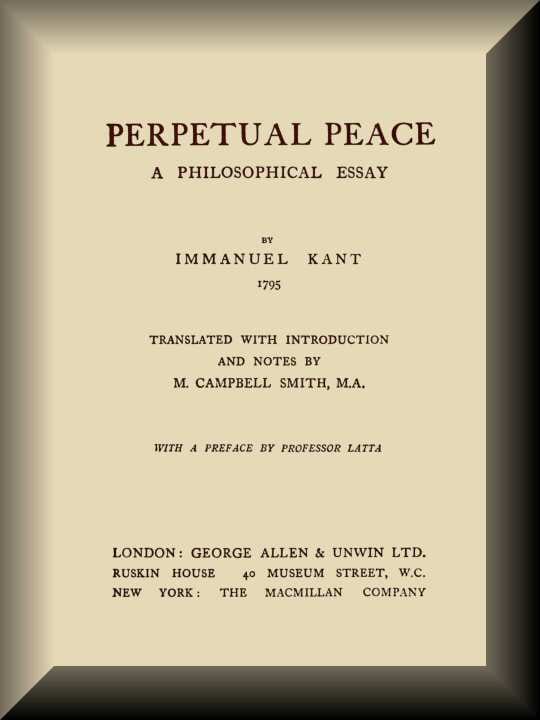
Perpetual Peace: A Philosophical Essay
1795
Translated by Mary Campbell Smith
In 1795, as Europe burned through another war, Immanuel Kant did something radical: he wrote a blueprint for ending war forever. This short, incendiary essay proposes that sovereign nations submit to a legal federation, that republican governments replace hereditary rule, and that universal hospitality replace the brutal logic of conquest. What makes Perpetual Peace startling isn't its idealism but its cold pragmatism. Kant knew exactly how power works. He argues that perpetual peace isn't naive wishful thinking but the inevitable destination of reason itself, if nations can be compelled to follow their own interests through law rather than force. The essay hums with a quiet radicalism: that the nation-state is not the end of political organization, that borders are conveniences not destinations, and that the same moral law binding individuals might bind peoples. Nearly 230 years later, with international courts, the United Nations, and debates over global governance still raging, Kant's questions feel less like philosophy and more like prophecy. This is essential reading for anyone who has ever wondered whether peace is possible or merely a pause between wars.
Editions
X-Ray
“Without man and his potential for moral progress, the whole of reality would be a mere wilderness, a thing in vain, and have no final purpose.””
— Immanuel Kant
“[Standing armies] constantly threaten other nations with war by giving the appearance that they are prepared for it, which goads nations into competing with one another in the number of men under arms, and this practice knows no bounds. And since the costs related to maintaining peace will in this way finally become greater than those of a short war, standing armies are the cause of wars of aggression that are intended to end burdensome expenditures. Moreover, paying men to kill or be killed appears to use them as mere machines and tools in the hands of another (the nation), which is inconsistent with the rights of humanity.””
— Immanuel Kant
“War seems to be ingrained in human nature, and even to be regarded as something noble to which man is inspired by his love of honor, without selfish motives.””
— Immanuel Kant
“The world will by no means perish by a diminution in the number of evil men.””
— Immanuel Kant
“THIRD DEFINITIVE ARTICLE OF PERPETUAL PEACEIII. The rights of men, as citizens of the world, shall be limited to the conditions of universal hospitality.We are speaking here, as in the previous articles, not of philanthropy, but of right; and in this sphere hospitality signifies the claim of a stranger entering foreign territoryto be treated by its owner without hostility. The latter may send him away again if this can be done without causing his death; but, so long as he conducts himself peaceably, he must not be treated as an enemy. It is not a right to be treated as a guest to which the stranger can lay claim-a special friendly compact on his behalf would be required to make him for a given time an actual inmate-but he has a right of visitation. This right to present themselves to society belongs to all mankind in virtue of our common right of possession of the surface of the earth on which, as it is a globe, we cannot be infinitely scattered, and must in the end reconcile ourselves to existence side by side: at the same time, originally no one individual had more right than another to live in any one particular spot.””
— Immanuel Kant
“La propia guerra, sin embargo, no necesita ningún motivo especial, sino que parece que está inserta en la naturaleza humana e, incluso, parece estar considerada como algo noble, a lo que el hombre tiende por un impulso de honor desprovisto de egoísmo, de modo que tanto los salvajes americanos como los europeos en la época de la caballería estiman que el coraje guerrero tiene un gran valor natural, no sólo cuando hay guerra -lo cual es razonable- sino que estiman también valioso que haya guerra, y con frecuencia se han comenzado guerras para mostrar simplemente aquel coraje, con lo que le dan a la guerra una dignidad intrínseca, hasta el punto de que algunos filósofos alaban la guerra como un cierto ennoblecimiento de la humanidad, olvidándose del dicho de aquel griego: "lo malo de la guerra es que hace más gente mala que la que se lleva".””
— Immanuel Kant
“De las tres formas de Estado, la democracia es, en el sentido propio de la palabra, necesariamente un despotismo, porque crea un poder ejecutivo en el que todos deciden sobre alguien y, en su caso, contra alguien (es decir, contra quien no esté de acuerdo con los demás), con lo que deciden todos, que no son realmente todos. Esto es una contradicción de la voluntad general consigo misma y con la libertad.””
— Immanuel Kant
“5. "Ningún estado debe inmiscuirse en la constitución y gobierno de otro de forma violenta".Pues, ¿qué le daría derecho a ello? ¿El escándalo, quizás, que ese Estado esté dando a los súbditos de otro Estado? Pero ese escándalo puede servir más bien de advertencia, al mostrar la gran desgracia que un pueblo se ha atraído sobre sí por vivir en un Estado sin leyes. Además, el mal ejemplo que una persona libre da a otra persona no es, como scandalum acceptum (escándalo aceptado), ninguna ofensa.Esto, sin embargo, no se podría aplicar si un Estado se dividiera en dos partes como consecuencia de una disensión interna, representando cada parte a un Estado distinto pero reivindicando cada uno todo el conjunto. En este caso, si un tercer Estado presta ayuda a uno de ellos, no se podría considerar injerencia en la constitución del otro (pues en ese caso éste es una anarquía). Pero mientras no esté solucionada esta lucha interna, la injerencia de potencias extranjeras sería una violación de los derechos de un pueblo que sólo está luchando contra una enfermedad interna y que no depende de ningún otro Estado.””
— Immanuel Kant
“El mundo de ningún modo se hundirá porque haya menos hombres malos.””
— Immanuel Kant
Link to this book
Add a free, dofollow link to Lex on your blog, forum, syllabus, or reading list.

<a href="https://lex-books.com/book/perpetual-peace-a-philosophical-essay-e3a0c543-9b45-49ba-b512-3e66e808a032"><img src="https://lex-books.com/badges/read-on-lex.svg" alt="Read Perpetual Peace: A Philosophical Essay by Immanuel Kant free on Lex" width="160" height="40"></a>[](https://lex-books.com/book/perpetual-peace-a-philosophical-essay-e3a0c543-9b45-49ba-b512-3e66e808a032)[url=https://lex-books.com/book/perpetual-peace-a-philosophical-essay-e3a0c543-9b45-49ba-b512-3e66e808a032][img]https://lex-books.com/badges/read-on-lex.svg[/img][/url]Read Perpetual Peace: A Philosophical Essay by Immanuel Kant free on Lex: https://lex-books.com/book/perpetual-peace-a-philosophical-essay-e3a0c543-9b45-49ba-b512-3e66e808a032Cite this book
Reading this edition for a paper or guide? Copy a citation.
Kant, Immanuel. Perpetual Peace: A Philosophical Essay. Lex, lex-books.com/book/perpetual-peace-a-philosophical-essay-e3a0c543-9b45-49ba-b512-3e66e808a032.Kant, I. (1795). Perpetual Peace: A Philosophical Essay. Lex. https://lex-books.com/book/perpetual-peace-a-philosophical-essay-e3a0c543-9b45-49ba-b512-3e66e808a032Kant, Immanuel. Perpetual Peace: A Philosophical Essay. Lex. https://lex-books.com/book/perpetual-peace-a-philosophical-essay-e3a0c543-9b45-49ba-b512-3e66e808a032.