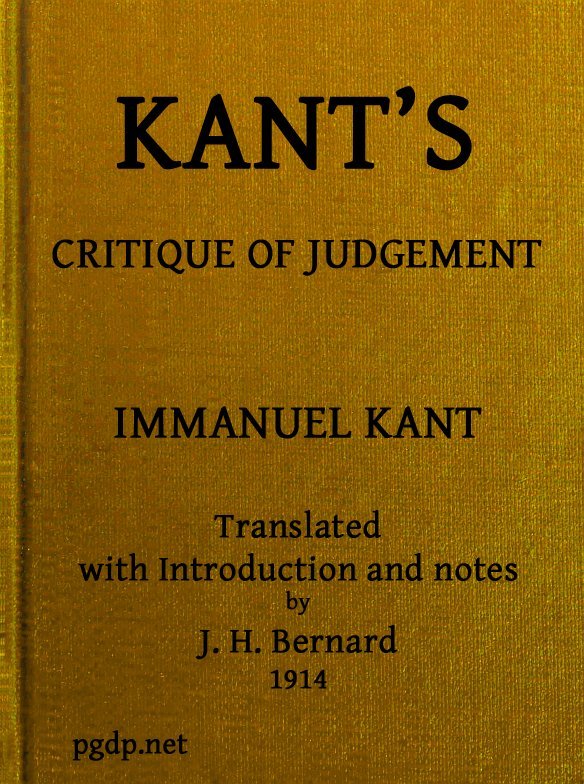
Kant's Critique of Judgement
1790

Kant's third and most elusive critique asks a deceptively simple question: how can we judge anything beautiful when beauty feels entirely subjective? His answer reshaped philosophy. When we experience something as beautiful, Kant argues, we're recognizing a "purposiveness without purpose" - a harmonious order that satisfies the mind's own need for order, even though we cannot prove the thing was made for any actual end. This becomes the bridge between his earlier works: pure reason investigates what we can know, practical reason what we should do, and judgment reveals what we can feel and appreciate. The second half tackles why we perceive purpose everywhere in nature - in the intricate design of organisms - and why this forces us to confront the idea of a designer, even as Kant insists such a being can never be proven. Dense and demanding, but it fundamentally changed how we think about art, taste, and our relationship to the natural world. For anyone who's ever wondered why a sunset or a sonnet moves them, and whether that response says more about the object or the mind encountering it.
Editions
X-Ray
“In all judgements by which we describe anything as beautiful, we allow no one to be of another opinion.””
— Immanuel Kant
“Nature is beautiful because it looks like Art; and Art can only be called beautiful if we are conscious of it as Art while yet it looks like Nature.””
— Immanuel Kant
“Laughter is an affect resulting from the sudden transformation of a heightened expectation into nothing.””
— Immanuel Kant
“...When he puts a thing on a pedestal and calls it beautiful, he demands the same delight from others. He judges not merely for himself, but for all men, and then speaks of beauty as if it were the property of things.””
— Immanuel Kant
“A man abandoned by himself on a desert island would adorn neither his hut nor his person; nor would he seek for flowers, still less would he plant them, in order to adorn himself therewith. It is only in society that it occurs to him to be not merely a man, but a refined man after his kind (the beginning of civilization). For such do we judge him to be who is both inclined and apt to communicate his pleasure to others, and who is not contented with an object if he cannot feel satisfaction in it in common with others. Again, every one expects and requires from every one else this reference to universal communication of pleasure, as it were from an original compact dictated by humanity itself.””
— Immanuel Kant
“It is an empirical judgement [to say] that I perceive and judge an object with pleasure. But it is an a priori judgement [to say] that I find it beautiful, i.e. I attribute this satisfaction necessarily to every one.””
— Immanuel Kant
“What does it avail, one will say, that this man has so much talent, that he is so active therewith, and that he exerts thereby a useful influence over the community, thus having a great worth both in relation to his own happy condition and to the benefit of others, if he does not possess a good will?””
— Immanuel Kant
“Only by what a man does heedless of enjoyment, in complete freedom and independently of what he can produce passively from the hand of nature, does he give absolute worth to his existence, as the real existence of a person. Happiness, with all its plethora of pleasures, is far from being an unconditioned good.””
— Immanuel Kant
“Our understanding is a faculty of concepts, i.e., a discursive understanding, for which it must of course be contingent what and how different might be the particular that can be given to it in nature and brought under its concepts.””
— Immanuel Kant
Link to this book
Add a free, dofollow link to Lex on your blog, forum, syllabus, or reading list.

<a href="https://lex-books.com/book/kant-s-critique-of-judgement-e8649014-5664-4c9f-9317-17c24f9eb2e6"><img src="https://lex-books.com/badges/read-on-lex.svg" alt="Read Kant's Critique of Judgement by Immanuel Kant free on Lex" width="160" height="40"></a>[](https://lex-books.com/book/kant-s-critique-of-judgement-e8649014-5664-4c9f-9317-17c24f9eb2e6)[url=https://lex-books.com/book/kant-s-critique-of-judgement-e8649014-5664-4c9f-9317-17c24f9eb2e6][img]https://lex-books.com/badges/read-on-lex.svg[/img][/url]Read Kant's Critique of Judgement by Immanuel Kant free on Lex: https://lex-books.com/book/kant-s-critique-of-judgement-e8649014-5664-4c9f-9317-17c24f9eb2e6Cite this book
Reading this edition for a paper or guide? Copy a citation.
Kant, Immanuel. Kant's Critique of Judgement. Lex, lex-books.com/book/kant-s-critique-of-judgement-e8649014-5664-4c9f-9317-17c24f9eb2e6.Kant, I. (1790). Kant's Critique of Judgement. Lex. https://lex-books.com/book/kant-s-critique-of-judgement-e8649014-5664-4c9f-9317-17c24f9eb2e6Kant, Immanuel. Kant's Critique of Judgement. Lex. https://lex-books.com/book/kant-s-critique-of-judgement-e8649014-5664-4c9f-9317-17c24f9eb2e6.