Hadrian the Seventh
1904
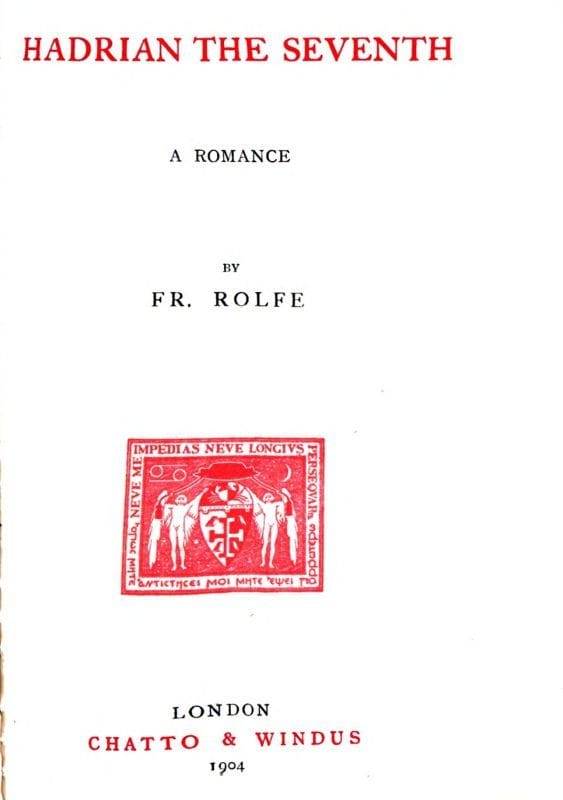
An extraordinary fantasy of defiance and wish-fulfillment from one of English literature's most fascinating eccentrics. Frederick Rolfe spent his life being rejected by publishers, patrons, and the Church he loved, and in this, his finest novel, he imagines himself not just accepted but elevated to absolute power. George Arthur Rose, a failed writer and minor priest, wakes one morning to learn he has been elected Pope. He accepts with serene audacity, taking the name Hadrian VII, and proceeds to reform the Church with the righteous fury of a man who has spent decades nursing grievances against its hypocrisies. The novel crackles with Rolfe's distinctive voice: caustic, pompous, deeply wounded, and irresistibly funny. Yet beneath the satire lies genuine melancholy and the raw ache of artistic frustration. Rose loves his cat Flavio, laments his failed literary ambitions, and dreams of a purer faith. This is wish-fulfillment at its most honest, a man transmuting a lifetime of rejection into something magnificent. It endures for readers who love literary eccentrics, outsider art, and novels that transform personal defeat into triumphant fantasy.
Editions

X-Ray
“Shall I tell you the difference between our Holy Father and ourselves? We see things from a single view-point. He sees things from several. We decide that the thing is as we see it. But He has seen it otherwise, and He presents it as a more or less complete coaction of its qualities. See this sapphire. Well, you see the face of it: underneath, if I take it off my finger, there are a number of facets to be seen and a number more which are hidden by the gold of the setting. Now my meaning is that our Holy Father has seen all the facets as well as the table of the sapphire, or the thing. Consequently He knows a great deal more about the sapphire, or the thing, than we do. You must have noted that in Him. You must have noted how that every now and then, when He deigns to explain, He makes mysteries appear most wonderfully lucid.””
— Frederick Rolfe
“No. We never have read a line of Tolstoy. We studiously avoid doing so.””
— Frederick Rolfe
“All His life long He had yearned to be giving. Now, under any circumstances, He always had something to give, ten words and a gesture; and people seemed so thankful for it. He was glad.””
— Frederick Rolfe
Link to this book
Add a free, dofollow link to Lex on your blog, forum, syllabus, or reading list.

<a href="https://lex-books.com/book/hadrian-the-seventh-38780090-58a5-4602-95c7-60f502431664"><img src="https://lex-books.com/badges/read-on-lex.svg" alt="Read Hadrian the Seventh by Frederick Rolfe free on Lex" width="160" height="40"></a>[](https://lex-books.com/book/hadrian-the-seventh-38780090-58a5-4602-95c7-60f502431664)[url=https://lex-books.com/book/hadrian-the-seventh-38780090-58a5-4602-95c7-60f502431664][img]https://lex-books.com/badges/read-on-lex.svg[/img][/url]Read Hadrian the Seventh by Frederick Rolfe free on Lex: https://lex-books.com/book/hadrian-the-seventh-38780090-58a5-4602-95c7-60f502431664Cite this book
Reading this edition for a paper or guide? Copy a citation.
Rolfe, Frederick. Hadrian the Seventh. Lex, lex-books.com/book/hadrian-the-seventh-38780090-58a5-4602-95c7-60f502431664.Rolfe, F. (1904). Hadrian the Seventh. Lex. https://lex-books.com/book/hadrian-the-seventh-38780090-58a5-4602-95c7-60f502431664Rolfe, Frederick. Hadrian the Seventh. Lex. https://lex-books.com/book/hadrian-the-seventh-38780090-58a5-4602-95c7-60f502431664.







