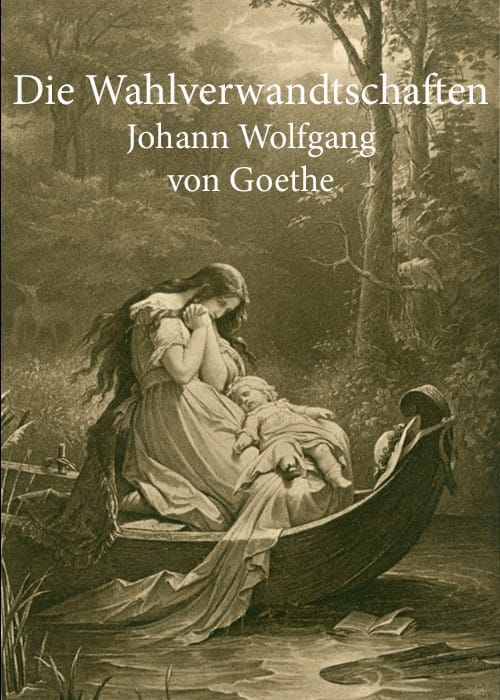
Die Wahlverwandtschaften
1809
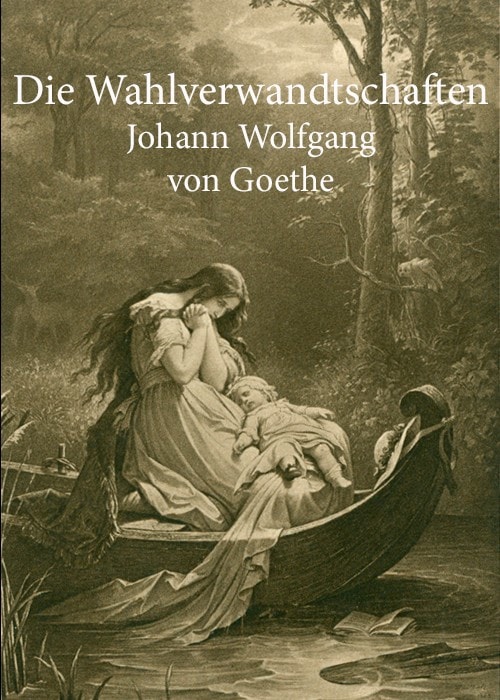
Elective Affinities takes its title from a chemical term, and Goethe deploys it with devastating precision: what if human attraction works like molecules, pulling us toward certain people with the inevitability of nature itself? The novel opens on Eduard and Charlotte, a married couple whose comfortable estate conceals a quiet desperation. When Eduard invites his old friend the Captain to enliven their lives, the chemistry between the four residents shifts in ways none of them can control. Charlotte finds herself drawn to the Captain; Eduard, to Charlotte's young niece Ottilie. The question that haunts every page: are these passions choices, or the inevitable reactions of souls too long denied their true elements? Goethe constructs his psychological drama with the precision of a chemist, showing how the best intentions, respectability, loyalty, duty, collide with the "real life" that demands expression. The consequences are neither moralistic nor sentimental. They are simply true, and that truth still resonates two centuries later. For readers who believe that the heart has its own logic, and that civilization is a thin veneer over elemental forces.
Editions
X-Ray
“.None are more hopelessly enslaved than those who falsely believe they are free.””
— Johann Wolfgang von Goethe
“There is nothing in which people more betray their character than in what they find to laugh at.””
— Johann Wolfgang von Goethe
“We lay aside letters never to read them again, and at last destroy them out of discretion, and so disappears the most beautiful, the most immediate breath of life, irrecoverably for ourselves and for others.””
— Johann Wolfgang von Goethe
“Fortunately a human being can comprehend only a certain degree of unhappiness; anything beyond it destroys him or leaves him cold. There are situations in which fear and hope become one and the same, cancel one another out, and lose themselves in a dark insensateness. How else could we know the people we love best to be in continual danger and yet go on with our daily lives as usual?””
— Johann Wolfgang von Goethe
“We would not say very much in company if we realized how often we misunderstand what others say.””
— Johann Wolfgang von Goethe
“Artists and artisans both demonstrate with perfect clarity that a person is least able to appropriate for himself those things which are most peculiarly his. His works leave him as birds do the best in which they were hatched.In this respect an architect's fate is the strangest of all. How often he employs his whole intellect and warmth of feeling in the creation of rooms from which he must exclude himself. Royal halls owe their splendor to him, and he may not share in the enjoyment of their finest effects. In temples he draws the line between himself and the holy of holies; the steps he built to ceremonies that lift up the heady, he may no longer climb; just as the goldsmith worships only from afar the monstrance which he wrought in the fire and set with jewels. With the keys of the palace the architect hands over all it's comforts to the wealthy man, and has not the least part in them. Surely in this way art must little by little grow away from the artist, if the work, like a child provided for, no longer teaches back to touch its father.””
— Johann Wolfgang von Goethe
“Even people who are entirely strange and indifferent to one another will exchange confidences if they live together for a while, and a certain intimacy is bound to develop.””
— Johann Wolfgang von Goethe
“But there are times," said Charlotte, "when it is necessary and an act of friendship to write nothing rather than not to write.””
— Johann Wolfgang von Goethe
“Few people are capable of concerning themselves with the most recent past. Either the present holds us violently captive, or we lose ourselves in the distant past and strive with might and main to recall and restore what is irrevocably lost.””
— Johann Wolfgang von Goethe
Link to this book
Add a free, dofollow link to Lex on your blog, forum, syllabus, or reading list.

<a href="https://lex-books.com/book/die-wahlverwandtschaften-4e836c74-71f2-446f-a665-dae36fda870d"><img src="https://lex-books.com/badges/read-on-lex.svg" alt="Read Die Wahlverwandtschaften by Johann Wolfgang von Goethe free on Lex" width="160" height="40"></a>[](https://lex-books.com/book/die-wahlverwandtschaften-4e836c74-71f2-446f-a665-dae36fda870d)[url=https://lex-books.com/book/die-wahlverwandtschaften-4e836c74-71f2-446f-a665-dae36fda870d][img]https://lex-books.com/badges/read-on-lex.svg[/img][/url]Read Die Wahlverwandtschaften by Johann Wolfgang von Goethe free on Lex: https://lex-books.com/book/die-wahlverwandtschaften-4e836c74-71f2-446f-a665-dae36fda870dCite this book
Reading this edition for a paper or guide? Copy a citation.
Goethe, Johann Wolfgang von. Die Wahlverwandtschaften. Lex, lex-books.com/book/die-wahlverwandtschaften-4e836c74-71f2-446f-a665-dae36fda870d.Goethe, J. W. V. (1809). Die Wahlverwandtschaften. Lex. https://lex-books.com/book/die-wahlverwandtschaften-4e836c74-71f2-446f-a665-dae36fda870dGoethe, Johann Wolfgang von. Die Wahlverwandtschaften. Lex. https://lex-books.com/book/die-wahlverwandtschaften-4e836c74-71f2-446f-a665-dae36fda870d.