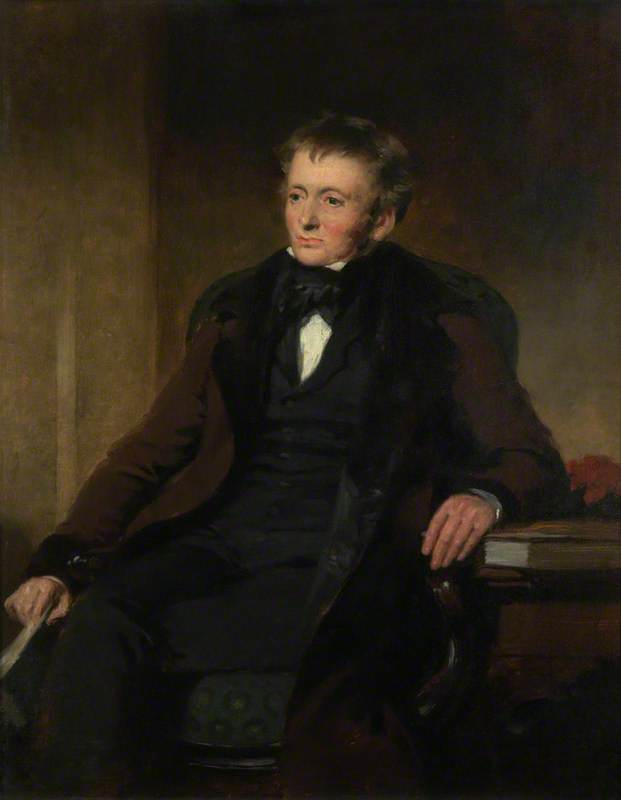
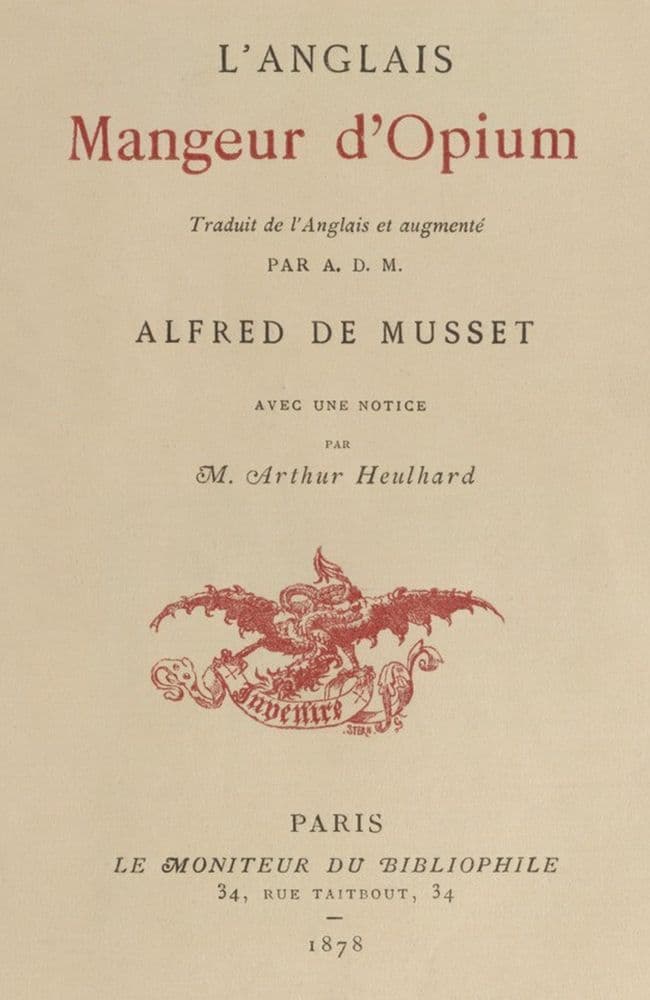
De L'assassinat Considéré Comme UN Des Beaux-Arts
1827
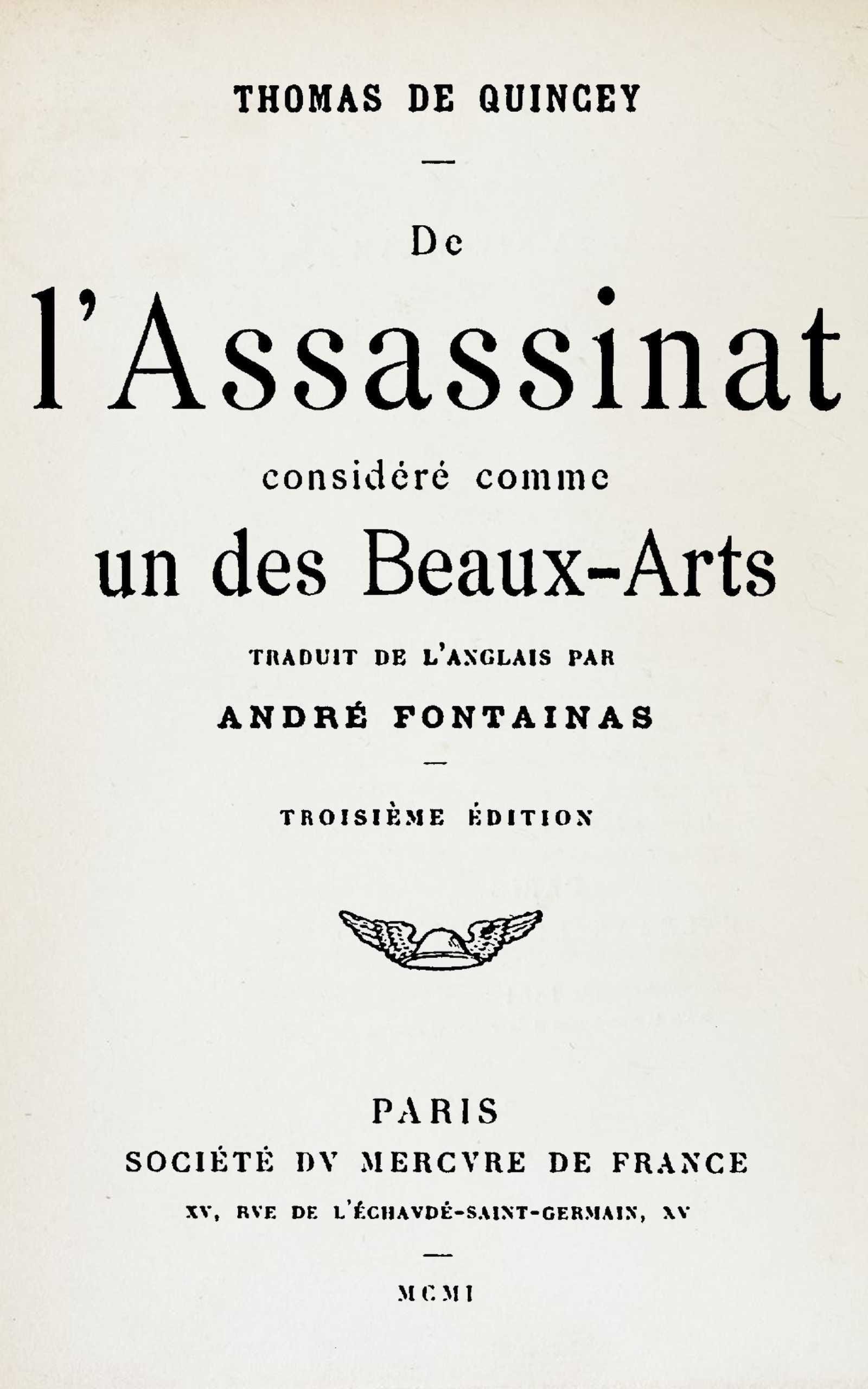
De L'assassinat Considéré Comme UN Des Beaux-Arts
1827
Translated by André Fontainas
De L'assassinat Considéré Comme UN Des Beaux-Arts, published in 1827 by Thomas De Quincey, is a philosophical treatise that examines murder through an aesthetic lens. De Quincey introduces a fictional society that critiques assassination as a form of performance art, exploring the moral and artistic implications of murder. His work blends irony with intellectual seriousness, challenging societal views on homicide and its representation. This unique perspective positions the act of killing within the realms of taste and aesthetics, making it a notable contribution to discussions on morality and art in literature.
Editions

X-Ray
“If once a man indulges himself in murder, very soon he comes to think little of robbing; and from robbing he comes next to drinking and Sabbath-breaking, and from that to incivility and procrastination.””
— Thomas De Quincey
“The subject chosen ought to be in good health: for it is absolutely barbarous to murder a sick person, who is usually quite unable to bear it. On this principle, no Cockney ought to be chosen who is above twenty-five, for after that age he is sure to be dyspeptic.””
— Thomas De Quincey
“Awkward disturbances will arise; people will not submit to have their throats cut quietly; they will run, they will kick, they will bite; and, whilst the portrait painter often has to complain of too much torpor in his subject, the artist, in our line, is generally embarrassed by too much animation.””
— Thomas De Quincey
“Fie on these dealers in poison, say I: can they not keep to the old honest way of cutting throats, without introducing such abominable innovations from Italy?””
— Thomas De Quincey
“Hobbes, but why, or on what principle, I never could understand, was not murdered. This was a capital oversight of the professional men in the seventeenth century; because in every light he was a fine subject for murder, except, indeed, that he was lean and skinny;””
— Thomas De Quincey
“People begin to see that something more goes to the composition of a fine murder than two blockheads to kill and be killed – a knife – a purse – and a dark lane. Design, gentlemen, grouping, light and shade, poetry, sentiment, are now deemed indispensable to attempts of this nature.””
— Thomas De Quincey
“opinionum commenta delet dies, naturae judicia confirmat ['Time erases the fictions of opinion, but it confirms the judgement of nature'].””
— Thomas De Quincey
Link to this book
Add a free, dofollow link to Lex on your blog, forum, syllabus, or reading list.

<a href="https://lex-books.com/book/de-l-assassinat-consid-r-comme-un-des-beaux-arts-9da5a010-e627-4047-9b4e-44564538b2ab"><img src="https://lex-books.com/badges/read-on-lex.svg" alt="Read De L'assassinat Considéré Comme UN Des Beaux-Arts by Thomas De Quincey free on Lex" width="160" height="40"></a>[](https://lex-books.com/book/de-l-assassinat-consid-r-comme-un-des-beaux-arts-9da5a010-e627-4047-9b4e-44564538b2ab)[url=https://lex-books.com/book/de-l-assassinat-consid-r-comme-un-des-beaux-arts-9da5a010-e627-4047-9b4e-44564538b2ab][img]https://lex-books.com/badges/read-on-lex.svg[/img][/url]Read De L'assassinat Considéré Comme UN Des Beaux-Arts by Thomas De Quincey free on Lex: https://lex-books.com/book/de-l-assassinat-consid-r-comme-un-des-beaux-arts-9da5a010-e627-4047-9b4e-44564538b2abCite this book
Reading this edition for a paper or guide? Copy a citation.
Quincey, Thomas De. De L'assassinat Considéré Comme UN Des Beaux-Arts. Lex, lex-books.com/book/de-l-assassinat-consid-r-comme-un-des-beaux-arts-9da5a010-e627-4047-9b4e-44564538b2ab.Quincey, T. D. (1827). De L'assassinat Considéré Comme UN Des Beaux-Arts. Lex. https://lex-books.com/book/de-l-assassinat-consid-r-comme-un-des-beaux-arts-9da5a010-e627-4047-9b4e-44564538b2abQuincey, Thomas De. De L'assassinat Considéré Comme UN Des Beaux-Arts. Lex. https://lex-books.com/book/de-l-assassinat-consid-r-comme-un-des-beaux-arts-9da5a010-e627-4047-9b4e-44564538b2ab.