Chaucer's Translation of Boethius's "De Consolatione Philosophiae
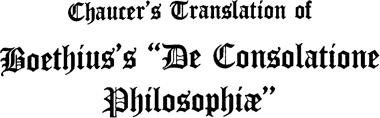
Chaucer's Translation of Boethius's "De Consolatione Philosophiae
Translated by Geoffrey, 1343? Chaucer
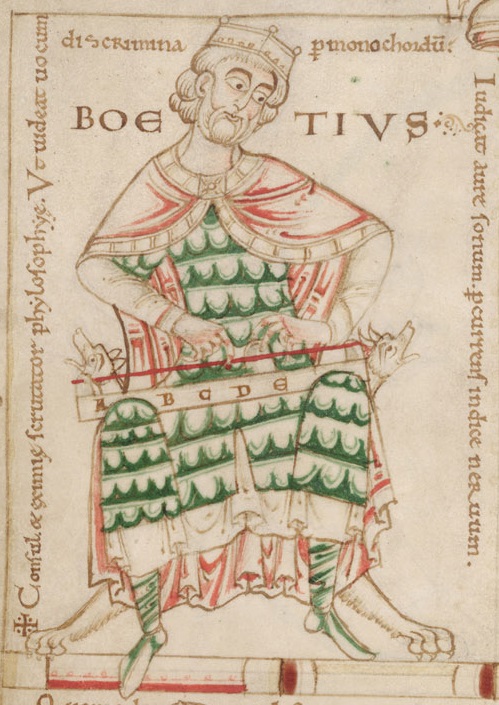
A condemned man in a prison cell, awaiting execution, turns to philosophy. This is the scene that opens one of the most consequential works in Western thought. Boethius, a Roman senator and scholar under the Gothic emperor Theodoric, has been imprisoned on false charges of treason. As death approaches, he enters into a dialogue with Lady Philosophy, who appears as his nurse and guide, dressed in patched garments but radiating authority. Through alternating prose and verse, they dissect fortune, happiness, good and evil, fate and free will, the great questions that still haunt us today. Chaucer's Middle English translation, completed in the late 14th century, renders this ancient text in the language of Chaucer's England: rough, pungent, and surprisingly intimate. This is not abstract philosophy. It is a man reasoning his way toward peace in his darkest hour, finding comfort not in wishful thinking but in rigorous thought. The Consolation shaped medieval European thought profoundly, influencing Dante and forming the intellectual backbone of Chaucer's own work. It endures because it addresses the only question that ultimately matters: how should we live when everything is taken from us?
Editions

X-Ray
“Nothing is miserable unless you think it so; and on the other hand, nothing brings happiness unless you are content with it.””
— Boethius
“Who would give a law to lovers? Love is unto itself a higher law.””
— Boethius
“Nunc fluens facit tempus,nunc stans facit aeternitatum.(The now that passes produces time, the now that remains produces eternity.)””
— Boethius
“Indeed, the condition of human nature is just this; man towers above the rest of creation so long as he realizes his own nature, and when he forgets it, he sinks lower than the beasts. For other living things to be ignorant of themselves, is natural; but for man it is a defect.””
— Boethius
“All fortune is good fortune; for it either rewards, disciplines, amends, or punishes, and so is either useful or just.””
— Boethius
“Balance out the good things and the bad that have happened in your life and you will have to acknowledge that you are still way ahead. You are unhappy because you have lost those things in which you took pleasure? But you can also take comfort in the likelihood that what is now making you miserable will also pass away.””
— Boethius
“And it is because you don't know the end and purpose of things that you think the wicked and the criminal have power and happiness.””
— Boethius
“If I have fully diagnosed the cause and nature of your condition, you are wasting away in pining and longing for your former good fortune. It is the loss of this which, as your imagination works upon you, has so corrupted your mind. I know the many disguises of that monster, Fortune, and the extent to which she seduces with friendship the very people she is striving to cheat, until she overwhelms them with unbearable grief at the suddenness of her desertion””
— Boethius
“No man is rich who shakes and groansConvinced that he needs more.””
— Boethius
Link to this book
Add a free, dofollow link to Lex on your blog, forum, syllabus, or reading list.

<a href="https://lex-books.com/book/chaucer-s-translation-of-boethius-s-de-consolatione-philosophiae-3f8ca816-1168-4134-97e4-2ec9572f47e8"><img src="https://lex-books.com/badges/read-on-lex.svg" alt="Read Chaucer's Translation of Boethius's "De Consolatione Philosophiae by Boethius free on Lex" width="160" height="40"></a>[](https://lex-books.com/book/chaucer-s-translation-of-boethius-s-de-consolatione-philosophiae-3f8ca816-1168-4134-97e4-2ec9572f47e8)[url=https://lex-books.com/book/chaucer-s-translation-of-boethius-s-de-consolatione-philosophiae-3f8ca816-1168-4134-97e4-2ec9572f47e8][img]https://lex-books.com/badges/read-on-lex.svg[/img][/url]Read Chaucer's Translation of Boethius's "De Consolatione Philosophiae by Boethius free on Lex: https://lex-books.com/book/chaucer-s-translation-of-boethius-s-de-consolatione-philosophiae-3f8ca816-1168-4134-97e4-2ec9572f47e8Cite this book
Reading this edition for a paper or guide? Copy a citation.
Boethius. Chaucer's Translation of Boethius's "De Consolatione Philosophiae. Lex, lex-books.com/book/chaucer-s-translation-of-boethius-s-de-consolatione-philosophiae-3f8ca816-1168-4134-97e4-2ec9572f47e8.Boethius (n.d.). Chaucer's Translation of Boethius's "De Consolatione Philosophiae. Lex. https://lex-books.com/book/chaucer-s-translation-of-boethius-s-de-consolatione-philosophiae-3f8ca816-1168-4134-97e4-2ec9572f47e8Boethius. Chaucer's Translation of Boethius's "De Consolatione Philosophiae. Lex. https://lex-books.com/book/chaucer-s-translation-of-boethius-s-de-consolatione-philosophiae-3f8ca816-1168-4134-97e4-2ec9572f47e8.