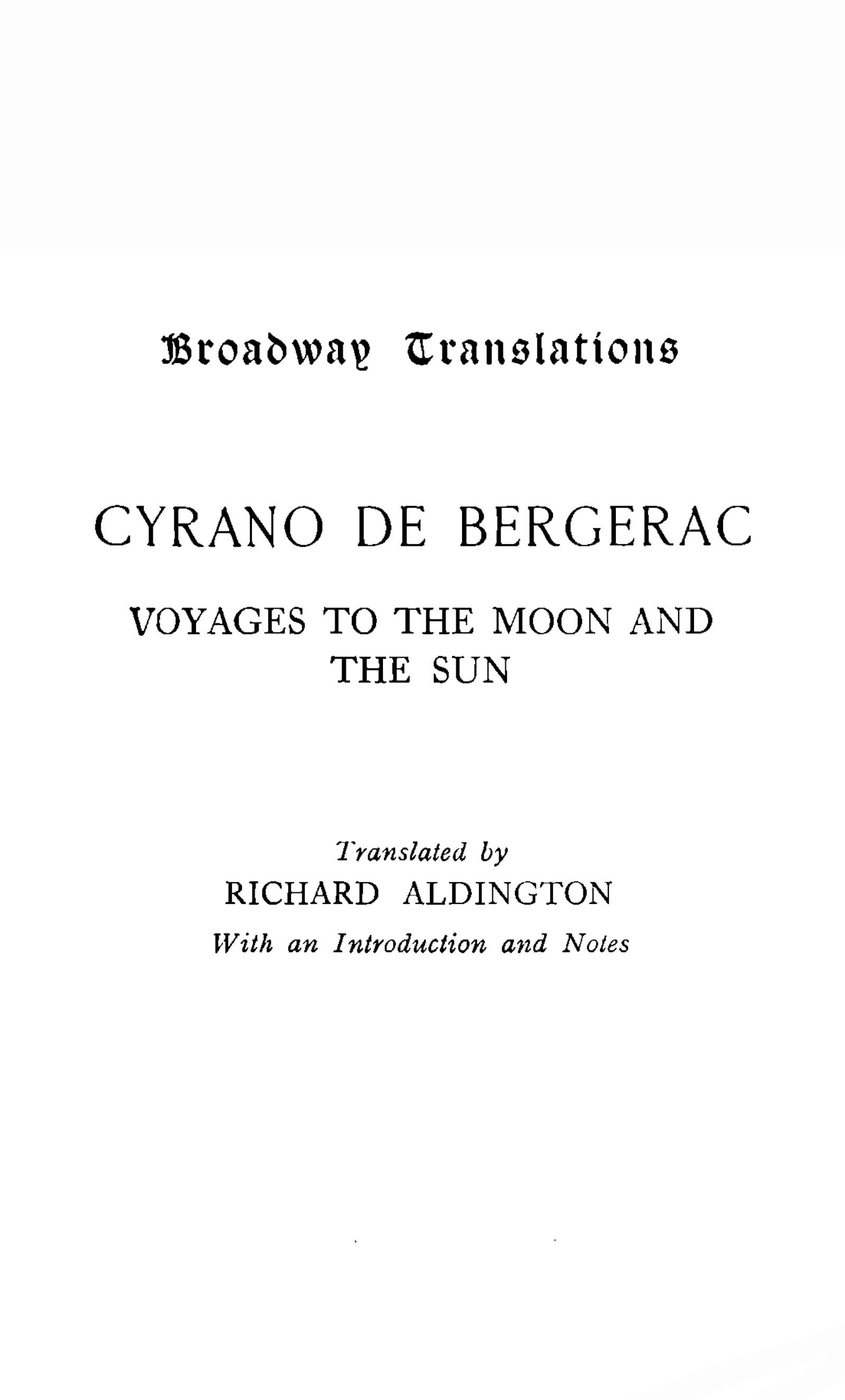
A Voyage to the Moon
1657
A Voyage to the Moon
1657
Translated by Archibald Lovell
Among the very first works of science fiction, this 1657 novel asks a question that still startles: what if the Moon is a world, and Earth its dim counterpart? Cyrano de Bergerac's narrator embarks on a fantastical journey propelled by dew and philosophical audacity, arriving on a lunar landscape where he becomes the monster. His very existence shocks the paradisiacal inhabitants, who view him as a grotesque malfunction of nature, a walking heresy. Condemned by the Moon's ecclesiastical courts for his heretical opinions, he discovers that the certitudes humanity holds sacred, religious, scientific, anthropocentric, appear trivial from a cosmic distance. The real joke runs deeper: from the Moon, Earth is the Moon, and everything we believe about our centrality collapses into vanity. This is libertine literature at its most audacious, a scathing attack on the institutions and smug certainties of 17th-century France that somehow feels urgent centuries later. For anyone curious about where science fiction began, or who delights in satirical daring that punches through time, this is the source.
Editions
X-Ray
“Более часа я занимался этим подарком, наконец, повесив эти книги себе на уши в виде серег, я пошел в город, чтобы погулять.””
— Cyrano de Bergerac
“Did your Father consult your Will and Pleasure, when he Embraced your Mother? Did he ask you, if you thought fit to see that Age, or to wait for another; if you would be satisfied to be the Son of a Sot, or if you had the Ambition to spring from a Brave Man? Alas, you whom alone the business concerned, were the only Person not consulted in the case.””
— Cyrano de Bergerac
“I fancy that the Earth does move, not for the Reasons alledged by Copernicus; but because Hell-fire being shut up in the Center of the Earth, the damned, who make a great bustle to avoid its Flames, scramble up to the Vault, as far as they can from them, and so make the Earth to turn, as a Turn-spit makes the Wheel go round when he runs about in it.””
— Cyrano de Bergerac
“Sfortunato paese, nel quale i segni della procreazione sono ignominiosi e quelli dell'annientamento sono onorevoli. Eppure, voi chiamate quel membro le parti vergognose, come se ci fosse qualcosa di più glorioso che dare la vita e di più infame che toglierla!””
— Cyrano de Bergerac
“[...]Todavia, protestais que nunca houve verdadeiras possessões. Ao ver as contorções com que agitais os pingentes de vossa roupa, ninguém duvida, aqui, de que tenhais o diabo no corpo; mas vejo bem o que é, procurais não acreditar no que temeis, e quereis curar do mal do inferno através de uma forte imaginação, mas, palavra, sede condenado ou sede salvo, que me importa! Tudo é válido, contanto que nos conventos em que fazeis vossas acrobacias só pendureis as velhas, porque a vinda do anticristo nos faz medo. Rides, senhor Jean, ao ouvir-me raciocinar deste modo, vós em quem o Apocalipse e a mitologia estão no mesmo nível. O inferno é uma historinha para assustar os homens, assim como se ameaçam os filhos do carvoeiro. Confesso que para a manutenção dos Estados, há muitas coisas verdadeiras que o povo deve ignorar, muitas falsas nas quais necessariamente deve crer, mas nossa religião não está estabelecida sobre tal máxima: uma conjuntura ainda quase milagrosa em vós é que sois ao mesmo tempo ímpio e supersticioso, compondo, com os fiozinhos de vossa vida, uma tela de ateísmo e de sortilégios, isso mostra bem que morrereis dançando as campainhas se o heléboro ou Saint-Mathurin não vos curarem.[...](trecho de carta)””
— Cyrano de Bergerac
“Embora não acrediteis em milagres”, repliquei-lhe, “eles não deixam de acontecer, e muito. Vi muitos com os meus olhos. Conheci mais de vinte doentes curados milagrosamente.”“Vós dizeis”, interrompeu-me ele, “que aquelas pessoas foram curadas por milagre, mas não sabeis que a força da imaginação é capaz de combater todas as doenças, por causa de um certo bálsamo natural difundido em nossos corpos, contendo todas as qualidades contrárias a todas as de cada mal que nos ataca; e nossa imaginação, advertida pela dor, vai escolher, em seu lugar, o remédio específico que ela opõe ao veneno e nos cura. É por isso que o mais hábil médico de nosso mundo aconselha o doente a escolher de preferência um médico ignorante, que ele considerará muito hábil, do que escolher um muito hábil, que ele considerará ignorante, porque crê que nossa imaginação trabalha para a nossa saúde; por pouco que ela seja ajudada pelos remédios, ela é capaz de nos curar; mas como os mais poderosos eram fracos quando a imaginação não se esforçava! Espantai-vos porque os primeiros homens de nosso mundo viviam tantos séculos sem ter nenhum conhecimento da medicina? Sua natureza era forte, esse bálsamo universal não era dissipado pelas drogas que nossos médicos usam. Para entrar em convalescença eles só podiam desejar ardentemente e imaginar que estavam curados. Logo, sua fantasia, clara, vigorosa e decidida, ia mergulhando nesse óleo vital, aplicava o ativo ao passivo e, quase num abrir e fechar dos olhos, ei-los sãos como antes. Ainda hoje acontecem curas espantosas, mas o povo as atribui a um milagre.””
— Cyrano de Bergerac
“Ao abrir a caixa, encontrei um não-sei-quê de metal quase completamente igual aos nossos relógios, cheio de um número infinito de pequenas molas e de maquinismos imperceptíveis. Na verdade, é um livro, mas é um livro milagroso que não possui folhas nem letras; enfim, é um livro em que, para aprender, os olhos são inúteis; só precisamos de orelhas. Portanto, quando alguém deseja ler, com uma grande quantidade de chaves ele liga essa máquina, depois gira a agulha para o assunto que deseja ouvir, e ao mesmo tempo sai desse bojo, como da boca de um homem ou de um instrumento de música, todos os sons distintos e diferentes que servem, entre os grandes habitantes lunares, para a expressão de linguagem.“Quando refleti sobre aquela milagrosa invenção de fazer livros, não mais me espantei ao ver que os jovens daquela região possuíam maiores conhecimentos aos dezesseis e dezoito anos do que os velhos encanecidos da nossa; pois, como sabem ler logo depois de saber falar, não ficam sem leitura; no quarto, ao passear, na cidade, em viagem, a pé, a cavalo, podem ter no bolso, ou dependurados nos arções de suas selas, uns trinta daqueles livros dos quais basta ligar uma mola para ouvir só um capítulo, ou então vários se estão com disposição de escutar um livro inteiro; tendes assim, eternamente ao vosso redor, todos os grandes homens, tanto mortos como vivos, que vos entretêm de viva voz.””
— Cyrano de Bergerac
“[...]Dou-vos ainda este outro [livro], de que gosto muito mais, A Grande Obra dos Filósofos, que foi composto por um dos mais fortes espíritos do Sol. Nele, o autor prova que todas as coisas são verdadeiras e mostra a maneira de unir fisicamente as verdades de cada oposição, como, por exemplo, que o branco é preto e o preto é branco; que se pode ser e não ser ao mesmo tempo; que pode haver uma montanha sem vale; que o nada é alguma coisa e que todas as coisas que existem não existem. Mas observai que ele prova esses inauditos paradoxos sem nenhuma razão capciosa nem fraudulenta.[...]””
— Cyrano de Bergerac
Link to this book
Add a free, dofollow link to Lex on your blog, forum, syllabus, or reading list.

<a href="https://lex-books.com/book/a-voyage-to-the-moon-ac578b38-d5ae-47c9-a5a6-32feb3f834d6"><img src="https://lex-books.com/badges/read-on-lex.svg" alt="Read A Voyage to the Moon by Cyrano de Bergerac free on Lex" width="160" height="40"></a>[](https://lex-books.com/book/a-voyage-to-the-moon-ac578b38-d5ae-47c9-a5a6-32feb3f834d6)[url=https://lex-books.com/book/a-voyage-to-the-moon-ac578b38-d5ae-47c9-a5a6-32feb3f834d6][img]https://lex-books.com/badges/read-on-lex.svg[/img][/url]Read A Voyage to the Moon by Cyrano de Bergerac free on Lex: https://lex-books.com/book/a-voyage-to-the-moon-ac578b38-d5ae-47c9-a5a6-32feb3f834d6Cite this book
Reading this edition for a paper or guide? Copy a citation.
Bergerac, Cyrano de. A Voyage to the Moon. Lex, lex-books.com/book/a-voyage-to-the-moon-ac578b38-d5ae-47c9-a5a6-32feb3f834d6.Bergerac, C. D. (1657). A Voyage to the Moon. Lex. https://lex-books.com/book/a-voyage-to-the-moon-ac578b38-d5ae-47c9-a5a6-32feb3f834d6Bergerac, Cyrano de. A Voyage to the Moon. Lex. https://lex-books.com/book/a-voyage-to-the-moon-ac578b38-d5ae-47c9-a5a6-32feb3f834d6.