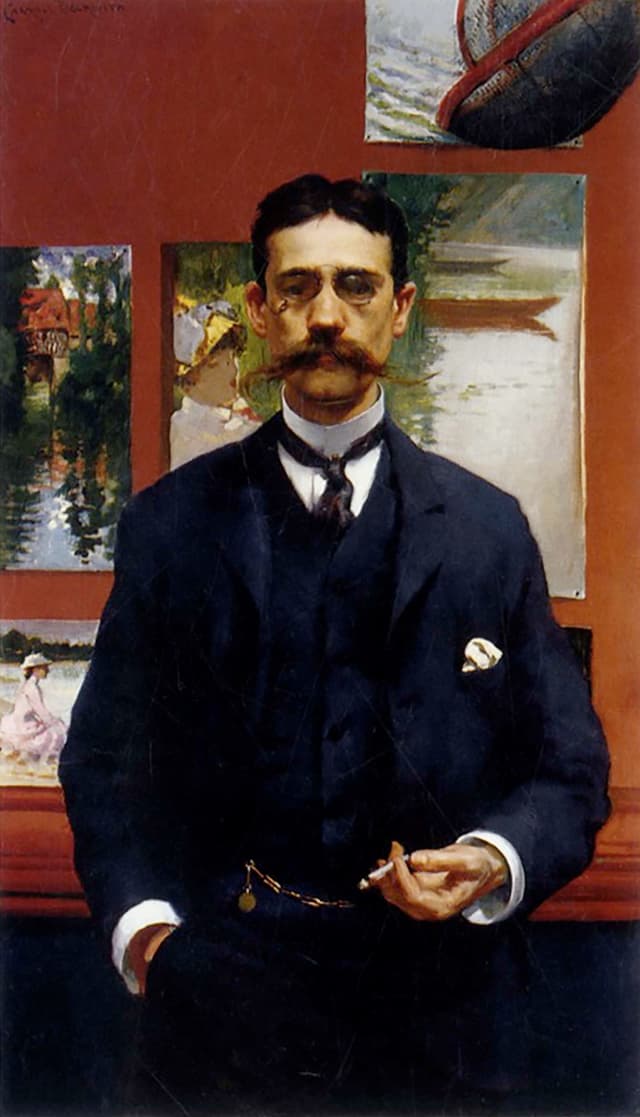
William Walton
Sir William Turner Walton OM (29 March 1902 – 8 March 1983) was an English composer. During a sixty-year career, he wrote music in several classical genres and styles, from film scores to opera. His best-known works include Façade, the cantata Belshazzar's Feast, the Viola Concerto, the First Symphony, and the British coronation marches Crown Imperial and Orb and Sceptre. Born in Oldham, Lancashire, the son of a musician, Walton was a chorister and then an undergraduate at Christ Church, Oxford. On leaving the university, he was taken up by the literary Sitwell siblings, who provided him with a home and a cultural education. His earliest work of note was a collaboration with Edith Sitwell, Façade, which at first brought him notoriety as a modernist, but later became a popular ballet score. In middle age, Walton left England and set up home with his young wife Susana on the Italian island of Ischia. By this time, he had ceased to be regarded as a modernist, and some of his compositions of the 1950s were criticised as old-fashioned. His only full-length opera, Troilus and Cressida, was among the works to be so labelled and has made little impact in opera houses. In his last years, his works came back into critical fashion; his later compositions, dismissed by critics at the time of their premieres, were revalued and regarded alongside his earlier works.
Famous Quotes
View all 1 quotes“Censorship and the suppression of reading materials are rarely about family values and almost always about control; About who is snapping the whip, who is saying no, and who is saying go. Censorship's bottom line is this: if the novel Christine offends me, I don't want just to make sure it's kept from my kid; I want to make sure it's kept from your kid, as well, and all the kids. This bit of intellectual arrogance, undemocratic and as old as time, is best expressed this way: "If it's bad for me and my family, it's bad for everyone's family." Yet when books are run out of school classrooms and even out of school libraries as a result of this idea, I'm never much disturbed not as a citizen, not as a writer, not even as a schoolteacher . . . which I used to be. What I tell kids is, Don't get mad, get even. Don't spend time waving signs or carrying petitions around the neighborhood. Instead, run, don't walk, to the nearest nonschool library or to the local bookstore and get whatever it was that they banned. Read whatever they're trying to keep out of your eyes and your brain, because that's exactly what you need to know.”
Books from the author

Link to this page
Add a free, dofollow link to Lex on your blog, forum, syllabus, or reading list.

<a href="https://lex-books.com/author/william-walton"><img src="https://lex-books.com/badges/read-on-lex.svg" alt="William Walton on Lex" width="160" height="40"></a>[](https://lex-books.com/author/william-walton)[url=https://lex-books.com/author/william-walton][img]https://lex-books.com/badges/read-on-lex.svg[/img][/url]William Walton on Lex: https://lex-books.com/author/william-walton