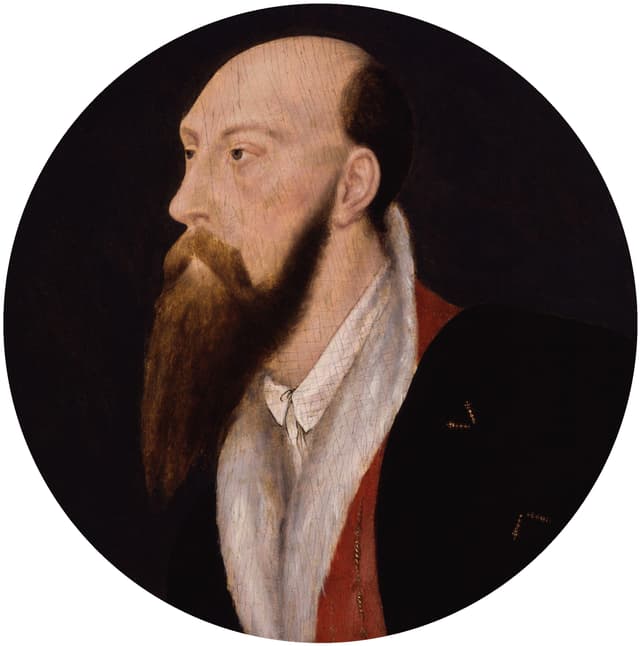
Thomas Wyatt
Thomas Wyatt was an English poet and diplomat, recognized as one of the foremost figures of the early Tudor period. Born into a prominent family, he was educated at St. John's College, Cambridge, and became a courtier under King Henry VIII. Wyatt is best known for introducing the Petrarchan sonnet form to English literature, which significantly influenced the development of English poetry. His poems, such as 'Whoso List to Hunt' and 'The Long Love That in My Thought Doth Harbor,' reflect themes of love, desire, and the complexities of courtly life, often infused with a sense of melancholy and introspection. Wyatt's literary significance lies not only in his innovative use of form but also in his ability to convey deep emotional resonance through his work. He was a pioneer in the use of the sonnet, paving the way for later poets like Sir Philip Sidney and William Shakespeare. Despite his relatively small body of work, Wyatt's contributions to English poetry have been recognized as foundational, marking a transition from medieval to Renaissance literature. His legacy endures as a testament to the evolving nature of poetic expression during a transformative period in English history.
Famous Quotes
View all 3 quotes“I find no peace, and all my war is done, I fear and hope; I burn and freeze like ice; I fly above the wind yet can I not arise; And naught I have and all the world I seize on. That looseth nor locketh holdeth me in prison, And holdeth me not, yet can I scape nowise; Nor letteth me live nor die at my devise, And yet of death it giveth none occasion. Without eyen I see, and without tongue I plain; I desire to perish, and yet I ask health; I love another, and thus I hate myself; I feed me in sorrow, and laugh in all my pain. Likewise displeaseth me both death and life And my delight is causer of this strife.”
“Noli me tangere, for Caesar's I am / And wild for to hold, though I seem tame.”
“Whoso list to hunt, I know where is an hind, But as for me, hélas, I may no more. The vain travail hath wearied me so sore, I am of them that farthest cometh behind. Yet may I by no means my wearied mind Draw from the deer, but as she fleeth afore Fainting I follow. I leave off therefore, Sithens in a net I seek to hold the wind. Who list her hunt, I put him out of doubt, As well as I may spend his time in vain. And graven with diamonds in letters plain There is written, her fair neck round about: Noli me tangere, for Caesar's I am, And wild for to hold, though I seem tame.”
Books from the author




Link to this page
Add a free, dofollow link to Lex on your blog, forum, syllabus, or reading list.

<a href="https://lex-books.com/author/thomas-wyatt"><img src="https://lex-books.com/badges/read-on-lex.svg" alt="Thomas Wyatt on Lex" width="160" height="40"></a>[](https://lex-books.com/author/thomas-wyatt)[url=https://lex-books.com/author/thomas-wyatt][img]https://lex-books.com/badges/read-on-lex.svg[/img][/url]Thomas Wyatt on Lex: https://lex-books.com/author/thomas-wyatt