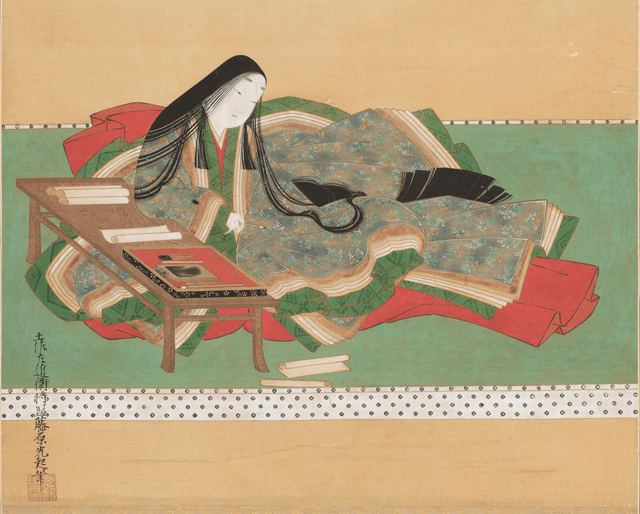
Murasaki Shikibu
Murasaki Shikibu was a Japanese novelist and poet, best known for her groundbreaking work, 'The Tale of Genji.' Written during the Heian period, this novel is often regarded as the world's first psychological novel, exploring the complexities of court life and human emotions through the life of its protagonist, Hikaru Genji. Murasaki's keen observations of the intricacies of love, power, and social dynamics set a precedent for future literature, establishing her as a pioneering figure in the genre of fiction. Little is known about Murasaki's early life, but she was likely born into a noble family and received an education that was uncommon for women of her time. Her literary contributions extended beyond 'The Tale of Genji,' as she also wrote essays and poetry, showcasing her versatility and depth as a writer. Murasaki Shikibu's influence on Japanese literature is profound; her works have inspired countless adaptations and interpretations, and she remains a symbol of women's literary achievement in a male-dominated society. Her legacy endures, as 'The Tale of Genji' continues to be studied and celebrated for its rich narrative and cultural significance.
Famous Quotes
View all 20 quotes“It is useless to talk with those who do not understand one and troublesome to talk with those who criticize from a feeling of superiority. Especially one-sided persons are troublesome. Few are accomplished in many arts and most cling narrowly to their own opinion.””
“To be pleasant, gentle, calm and self-possessed: this is the basis of good taste and charm in a woman. No matter how amorous or passionate you may be, as long as you are straightforward and refrain from causing others embarrassment, no one will mind. But women who are too vain and act pretentiously, to the extent that they make others feel uncomfortable, will themselves become the object of attention; and once that happens, people will find fault with whatever they say or do; whether it be how they enter a room, how they sit down, how they stand up or how they take their leave. Those who end up contradicting themselves and those who disparage their companions are also carefully watched and listened to all the more. As long as you are free from such faults, people will surely refrain from listening to tittle-tattle and will want to show you sympathy, if only for the sake of politeness. I am of the opinion that when you intentionally cause hurt to another, or indeed if you do ill through mere thoughtless behavior, you fully deserve to be censured in public. Some people are so good-natured that they can still care for those who despise them, but I myself find it very difficult. Did the Buddha himself in all his compassion ever preach that one should simply ignore those who slander the Three Treasures? How in this sullied world of ours can those who are hard done by be expected to reciprocate in kind?””
Books from the author














Link to this page
Add a free, dofollow link to Lex on your blog, forum, syllabus, or reading list.

<a href="https://lex-books.com/author/murasaki-shikibu"><img src="https://lex-books.com/badges/read-on-lex.svg" alt="Murasaki Shikibu on Lex" width="160" height="40"></a>[](https://lex-books.com/author/murasaki-shikibu)[url=https://lex-books.com/author/murasaki-shikibu][img]https://lex-books.com/badges/read-on-lex.svg[/img][/url]Murasaki Shikibu on Lex: https://lex-books.com/author/murasaki-shikibu