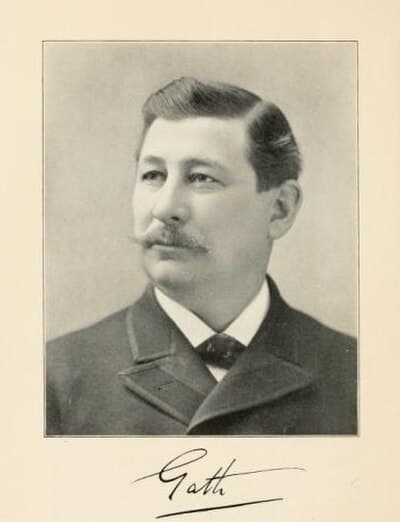
George Alfred Townsend
George Alfred Townsend, known by his pen name Gath, was an influential American journalist and novelist recognized for his vivid reporting during the American Civil War. As one of the youngest war correspondents of his time, he worked for prominent newspapers such as the Philadelphia Inquirer, New York Herald, and Chicago Tribune. His most notable work, 'The Life, Crime, and Capture of John Wilkes Booth,' published in 1865, was a direct result of his coverage of the assassination of Abraham Lincoln, showcasing his ability to blend journalism with narrative storytelling. Townsend's firsthand accounts provided a unique perspective on the tumultuous events of the era, solidifying his reputation as a significant figure in American journalism. In addition to his reporting, Townsend ventured into editing and publishing, co-founding the Washington D.C. newspaper the Capital in 1871. He later established an estate named Gapland in Maryland, where he built the National War Correspondents Memorial to honor journalists who lost their lives in conflict. Townsend's legacy endures through his contributions to war journalism and his efforts to commemorate the sacrifices of his fellow correspondents, with his estate now serving as Gathland State Park, a testament to his impact on both literature and journalism.
Famous Quotes
View all 1 quotes“Last night, the 27th of April, a small row boat received the carcass of the murderer; two men were in it, they carried the body off into the darkness, and out of that darkness it will never return…. In the darkness, like his great crime, may it remain forever, impalpable, invisible, nondescript, condemned to that worse than damnation,—annihilation. The river-bottom may ooze about it laden with great shot and drowning manacles. The earth may have opened to give it that silence and forgiveness which man will never give its memory. The fishes may swim around it, or the daisies grow white above it; but we shall never know. Mysterious, incomprehensible, unattainable, like the dim times through which we live and think upon as if we only dreamed them in perturbed fever, the assassin of a nation’s head rests somewhere in the elements, and that is all; but if the indignant seas or the profaned turf shall ever vomit his corpse from their recesses, and it receive humane or Christian burial from some who do not recognize it, let the last words those decaying lips ever uttered be carved above them with a dagger, to tell the history of a young and once promising life—USELESS! USELESS!”
Books from the author



Link to this page
Add a free, dofollow link to Lex on your blog, forum, syllabus, or reading list.

<a href="https://lex-books.com/author/george-alfred-townsend"><img src="https://lex-books.com/badges/read-on-lex.svg" alt="George Alfred Townsend on Lex" width="160" height="40"></a>[](https://lex-books.com/author/george-alfred-townsend)[url=https://lex-books.com/author/george-alfred-townsend][img]https://lex-books.com/badges/read-on-lex.svg[/img][/url]George Alfred Townsend on Lex: https://lex-books.com/author/george-alfred-townsend