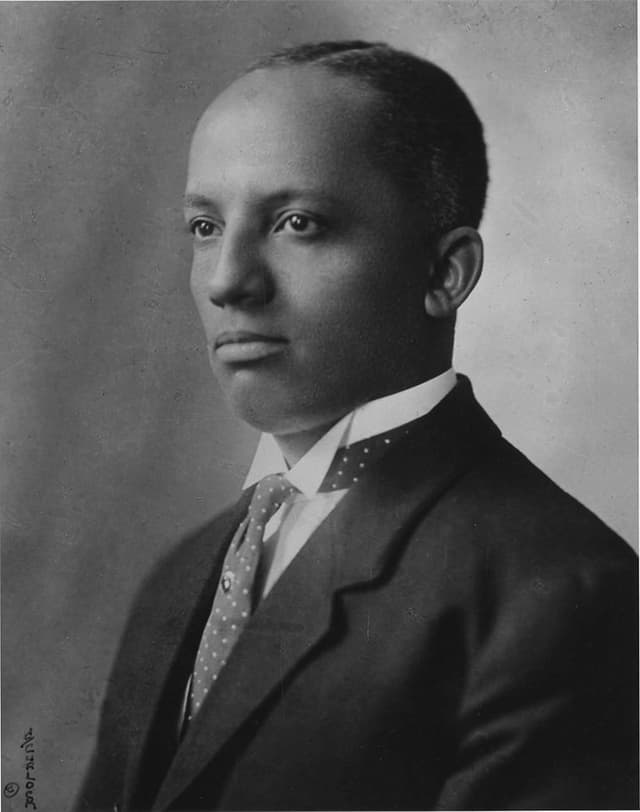
Carter Godwin Woodson
Carter Godwin Woodson was a pioneering American historian and author, widely regarded as the 'father of Black history.' Born in Virginia to former slaves, he faced significant obstacles in his early education, working in coal mines before eventually graduating from Berea College. Woodson earned graduate degrees from the University of Chicago and became the second African American to receive a PhD from Harvard University, making him the only individual with enslaved parents in the U.S. to achieve such a distinction in history. His academic journey laid the groundwork for his lifelong commitment to the study and promotion of African American history. In 1916, Woodson founded The Journal of Negro History, which became a vital platform for scholarly work on the Black experience in America. He also established the Association for the Study of African American Life and History (ASALH) and initiated the celebration of 'Negro History Week' in 1926, which later evolved into Black History Month. Woodson's work emphasized the importance of placing people of Sub-Saharan African descent at the center of historical narratives, challenging the prevailing Eurocentric perspectives of his time. His legacy continues to influence the fields of history and education, underscoring the significance of African American contributions to the broader tapestry of American history.
Famous Quotes
View all 8 quotes“If you can control a man's thinking you do not have to worry about his action. When you determine what a man shall think you do not have to concern yourself about what he will do. If you make a man feel that he is inferior, you do not have to compel him to accept an inferior status, for he will seek it himself. If you make a man think that he is justly an outcast, you do not have to order him to the back door. He will go without being told; and if there is no back door, his very nature will demand one.””
“History shows that it does not matter who is in power or what revolutionary forces take over the government, those who have not learned to do for themselves and have to depend solely on others never obtain any more rights or privileges in the end than they had in the beginning.””
“No man knows what he can do until he tries.””
Books from the author



Link to this page
Add a free, dofollow link to Lex on your blog, forum, syllabus, or reading list.

<a href="https://lex-books.com/author/carter-godwin-woodson"><img src="https://lex-books.com/badges/read-on-lex.svg" alt="Carter Godwin Woodson on Lex" width="160" height="40"></a>[](https://lex-books.com/author/carter-godwin-woodson)[url=https://lex-books.com/author/carter-godwin-woodson][img]https://lex-books.com/badges/read-on-lex.svg[/img][/url]Carter Godwin Woodson on Lex: https://lex-books.com/author/carter-godwin-woodson