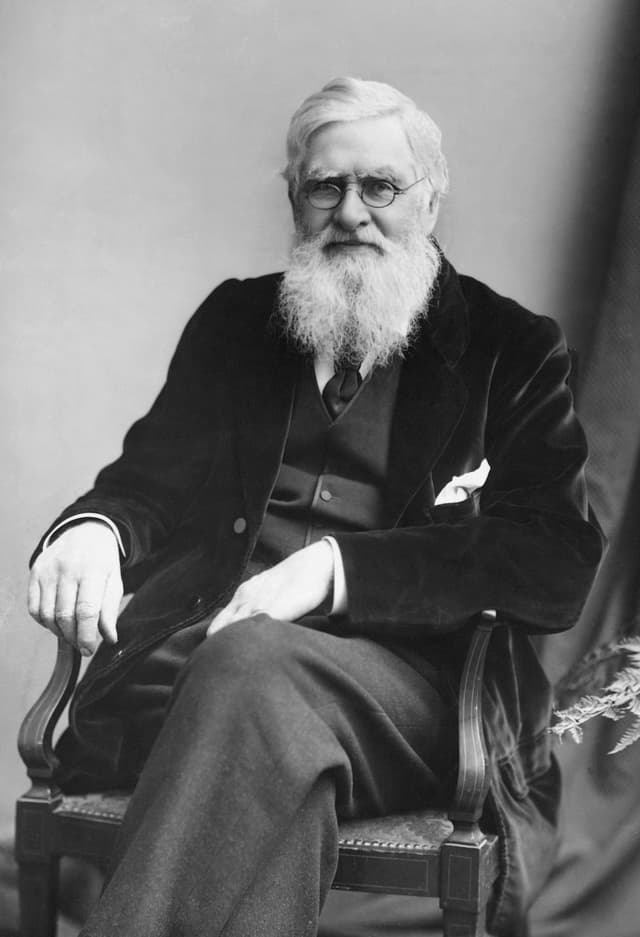
Alfred Russel Wallace
Alfred Russel Wallace was an influential English naturalist and explorer, best known for independently formulating the theory of evolution through natural selection. His groundbreaking 1858 paper on the subject, presented alongside extracts from Charles Darwin's earlier work, prompted Darwin to expedite the publication of his own seminal text, On the Origin of Species, in 1859. Wallace's extensive fieldwork in the Amazon River basin and the Malay Archipelago led to significant discoveries, including the identification of the Wallace Line, which delineates the distinct faunal regions of Asia and Australasia. This work established him as a leading figure in biogeography, earning him the title of the 'father of biogeography' and making him a key contributor to the understanding of species distribution. In addition to his contributions to evolutionary theory, Wallace explored various aspects of natural history, including warning coloration in animals and the mechanisms of speciation, known as the Wallace effect. His 1904 book, Man's Place in the Universe, marked a pioneering attempt to assess the possibility of extraterrestrial life, positioning him as one of the first scientists to seriously consider the existence of life on other planets, including Mars. Wallace's legacy endures not only through his scientific achievements but also as a prominent figure in the history of evolutionary thought, whose ideas continue to influence contemporary biology and ecology.
Famous Quotes
View all 3 quotes“[I]t is indisputably the mediocre, if not the low, both as regards morality and intelligence, who succeed in life and multiply the fastest.”
“{ Letter to his brother, 1861 } ... I remain an utter disbeliever in almost all that you consider the most sacred truths... But whether there be a God and whatever be His nature; whether we have an immortal soul or not, or whatever may be our state after death, I can have no fear of having to suffer for the study of nature and the search for truth, or believe that those will be better off in a future state who have lived in the belief of doctrines inculcated from childhood, and which are to them rather a matter of blind faith than intelligent conviction .”
“Truth is born into this world only with pangs and tribulations, and every fresh truth is received unwillingly.”
Books from the author


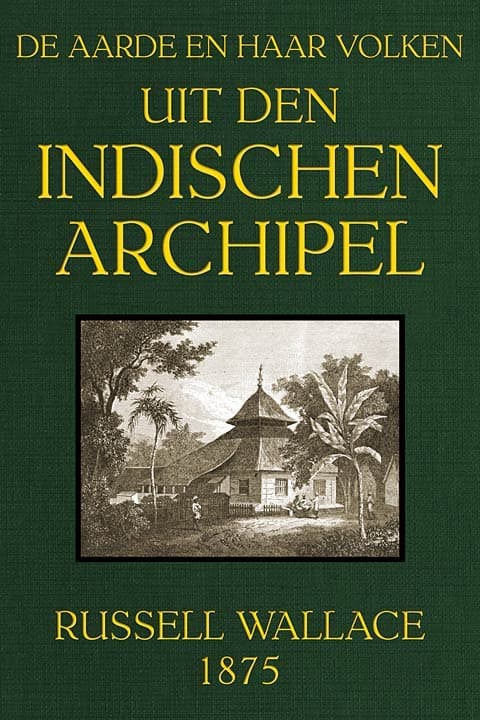




Link to this page
Add a free, dofollow link to Lex on your blog, forum, syllabus, or reading list.

<a href="https://lex-books.com/author/alfred-russel-wallace"><img src="https://lex-books.com/badges/read-on-lex.svg" alt="Alfred Russel Wallace on Lex" width="160" height="40"></a>[](https://lex-books.com/author/alfred-russel-wallace)[url=https://lex-books.com/author/alfred-russel-wallace][img]https://lex-books.com/badges/read-on-lex.svg[/img][/url]Alfred Russel Wallace on Lex: https://lex-books.com/author/alfred-russel-wallace