The Story of a Country Town
1883
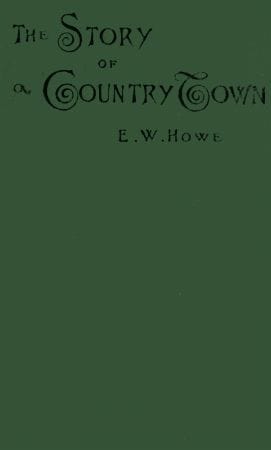
Before Steinbeck, before Hemingway, there was E.W. Howe, writing with brutal honesty about the emptiness of rural American life. Published in 1883, The Story of a Country Town follows Ned Westlock, the son of a harsh, uncompromising preacher in the dying town of Fairview on the American prairie. Through Ned's eyes, we witness the grinding poverty, the suffocating religious orthodoxy, and the quiet desperation that defines his world. His father preaches a Gospel of suffering, while neighbors drown their disappointments in alcohol and children grow up hollowed by tedium. Ned finds one ally in Jo Erring, a dreamer who wants to become a miller, but even hope feels muted against the gray sky of the plains. This is not the nostalgic pastoral of later American literature. It is something more honest: a reckoning with what it means to be trapped in a place that offers nothing, to believe in a God who seems absent, to want desperately to escape and have nowhere to go. Howe's novel laid groundwork that Sherwood Anderson and Sinclair Lewis would later build upon, but its stark, unsentimental portrait remains singular. It is for readers who believe American literature began with Fitzgerald's glamour or Hemingway's machismo: this is a necessary correction. Howe wrote about the losers, the pious hypocrites, the broken dreams of places no one writes poems about.
Editions

Link to this book
Add a free, dofollow link to Lex on your blog, forum, syllabus, or reading list.

<a href="https://lex-books.com/book/the-story-of-a-country-town-4b166589-6d42-4323-8aff-0b3cdb6b7d38"><img src="https://lex-books.com/badges/read-on-lex.svg" alt="Read The Story of a Country Town by E. W. Howe free on Lex" width="160" height="40"></a>[](https://lex-books.com/book/the-story-of-a-country-town-4b166589-6d42-4323-8aff-0b3cdb6b7d38)[url=https://lex-books.com/book/the-story-of-a-country-town-4b166589-6d42-4323-8aff-0b3cdb6b7d38][img]https://lex-books.com/badges/read-on-lex.svg[/img][/url]Read The Story of a Country Town by E. W. Howe free on Lex: https://lex-books.com/book/the-story-of-a-country-town-4b166589-6d42-4323-8aff-0b3cdb6b7d38Cite this book
Reading this edition for a paper or guide? Copy a citation.
Howe, E. W.. The Story of a Country Town. Lex, lex-books.com/book/the-story-of-a-country-town-4b166589-6d42-4323-8aff-0b3cdb6b7d38.Howe, E. W. (1883). The Story of a Country Town. Lex. https://lex-books.com/book/the-story-of-a-country-town-4b166589-6d42-4323-8aff-0b3cdb6b7d38Howe, E. W.. The Story of a Country Town. Lex. https://lex-books.com/book/the-story-of-a-country-town-4b166589-6d42-4323-8aff-0b3cdb6b7d38.