The Spanish Tragedie
1587
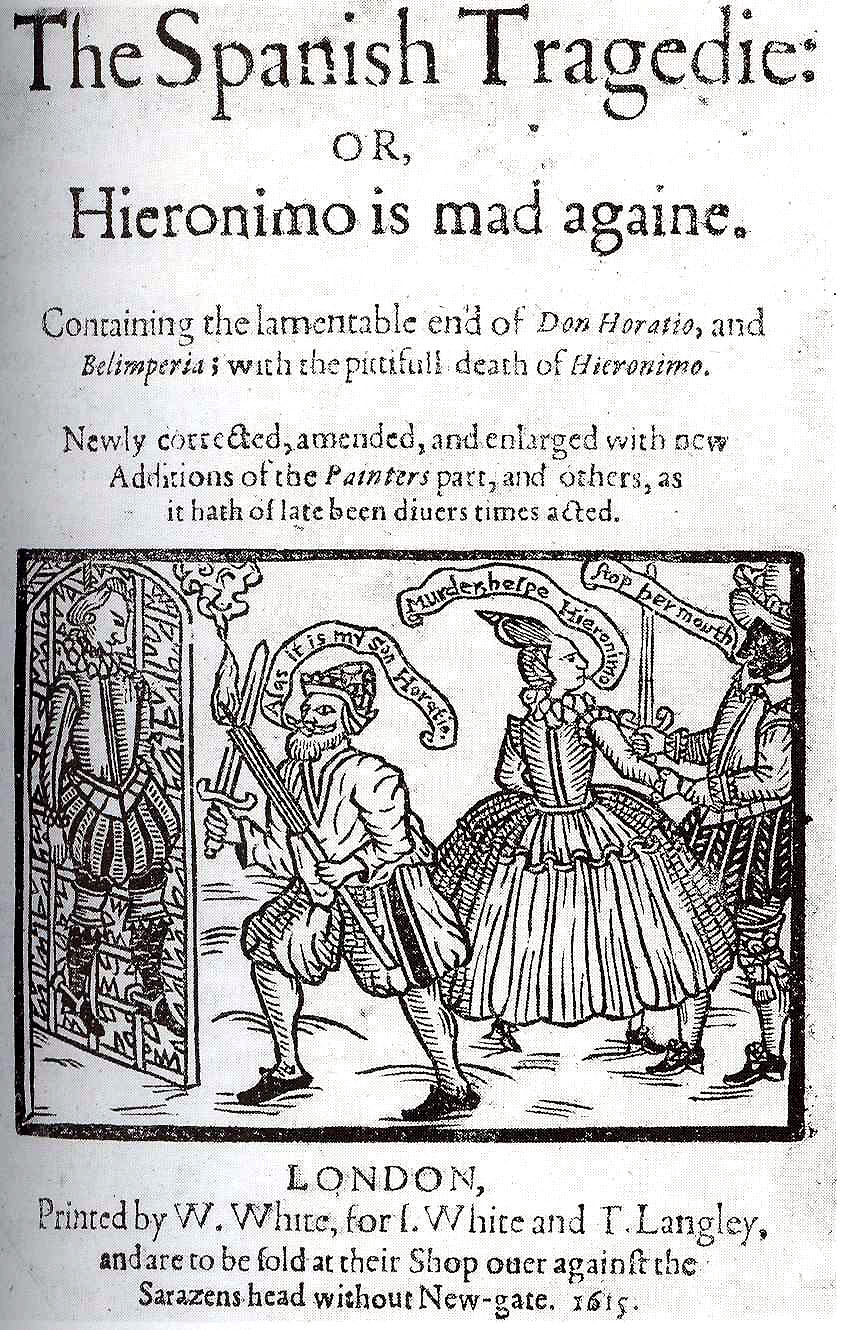
When the Ghost of Andrea demands justice from the personified spirit of Revenge, he sets in motion a chain of murder and madness that will consume the Spanish court. The aged knight-marshal Hieronimo, hero of Spain's wars against Portugal, returns to find his beloved son Horatio slain by envious rivals and his honor destroyed. What follows is a descent into rhetorical fury and calculated violence that invented the revenge tragedy as a dramatic form. Kyd gives his protagonist not merely a grief to bear but a language of anguish so powerful it transcended the stage itself, making Hieronimo the very image of a father destroyed by loss. The play pulses with the raw energy of a culture obsessed with honor, blood-debts, and the question of whether justice can ever truly be served by murder. Its influence on Hamlet is direct and undeniable: the ghost demanding vengeance, the play-within-a-play used to expose a killer, the hero teetering on the edge of suicide. Four centuries later, this remains visceral theater, its violence not softened by time, its grief still raw.
Editions
X-Ray
“The less I speak, the more I meditate.””
— Thomas Kyd
“Let dangers go; thy war shall be with me,But such a war, as breaks no bonds of peace.Speak thou fair words, I'll cross them with fair words;Send thou sweet looks, I'll meet them with sweet looks;Write loving lines, I'll answer loving lines;Give me a kiss, I'll countercheck thy kiss.Be this our warring peace, or peaceful war.””
— Thomas Kyd
“My soule, poore soule thou talkes of things/ Thou knowest not what, my soule hath sliver wings,/ That mounts me up unto the highest heavens.””
— Thomas Kyd
“HIERONIMO. O eyes! no eyes, but fountains fraught with tears; O life! no life, but lively form of death O world! no world, but mass of public wrongs, Confus'd and fill'd with murder and misdeeds! O sacred heav'ns! if this unhallowed deed, If this inhuman and barbarous attempt, If this incomparable murder thus Of mine, but now no more my son, Shall unreveal'd and unreveng'd pass, How should we term your dealings to be just, If you unjustly deal with those that in your justice trust?””
— Thomas Kyd
“I'll trust myself, myself shall be my friend.””
— Thomas Kyd
“My grief no heart, my thoughts no tongue can tell.””
— Thomas Kyd
“Fear shall force what friendship cannot win.””
— Thomas Kyd
“That that is good for the body is likewise good for the soul.””
— Thomas Kyd
“Qui jacet in terra non habet unde cadat. In me consumpsit vires fortuna nocendo, Nil superest ut iam possit obesse magis." (loosely translated: "He who lies on the ground can fall no farther. In me, Fortune has exhausted her power of hurting; nothing remains that can harm me anymore.")””
— Thomas Kyd
Link to this book
Add a free, dofollow link to Lex on your blog, forum, syllabus, or reading list.

<a href="https://lex-books.com/book/the-spanish-tragedie-0ec342b8-e8bd-4eef-b3ee-8284e9816094"><img src="https://lex-books.com/badges/read-on-lex.svg" alt="Read The Spanish Tragedie by Thomas Kyd free on Lex" width="160" height="40"></a>[](https://lex-books.com/book/the-spanish-tragedie-0ec342b8-e8bd-4eef-b3ee-8284e9816094)[url=https://lex-books.com/book/the-spanish-tragedie-0ec342b8-e8bd-4eef-b3ee-8284e9816094][img]https://lex-books.com/badges/read-on-lex.svg[/img][/url]Read The Spanish Tragedie by Thomas Kyd free on Lex: https://lex-books.com/book/the-spanish-tragedie-0ec342b8-e8bd-4eef-b3ee-8284e9816094Cite this book
Reading this edition for a paper or guide? Copy a citation.
Kyd, Thomas. The Spanish Tragedie. Lex, lex-books.com/book/the-spanish-tragedie-0ec342b8-e8bd-4eef-b3ee-8284e9816094.Kyd, T. (1587). The Spanish Tragedie. Lex. https://lex-books.com/book/the-spanish-tragedie-0ec342b8-e8bd-4eef-b3ee-8284e9816094Kyd, Thomas. The Spanish Tragedie. Lex. https://lex-books.com/book/the-spanish-tragedie-0ec342b8-e8bd-4eef-b3ee-8284e9816094.