The Return
1922
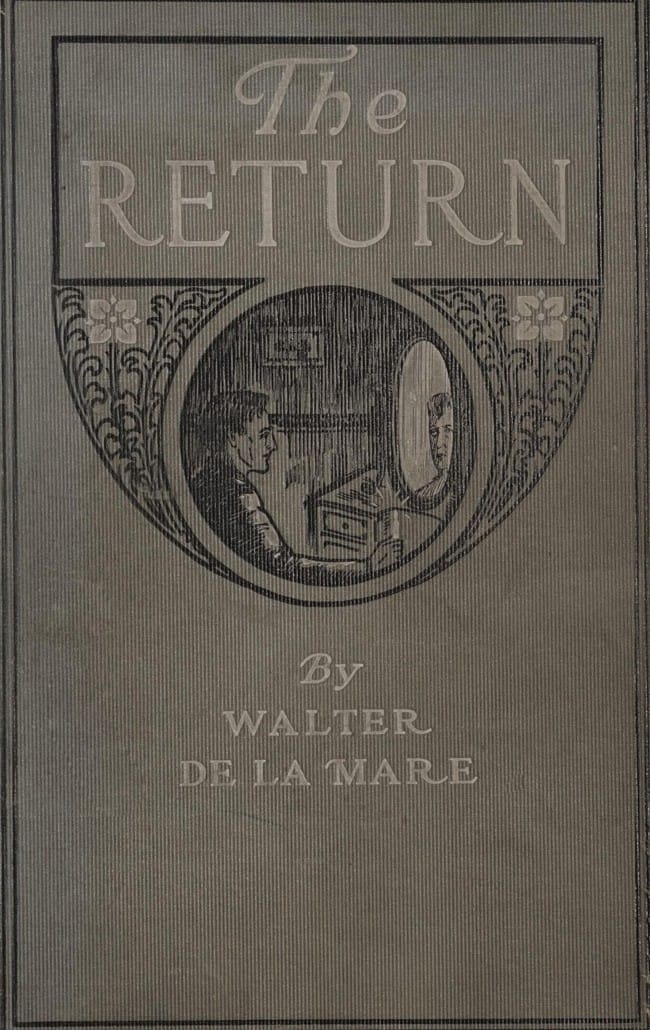
A man walks into an old churchyard, tired from illness, seeking solitude among the gravestones. He dozes in the autumn dampness. When he wakes, something has changed. He looks the same in the mirror. His wife looks at him with fear. He has become a stranger in his own life, inhabited by the spirit of an 18th-century pirate whose bones lie somewhere in that ancient ground. This is psychological horror at its most intimate: not ghosts rattling chains, but the quiet dissolution of a man watching himself become someone else. Arthur Lawford's body houses another consciousness, one with violent memories and alien desires. De la Mare probes the fragility of selfhood with exquisite, unsettling prose. The domestic sphere becomes a theater of creeping dread as Arthur confronts his wife's terror and his own diminishing grip on who he was. What begins as a meditation on mortality in a tranquil churchyard becomes a harrowing exploration of identity: who are we when we're no longer the only one inhabiting our skin?
Editions
X-Ray
“After all, what is every man? A horde of ghosts – like a Chinese nest of boxes – oaks that were acorns that were oaks. Death lies behind us, not in front – in our ancestors, back and back until...””
— Walter De la Mare
“God has mercifully ordered that the human brain works slowly; first the blow, hours afterwards the bruise.””
— Walter De la Mare
“Once a man strays out of the common herd, he's more likely to meet wolves in the thickets than angels.””
— Walter De la Mare
“He got out of bed and peeped through the blinds. To the east and opposite to him gardens and an apple-orchard lay, and there in strange liquid tranquility hung the morning star, and rose, rilling into the dusk of night the first grey of dawn. The street beneath its autumn leaves was vacant, charmed, deserted.””
— Walter De la Mare
“An hour's terror is better than a lifetime of timidity.””
— Walter De la Mare
“What a haunting, inescapable riddle life was.””
— Walter De la Mare
“It was a pity thoughts always ran the easiest way, like water in old ditches.””
— Walter De la Mare
“Lear, Macbeth. Mercutio – they live on their own as it were. The newspapers are full of them, if we were only the Shakespeares to see it. Have you ever been in a Police Court? Have you ever watched tradesmen behind their counters? My soul, the secrets walking in the streets! You jostle them at every corner. There's a Polonius in every first-class railway carriage, and as many Juliets as there are boarding-schools. ... How inexhaustibly rich everything is, if you only stick to life.””
— Walter De la Mare
“Yes, after all, this by now was his customary loneliness: there was little else he desired for the present than the hospitality of the dark.””
— Walter De la Mare
Link to this book
Add a free, dofollow link to Lex on your blog, forum, syllabus, or reading list.

<a href="https://lex-books.com/book/the-return-51d019ec-0205-4ced-82a2-e1bf02e177c6"><img src="https://lex-books.com/badges/read-on-lex.svg" alt="Read The Return by Walter De la Mare free on Lex" width="160" height="40"></a>[](https://lex-books.com/book/the-return-51d019ec-0205-4ced-82a2-e1bf02e177c6)[url=https://lex-books.com/book/the-return-51d019ec-0205-4ced-82a2-e1bf02e177c6][img]https://lex-books.com/badges/read-on-lex.svg[/img][/url]Read The Return by Walter De la Mare free on Lex: https://lex-books.com/book/the-return-51d019ec-0205-4ced-82a2-e1bf02e177c6Cite this book
Reading this edition for a paper or guide? Copy a citation.
Mare, Walter De la. The Return. Lex, lex-books.com/book/the-return-51d019ec-0205-4ced-82a2-e1bf02e177c6.Mare, W. D. L. (1922). The Return. Lex. https://lex-books.com/book/the-return-51d019ec-0205-4ced-82a2-e1bf02e177c6Mare, Walter De la. The Return. Lex. https://lex-books.com/book/the-return-51d019ec-0205-4ced-82a2-e1bf02e177c6.